Retrato de Penry Williams

As 81 Pinturas Mais Famosas de Penry Williams, uma Seleção da Galeria

Atualizado em Novembro 2026 · classificado pela nossa pontuação de popularidade (pesquisas, visitas e pedidos de cada obra) · 84 obras de Penry Williams em nosso catálogo

Em resumo

De todas as obras originais que Penry Williams deixou, a mais famosa é Mediterranean Bay Seen Through An Arch. Logo atrás vêm Painting of a young boy riding a pony (1829) e A ferry on the Ninfa, Sermoneta in the distance - a scene in the Pontine marshes, near Rome (1838). Nosso catálogo contém 84 obras de Penry Williams; a galeria preservou as 81 que o mundo mais admira, cada uma exibida com sua data, seu museu e sua história.

1802 – 1885, Merthyr Tudful Romanticism Mais obras: National Museum Cardiff

As 10 principais pinturas de Penry Williams: a escolha da galeria

1
Mediterranean Bay Seen Through An Arch de Penry Williams

Mediterranean Bay Seen Through An Arch

A heavy stone archway anchors the foreground, its surface textured by time and draped in thick, green ivy. This masonry acts as a threshold, separating the viewer from the expanse of the Mediterranean Sea. Through this opening, the water stretches toward a distant horizon in shifting shades of blue. Small sailboats drift upon the surface, their white shapes punctuating the deep azure. The sunlight hits the stone and the leaves…

2
Painting of a young boy riding a pony (1829) de Penry Williams

Painting of a young boy riding a pony

1829 · Watercolor

There is a certain stillness in this 1829 watercolor that feels almost private, as if we have stumbled upon a fleeting moment of childhood caught in the soft light of an overcast afternoon. A young boy sits atop a pony, his small frame balanced with a natural ease that suggests he is quite at home in this pastoral setting. The pony, rendered in deep shades of brown and black, appears…

3
A ferry on the Ninfa, Sermoneta in the distance - a scene in the Pontine marshes, near Rome (1838) de Penry Williams

A ferry on the Ninfa, Sermoneta in the distance - a scene in the Pontine marshes, near Rome

1838 · Oil On Canvas

The composition centers on a wooden raft navigating the calm waters of the River Ninfa. In the foreground, a group of figures occupies the vessel, their presence grounding the scene in the daily realities of 19th-century rural transport. A man’s pole creates a strong diagonal line, guiding the eye across the water toward the receding shoreline. The landscape unfolds in layers, moving from the immediate ripples of the river to…

4
A peasant family by a fountain in an Italian landscape (1862) de Penry Williams

A peasant family by a fountain in an Italian landscape

1862 · Oil On Canvas

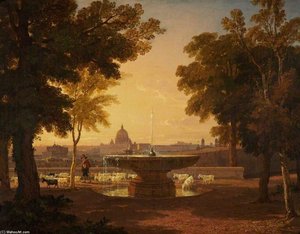
A peasant family by a fountain in an Italian landscape emerges from the brush of Penry Williams, a painter who found his true home amidst the light of the Mediterranean. Born in Merthyr Tydfil, United Kingdom, in 1802, Williams eventually leaves his Welsh roots behind to settle in the heart of Italy. This specific scene, captured about 1862, finds its soul in the quiet rhythms of rural life. The work…

5
Italian peasants in a landscape near lake Nemi (1860) de Penry Williams

Italian peasants in a landscape near lake Nemi

1860 · Oil On Canvas

The oil on canvas captures a specific moment of midday clarity. The light is natural and direct, casting shadows that define the contours of the path and the figures. There is a sense of heat in the colors—the greens of the leaves and the warm tones of the soil suggest a sun-drenched afternoon. The sky is filled with clouds that possess a visible, textured quality, rendered with brushstrokes that suggest…

6
Fisher Boys de Penry Williams

Fisher Boys

Two figures occupy a serene shoreline, their presence anchored by a dark-hulled boat resting upon the sand. To the left, a figure in a white shirt and dark trousers stands in quiet contemplation, while beside them, a companion wears a red hat and light-colored attire typical of traditional maritime life. A single large oar leans against the vessel, a silent indicator of recent labor or the anticipation of departure. The…

7
Waterfall In The Neath Valley de Penry Williams

Waterfall In The Neath Valley

Painting

Waterfall In The Neath Valley is a painting by Penry Williams. The artist, born in 1802 in Merthyr Tydfil, was the son of a house-painter. Although his origins are in Wales, Williams spent much of his life in Rome. His background in the United Kingdom provided the foundation for a career that eventually centered in Italy.

8
Ysgwd or Scwd Fall, Neath Valley (1819) de Penry Williams

Ysgwd or Scwd Fall, Neath Valley

1819

Ysgwd or Scwd Fall, Neath Valley is a painting by Penry Williams. The work is a landscape study of a specific natural feature within the Neath Valley. This piece belongs to a body of work where the artist returned to the landscapes of his native Wales. The painting dates to about 1819.

9
Sgwd yr Henryd, Vale of Neath (1819) de Penry Williams

Sgwd yr Henryd, Vale of Neath

1819 · Oil On Board · National Museum Cardiff, Cardiff

The rushing waters of Sgwd yr Henryd, Vale of Neath find their expression through the hand of Penry Williams. Created in 1819, this work captures a specific moment of natural movement within the Welsh landscape. The artist, Penry Williams, brings a sense of life to the scene, perhaps drawing from the very air and light of the valley itself.

10
Sgwd Gwladys, Vale of Neath (1819) de Penry Williams

Sgwd Gwladys, Vale of Neath

1819 · National Museum Cardiff, Cardiff

Sgwd Gwladys, Vale of Neath is a landscape study by Penry Williams. The artist, born in 1802 in Merthyr Tydfil, United Kingdom, turned his gaze back toward the rugged terrain of his native Wales. This specific work captures a natural feature within the Neath Valley, focusing on the movement of water and the weight of the surrounding earth. It was painted about 1819.

A seleção de Penry Williams continua, de 11 a 81

11Scene In The Roman Campagna de Penry WilliamsScene In The Roman Campagna 12The Visitation de Penry WilliamsThe Visitation 13Italian Peasant Children de Penry WilliamsItalian Peasant Children 14A Passiontide Procession de Penry WilliamsA Passiontide Procession 15The Vision Of Saint Bruno de Penry WilliamsThe Vision Of Saint BrunoMuseu do Prado 16The Temple Of Vesta, Rome de Penry WilliamsThe Temple Of Vesta, Rome 17Tivoli de Penry WilliamsTivoli 18By The Well de Penry WilliamsBy The Well 19An Italian Girl With A Tambourain On A Terrace de Penry WilliamsAn Italian Girl With A Tambourain On A Terrace 20The Shrine - de Penry WilliamsThe Shrine - 21Labourers de Penry WilliamsLabourers 22Mother and Child de Penry WilliamsMother and Child 23Porth Yr Ogof de Penry WilliamsPorth Yr Ogof 24Swansea de Penry WilliamsSwansea 25Roman Aqueduct In The Campana de Penry WilliamsRoman Aqueduct In The Campana 26Pozzuoli de Penry WilliamsPozzuoli 27Italian Peasants - de Penry WilliamsItalian Peasants - 28The Feast In The House Of Levi de Penry WilliamsThe Feast In The House Of Levi 29Gwaelod Y Garth de Penry WilliamsGwaelod Y Garth 30Santa Maria Maggiore Seen From The Gardens de Penry WilliamsSanta Maria Maggiore Seen From The Gardens 31Two Girls With A Tambourine de Penry WilliamsTwo Girls With A Tambourine 32The Ferry de Penry WilliamsThe Ferry 33South Wales Industrial Landscape de Penry WilliamsSouth Wales Industrial LandscapeNational Library of Wales 34Mass For The Reapers de Penry WilliamsMass For The Reapers 35Helping Out A Friend On The Road de Penry WilliamsHelping Out A Friend On The Road 36The Tiber With The Temple Of Vesta, Santa Maria de Penry WilliamsThe Tiber With The Temple Of Vesta, Santa Maria 37Landscape With Figures And A Ruin de Penry WilliamsLandscape With Figures And A Ruin 38An Ischian Peasant Study de Penry WilliamsAn Ischian Peasant Study 39The Temple of Vesta de Penry WilliamsThe Temple of Vesta 40A Goatherd on the Romas Campagna de Penry WilliamsA Goatherd on the Romas CampagnaMusée national des beaux-arts du Québec 41Two Saints de Penry WilliamsTwo Saints 42Merthyr Riots de Penry WilliamsMerthyr Riots 43The Temple Of Vesta, The Piazza Di Bocca Di Verita de Penry WilliamsThe Temple Of Vesta, The Piazza Di Bocca Di Verita 44Porth-yr-ogof, Brecknockshire de Penry WilliamsPorth-yr-ogof, Brecknockshire 45A Goatherd On The Roman Campagna de Penry WilliamsA Goatherd On The Roman Campagna 46Crawshay's Cyfarthfa Ironworks de Penry WilliamsCrawshay's Cyfarthfa Ironworks 47The Festa Of The Madonna Dell'arco At Naples de Penry WilliamsThe Festa Of The Madonna Dell'arco At Naples 48Field Marshal General Suwarrow de Penry WilliamsField Marshal General Suwarrow 49The Procession To The Christening de Penry WilliamsThe Procession To The Christening 50Bridge Over The River Taff de Penry WilliamsBridge Over The River Taff 51The Italian Family - Ferry On The River Ninfa de Penry WilliamsThe Italian Family - Ferry On The River Ninfa 52The Assumption Of The Virgin de Penry WilliamsThe Assumption Of The Virgin 53At The Well de Penry WilliamsAt The Well 54The Tambourine de Penry WilliamsThe Tambourine 55Repose de Penry WilliamsRepose 56Massacre Of The Innocents de Penry WilliamsMassacre Of The Innocents 57Cyfarthfa Castle de Penry WilliamsCyfarthfa Castle 58Saint John de Penry WilliamsSaint John 59Cyfarthfa Ironworks Interior At Night de Penry WilliamsCyfarthfa Ironworks Interior At Night 60Two Roman ladies and their children de Penry WilliamsTwo Roman ladies and their children 61Italian Goatherds de Penry WilliamsItalian Goatherds 62Merthyr Riots - de Penry WilliamsMerthyr Riots - 63Ha! Ha! I've Got The Chink de Penry WilliamsHa! Ha! I've Got The Chink 64Neapolitan Peasants At A Fountain - de Penry WilliamsNeapolitan Peasants At A Fountain - 65Sgwd Yr Eira, Vale Of Neath de Penry WilliamsSgwd Yr Eira, Vale Of Neath 66An Autumn Festival de Penry WilliamsAn Autumn Festival 67Peasant Girls – Sorrento de Penry WilliamsPeasant Girls – Sorrento 68Pilgrims Reposing At A Cross de Penry WilliamsPilgrims Reposing At A Cross 69Sgwd Gwladys, Vale Of Neath de Penry WilliamsSgwd Gwladys, Vale Of Neath 70Subiaco de Penry WilliamsSubiaco 71Procession To The Christening Near Araccia de Penry WilliamsProcession To The Christening Near Araccia 72The Shrine de Penry WilliamsThe Shrine 73A Mother And Child Beneath An Arbour At Evening de Penry WilliamsA Mother And Child Beneath An Arbour At Evening 74Upper Clyngwyn Fall Or Hendrebolon Fall, Neath Valley de Penry WilliamsUpper Clyngwyn Fall Or Hendrebolon Fall, Neath Valley 75The Shrine - de Penry WilliamsThe Shrine - 76The Grape Pickers; And Figures In An Extensive Landscape de Penry WilliamsThe Grape Pickers; And Figures In An Extensive Landscape 77A Distant View Of Saint Peter's, Rome de Penry WilliamsA Distant View Of Saint Peter's, Rome 78Eionon Garn On The Perddyn Or Ysgwd Or Scwd Fall, Neath Valley de Penry WilliamsEionon Garn On The Perddyn Or Ysgwd Or Scwd Fall, Neath Valley 79Spanish Lady de Penry WilliamsSpanish LadyBavarian State Painting Collections 80Italian Girl With Tambourine de Penry WilliamsItalian Girl With Tambourine 81Italian Peasants de Penry WilliamsItalian Peasants

Pinturas famosas de Penry Williams, período por período

Os temas que cativaram o olhar de Penry Williams

Os quatro temas que mais se repetem nestas obras originais, cada um com o seu melhor exemplo.

Os museus que guardam os originais de Penry Williams

Os 5 museus que detêm a maioria das pinturas desta página.

Museus Cidade Obras de Penry Williams Pinturas desta lista
National Museum Cardiff, CardiffNational Museum Cardiff Cardiff 2 Sgwd yr Henryd, Vale of Neath, Sgwd Gwladys, Vale of Neath
Museu do Prado, MadridMuseu do Prado Madrid 1 The Vision Of Saint Bruno
National Library of Wales, AberystwythNational Library of Wales Aberystwyth 1 South Wales Industrial Landscape
Musée national des beaux-arts du Québec, Cidade de QuébecMusée national des beaux-arts du Québec Cidade de Québec 1 A Goatherd on the Romas Campagna
Bavarian State Painting Collections, MuniqueBavarian State Painting Collections Munique 1 Spanish Lady

Penry Williams década a década: a obra original que define cada uma

Obras por década

Escolha uma década para ver a obra original que a define.

Perguntas de colecionadores sobre as pinturas de Penry Williams

Por qual obra Penry Williams é mais conhecido(a)?Revelar a resposta

Mediterranean Bay Seen Through An Arch. Painting of a young boy riding a pony (1829) e A ferry on the Ninfa, Sermoneta in the distance - a scene in the Pontine marshes, near Rome (1838) vêm a seguir.

Quais são as dez pinturas mais famosas de Penry Williams?Revelar a resposta

Mediterranean Bay Seen Through An Arch, Painting of a young boy riding a pony, A ferry on the Ninfa, Sermoneta in the distance - a scene in the Pontine marshes, near Rome, A peasant family by a fountain in an Italian landscape, Italian peasants in a landscape near lake Nemi, Fisher Boys, Waterfall In The Neath Valley, Ysgwd or Scwd Fall, Neath Valley, Sgwd yr Henryd, Vale of Neath e Sgwd Gwladys, Vale of Neath. O ranking acima apresenta o ano e o museu de cada uma.

Quantas pinturas Penry Williams deixou?Revelar a resposta

Nosso catálogo contém 84 obras de Penry Williams, datadas de 1819 a 1862.

Em quais museus estão expostas as obras-primas de Penry Williams?Revelar a resposta

Principalmente em National Museum Cardiff (Cardiff), Museu do Prado (Madrid) e National Library of Wales (Aberystwyth). A tabela de museus acima lista todos eles.

Em que anos Penry Williams pintou as suas obras mais famosas?Revelar a resposta

Em 1810s: 3 das 81 obras nesta página foram feitas então, sendo Ysgwd or Scwd Fall, Neath Valley delas.

Quais são as primeiras e as últimas obras originais famosas de Penry Williams?Revelar a resposta

Nesta página, a mais antiga é Ysgwd or Scwd Fall, Neath Valley (1819) e a mais recente é A peasant family by a fountain in an Italian landscape (1862).

Quais temas Penry Williams escolheu com mais frequência?Revelar a resposta

Landscape (8), Italy (7) e Trees (5), entre as 81 obras nesta página.

Qual técnica Penry Williams mais utilizou?Revelar a resposta

Oil On Canvas, para 11 das 81 obras nesta página.

A qual movimento artístico pertence Penry Williams?Revelar a resposta

Romanticism, a julgar pelos originais nesta página.

Quais obras de Penry Williams estão expostas no National Museum Cardiff?Revelar a resposta

Sgwd yr Henryd, Vale of Neath e Sgwd Gwladys, Vale of Neath: o National Museum Cardiff, Cardiff detém 2 das obras desta página.

Penry Williams: vida e obra

Penry Williams: Um Visionário Romano

Penry Williams, um nome talvez menos familiar do que o de muitos de seus contemporâneos, ergue-se como uma figura significativa na arte britânica do século XIX – especificamente, no vibrante e influente mundo da pintura de paisagem italiana. Nascido em Merthlam Tydfil, no País de Gales, em 1802, filho de um pintor de paredes, a jornada artística de Williams começou com uma educação formal em Londres, nutrida pela exposição à Royal Academy e seus prestigiados instrutores, como Henry Fuseli. No entanto, foi sua mudança para Roma, em 1827, que verdadeiramente definiu sua carreira e o estabeleceu como um artista respeitado dentro da comunidade de expatriados ingleses da cidade. Mais do que um simples registrador de cenários italianos, Williams possuía uma habilidade notável de capturar não apenas a beleza visual, mas também a atmosfera e o espírito da vida romana, imbuindo suas obras com um senso de realismo temperado por uma sensibilidade Romântica.

Seu treinamento inicial instilou nele uma base sólida em desenho e composição. O currículo da Royal Academy proporcionou um embasamento rigoroso nos princípios da arte clássica, enquanto a influência de Fuseli é evidente nos primeiros retratos de Williams – caracterizados por uma iluminação dramática e uma caracterização expressiva. A medalha de prata que conquistou da Society of Arts em 182 de 1821 por um “desenho do antigo” sinalizou seu talento emergente e marcou um momento crucial em seu desenvolvimento artístico. Este sucesso precoce pavimentou o caminho para sua subsequente exploração da pintura de paisagem, um gênero que acabaria por se tornar sua marca registrada.

Um Ateliê Romano e o Desenvolvimento Artístico

A decisão de Williams de se estabelecer permanentemente em Roma foi transformadora. A cidade tornou-se não apenas um tema para suas pinturas, mas também seu lar e estúdio. Seu workshop romano rapidamente ganhou reconhecimento como um dos destinos mais populares para visitantes ingleses, oferecendo um vislumbre da vida e do trabalho de um artista de sucesso vivendo no exterior. Este ambiente estabelecido permitiu que ele refinasse sua técnica e desenvolvesse um estilo distinto – um que fundia a observação meticulosa com uma abordagem lírica de cor e luz.

Ao longo das décadas de 1830 e 1840, Williams exibiu regularmente na Royal Academy, na British Institution e na Society of British Artists em Londres. Seus temas durante este período incluíam retratos e cenas da Inglaterra, mas foram suas paisagens italianas que verdadeiramente cativaram o público. Ele estudou meticulosamente a luz, a cor e a atmosfera da campiã romana, criando pinturas que eram simultaneamente realistas e imbuídas de um senso de romantismo. Suas obras frequentemente retratavam a vida cotidiana – camponeses trabalhando nos campos, praças de mercado movimentadas e margens serenas de rios – oferecendo aos espectadores um vislumbre íntimo dos ritmos da sociedade italiana.

Obras Primordiais e Estilo Artístico

Várias das pinturas de Williams destacam-se como exemplos particularmente notáveis de sua habilidade e visão artística. “The Festa of the Madonna dell’ Arco” (gravada por D. Lucas, 1830) é uma representação vibrante de uma procissão religiosa em Roma, capturando a energia e o entusiasmo do evento com um detalhe extraordinário. “Ferry on the River Ninfa” demonstra sua capacidade de renderizar a superfície cintilante da água e a vegetação exuberante da paisagem circundante. “Il Voto, or the Convalescent” oferece um retrato pungente de um homem doente recebendo cuidados em um jardim romano, demonstrando sua sensibilidade à emoção humana.

O estilo de Williams pode ser caracterizado como a pintura de paisagem italiana convencional – ele aderiu às técnicas e convenções estabelecidas do gênero. No entanto, ele possuí uma habilidade única de infundir suas obras com um senso de imediatismo e autenticidade. Suas pinturas não são meramente representações pitorescas da Itália; elas são imbuídas de uma atmosfera palpável — uma sensação de calor, luz e conexão humana. Seu uso da cor era particularmente digno de nota, empregando uma paleta rica de tons terrosos e matizes vibrantes para criar uma sensação de profundidade e realismo.

Legado e Reconhecimento

Penry Williams faleceu em Roma, em 27 de julho de 1885, deixando para trás um corpo substancial de trabalho que continua a ser apreciado por sua beleza e mérito artístico. Suas pinturas foram adquiridas por instituições prestigiadas, como a National Gallery e a Tate Gallery, consolidando seu lugar na história da arte britânica. Seu legado estende-se além de suas obras individuais; ele ajudou a estabelecer uma tradição de pintura de paisagem inglesa na Itália, inspirando gerações de artistas a explorar a beleza e a riqueza do campo italiano.

Hoje, as pinturas de Williams oferecem uma janela valiosa para a vida do século XIX — tanto na Inglaterra quanto na Itália. Elas são testemunhos de sua habilidade artística, de sua observação aguçada e de sua capacidade de capturar a essência de um lugar e de um tempo específicos. Seu trabalho permanece como um lembrete vibrante do apelo duradouro da pintura de paisagem e do poder transformador da arte.