The Life and Legacy of Lemuel Francis Abbott
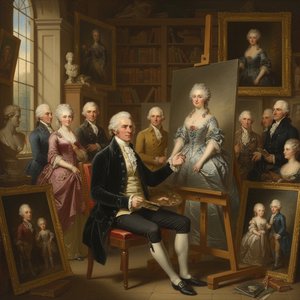
In the vibrant landscape of late eighteenth-century English portraiture, few names resonate with the same historical intimacy as Lemuel Francis Abbott. Born in Leicestershire to a clergyman, Abbott’s journey into the heart of the London art scene began remarkably early. At just fourteen years of age, he entered the studio of Francis Hayman, a formative apprenticeship that planted the seeds of his future mastery. Though the death of his mentor briefly drew him back to his family in Leicestershire, the pull of the capital was irresistible. It was within the bustling atmosphere of London that Abbott truly began to refine his craft, potentially drawing inspiration from the dramatic lighting and tonal depth characteristic of Joseph Wright of Derby.
Abbott’s career was defined by a profound ability to capture the essence of the era's most influential figures. He did not merely paint faces; he documented the very spirit of the late eighteenth and early nineteenth centuries. His brush possessed a unique capacity for Neoclassical precision, blending meticulous detail with a sense of dramatic atmosphere. This skill is perhaps most famously realized in his portrait of Horatio Nelson, 1st Viscount Nelson. Created during a period when Abbott shared lodgings with the naval hero, this work stands as a testament to his ability to convey both the physical likeness and the commanding presence of a legend. The painting, noted for its accuracy by even the Admiral's own wife, remains one of the most enduring images of the man who would become Britain's greatest naval icon.
Artistic Mastery and Historical Significance
Beyond his celebrated depiction of Nelson, Abbott’s portfolio serves as a window into the social and intellectual fabric of his time. He was a sought-after portraitist for a diverse array of luminaries, ranging from the scientific brilliance of astronomer Sir William Herschel to the literary and naval elite. His works often utilized chiaroscuro—the dramatic interplay of light and shadow—to imbue his subjects with a sense of gravity and depth. Whether capturing the rugged determination of Captain William Locker or the refined features of contemporary entrepreneurs, Abbott’s technique allowed him to navigate between the heroic and the intimate.
Despite his significant contributions to the Royal Academy exhibitions, Abbott’s personal life was marked by profound struggles. The immense pressure of maintaining a prolific commission schedule, coupled with domestic hardships, eventually took a heavy toll on his mental well-being. His later years were shadowed by illness and instability, yet the artistic legacy he left behind remains untarnished by his personal tribulations. Through his portraits, Abbott ensured that the faces of the Enlightenment—the sailors, the scientists, and the poets—would remain etched in the collective memory of history, preserved through the enduring power of his painted gaze.
Perguntas e Respostas
Como a carreira de Lemuel Francis Abbott é dividida em períodos?
Um relato cronológico da obra de Lemuel Francis Abbott está disponível na página Linha do tempo do artista, onde as obras são apresentadas em ordem de criação, capítulo por capítulo.
Posso navegar pelas obras de Lemuel Francis Abbott por humor?
A página de Coleção por Humor do artista apresenta as obras de Lemuel Francis Abbott organizadas por sua atmosfera.
Posso estudar o uso de cores de Lemuel Francis Abbott em todas as suas obras?
O perfil de cores da obra de Lemuel Francis Abbott pode ser visualizado na página DNA da Paleta do artista.