Retrato de John Mix Stanley

As 54 Pinturas Mais Famosas de John Mix Stanley, Cada Uma Única

Atualizado em Novembro 2026 · classificado pela nossa pontuação de popularidade (pesquisas, visitas e pedidos de cada obra) · 59 obras de John Mix Stanley em nosso catálogo

Em resumo

Black Knife, an Apache Warrior (1846) é a pintura de John Mix Stanley que mais atrai olhares; a obra original pertence ao Smithsonian American Art Museum, Washington, D.C.. Depois disso, o olhar recai sobre Beggar Boy (1865) e Portrait of Stephen Reynolds (1848). Entre as 59 obras de John Mix Stanley em nosso catálogo, estas 54 são as mais famosas, cada uma uma original única apresentada com o seu ano, o seu museu e a razão pela qual perdura.

1814 – 1872, Canandaigua Romantic landscape painting Mais obras: Detroit Institute of Arts

As 10 principais pinturas de John Mix Stanley, sob o olhar da galeria

1
Black Knife, an Apache Warrior (1846) de John Mix Stanley

Black Knife, an Apache Warrior

1846 · Oil On Canvas · Smithsonian American Art Museum, Washington, D.C.

John Mix Stanley’s “Black Knife,” painted in 1846, is more than just a portrait; it’s a window into the complex and often fraught relationship between American expansionism and the indigenous peoples of the American West. This arresting depiction of Baishan, also known as Black Knife, an Apache chief, transcends simple representation to become a poignant study of power, resilience, and the enduring spirit of a vanishing culture. The painting captures…

2
Beggar Boy (1865) de John Mix Stanley

Beggar Boy

1865 · Oil · Fine Arts Museums of San Francisco, São Francisco

In Beggar Boy, John Mix Stanley presents a somber study of social realism. The vertically oriented composition focuses on two impoverished children positioned in the lower half of the frame. A standing boy and a seated girl emerge from a dark, indistinct background that suggests the shadows of a narrow street or alleyway. This arrangement creates an intimate, straight-on eye-level view that forces a direct encounter with the subjects.

3
Portrait of Stephen Reynolds (1848) de John Mix Stanley

Portrait of Stephen Reynolds

1848 · Oil · Peabody Essex Museum, Salem

The Portrait of Stephen Reynolds is a significant oil painting by the American artist John Mix Stanley. Executed in 1848, this work captures the likeness of Stephen Reynolds, a man who lived from 1782 to 1857. Through this portrait, Stanley provides a formal record of a figure central to the early maritime and commercial history of the Pacific.

4
Western Landscape (1847) de John Mix Stanley

Western Landscape

1847 · Oil On Canvas · Detroit Institute of Arts, Detroit

In this work, titled Western Landscape, we encounter a quiet moment from 1847. The artist, John Mix Stanley, captures a scene that reflects the expansive character of the American West. It is a composition focused on the natural world, specifically a landscape defined by its mountains and water.

5
Tin Tin Malikin (1847) de John Mix Stanley

Tin Tin Malikin

1847 · Oil On Canvas · Detroit Institute of Arts, Detroit

In the portrait Tin Tin Malikin, John Mix Stanley presents a bust-length study of a single individual. The subject is positioned slightly off-center, a choice that disrupts perfect symmetry to favor a more natural, immediate presence. Captured in a close-up perspective, the man looks downward and away from the viewer, his gaze retreating into a private space. This averted look, combined with the weathered features of his face, suggests a…

6
Bin-Tah, The Wounded Man (1843) de John Mix Stanley

Bin-Tah, The Wounded Man

1843 · Oil · Yale University Art Gallery, New Haven

In this intimate portrait, titled Bin-Tah, The Wounded Man, the artist John Mix Stanley presents a quiet encounter with an Indigenous man. Created about 1843, the work captures the subject in a bust-length composition. The man, identified as Bin-Tah, is positioned centrally, meeting the viewer's gaze with a sense of profound dignity. His presence is marked by a certain stillness that commands attention without the need for grand gestures.

7
Portrait of Princess Manaiula Tehuiarii (1848) de John Mix Stanley

Portrait of Princess Manaiula Tehuiarii

1848 · Oil On Canvas · Honolulu Museum of Art, Honolulu

The Portrait of Princess Manaiula Tehuiarii by John Mix Stanley brings a figure of quiet dignity into view. The subject of this work is Princess Manaiula Tehuiarii, a noblewoman hailing from the Kingdom of Tahiti. Her presence carries the weight of her lineage, reflecting a life that eventually led her to settle within the Kingdom of Hawaii. She exists here in a moment of stillness, captured by the brush of…

8
Valley of the Mimbres, (painting) (1846) de John Mix Stanley

Valley of the Mimbres, (painting)

1846 · Watercolor

Valley of the Mimbres, (painting) is a work by the American artist John Mix Stanley. Created in 1846, the piece captures a specific moment of movement through the landscape. It emerged from Stanley's time serving as a civilian draughtsman for General Kearny's Army of the West.

9
View of Mt. Graham, (painting) (1846) de John Mix Stanley

View of Mt. Graham, (painting)

1846 · Oil On Canvas

The artwork titled View of Mt. Graham, (painting) is a landscape created by the artist John Mix Stanley. This work depicts the mountainous terrain of Mt. Graham. The subject matter focuses on the natural features of this specific location, presenting a view of the geological formations and the surrounding environment.

10
Passing an Obstruction Mouth of Might Creek, (painting) (1846) de John Mix Stanley

Passing an Obstruction Mouth of Might Creek, (painting)

1846 · Watercolor

Passing an Obstruction Mouth of Might Creek, (painting) by John Mix Stanley captures a moment of human interaction with the rugged terrain of the American West. Created about 1846, the work presents a landscape scene featuring a group of people on horseback. The figures navigate a mountainous valley, suggesting an exploration through challenging, untamed environments.

Pinturas famosas de John Mix Stanley, números 11 a 54

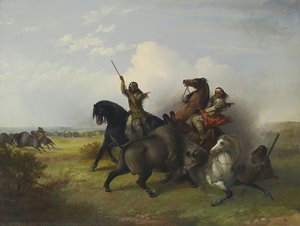
11Osage Scalp Dance, (painting) (1845) de John Mix StanleyOsage Scalp Dance, (painting)1845 12Portrait of Queen Kalama (1850) de John Mix StanleyPortrait of Queen Kalama1850 13Portrait of King Kamehameha III (1850) de John Mix StanleyPortrait of King Kamehameha III1850 14Kidnapped (1853) de John Mix StanleyKidnapped1853 · Denver Art Museum 15Hawaiian Girl with Dog (1849) de John Mix StanleyHawaiian Girl with Dog1849 · Bishop Museum 16Berniah Willet (1853) de John Mix StanleyBerniah Willet1853 · Smithsonian American Art Museum 17A Halt on the Prairie for a Smoke (1860) de John Mix StanleyA Halt on the Prairie for a Smoke1860 · Detroit Institute of Arts 18Indian Telegraph (1860) de John Mix StanleyIndian Telegraph1860 · Detroit Institute of Arts 19Prairie Indian Encampment (1870) de John Mix StanleyPrairie Indian Encampment1870 · Detroit Institute of Arts 20Indians with Deer (1867) de John Mix StanleyIndians with Deer1867 · Cincinnati Art Museum 21Indians Playing Cards (1866) de John Mix StanleyIndians Playing Cards1866 · Detroit Institute of Arts 22Indians Hunting (1867) de John Mix StanleyIndians Hunting1867 · Cincinnati Art Museum 23Oregon City no Rio Willamette (1852) de John Mix StanleyOregon City no Rio Willamette1852 · Amon Carter Museum of American Art 24Ko-rak-koo-kiss, a Towoccono Warrior (1844) de John Mix StanleyKo-rak-koo-kiss, a Towoccono Warrior1844 · Smithsonian American Art Museum 25The Buffalo Hunt (1855) de John Mix StanleyThe Buffalo Hunt1855 · Crystal Bridges Museum of American Art 26River in a Mountain Landscape (1840) de John Mix StanleyRiver in a Mountain Landscape1840 27Wai-E-Cat (One that Flies) (1847) de John Mix StanleyWai-E-Cat (One that Flies)1847 28Passing an Obstruction: Mouth of Night Creek (1846) de John Mix StanleyPassing an Obstruction: Mouth of Night Creek1846 29International Indian Council (Held at Tallequah, Indian Territory, in 1843), (painting) (1843) de John Mix StanleyInternational Indian Council (Held at Tallequah, Indian Territory, in 1843), (painting)1843 30Shu-Ma-Hgci (Painted Shirt) (1847) de John Mix StanleyShu-Ma-Hgci (Painted Shirt)1847 31Osage Scalp Dance (1845) de John Mix StanleyOsage Scalp Dance1845 32International Indian Council (Held at Tallequah, Indian Territory, in 1843) (1843) de John Mix StanleyInternational Indian Council (Held at Tallequah, Indian Territory, in 1843)1843 · Smithsonian American Art Museum 33Chain of Spires Along the Gila River (1855) de John Mix StanleyChain of Spires Along the Gila River1855 · Phoenix Art Museum 34Oregon City on the Willamette River (1850) de John Mix StanleyOregon City on the Willamette River1850 · Amon Carter Museum of American Art 35Emeline Willet (1853) de John Mix StanleyEmeline Willet1853 · Smithsonian American Art Museum 36Assiniboin Encampment on the Upper Missouri (1860) de John Mix StanleyAssiniboin Encampment on the Upper Missouri1860 · Detroit Institute of Arts 37The Trapper's Cabin (1858) de John Mix StanleyThe Trapper's Cabin1858 · National Gallery of Art 38Fort Benton Indians, Fort Benton, Montana (1859) de John Mix StanleyFort Benton Indians, Fort Benton, Montana1859 39Last of Their Race (1857) de John Mix StanleyLast of Their Race1857 40Chinook Burial Grounds (1870) de John Mix StanleyChinook Burial Grounds1870 · Detroit Institute of Arts 41A Morning in Milk River Valley (1870) de John Mix StanleyA Morning in Milk River Valley1870 · Detroit Institute of Arts 42After a Storm on the Lee Shore, (painting) (1869) de John Mix StanleyAfter a Storm on the Lee Shore, (painting)1869 43Scouting Party (1864) de John Mix StanleyScouting Party1864 44Interior of Wigwam (1865) de John Mix StanleyInterior of Wigwam1865 45Pontiac de John Mix StanleyPontiac 46Interior of Wigwam de John Mix StanleyInterior of Wigwam 47Untitled (D2X2SL) (1841) de John Mix StanleyUntitled (D2X2SL)1841 · Metropolitan Museum of Art 48The Challenge (1870) de John Mix StanleyThe Challenge1870 · Detroit Institute of Arts 49Mountain Landscape with Indians (1870) de John Mix StanleyMountain Landscape with Indians1870 · Detroit Institute of Arts 50Buffalo Hunt on the Southwestern Prairies (1845) de John Mix StanleyBuffalo Hunt on the Southwestern Prairies1845 · Smithsonian American Art Museum 51The Trial of Red Jacket (1869) de John Mix StanleyThe Trial of Red Jacket1869 · Smithsonian American Art Museum 52Osage Scalp Dance (1845) de John Mix StanleyOsage Scalp Dance1845 · Smithsonian American Art Museum 53Mount Carter - Autumn in the White Mountains de John Mix StanleyMount Carter - Autumn in the White Mountains 54The River Bend de John Mix StanleyThe River Bend

Os temas que cativaram o olhar de John Mix Stanley

Os quatro temas que mais se repetem nestas obras originais, cada um com o seu melhor exemplo.

Os museus que guardam os originais de John Mix Stanley

Os 8 museus que detêm a maioria das pinturas desta página.

Museus Cidade Obras de John Mix Stanley Pinturas desta lista
Detroit Institute of Arts, DetroitDetroit Institute of Arts Detroit 11 Western Landscape, Tin Tin Malikin, A Halt on the Prairie for a Smoke
Smithsonian American Art Museum, Washington, D.C.Smithsonian American Art Museum Washington, D.C. 8 Black Knife, an Apache Warrior, Berniah Willet, Ko-rak-koo-kiss, a Towoccono Warrior
Cincinnati Art Museum, CincinnatiCincinnati Art Museum Cincinnati 2 Indians with Deer, Indians Hunting
Amon Carter Museum of American Art, Fort WorthAmon Carter Museum of American Art Fort Worth 2 Oregon City no Rio Willamette, Oregon City on the Willamette River
Fine Arts Museums of San Francisco, São FranciscoFine Arts Museums of San Francisco São Francisco 1 Beggar Boy
Peabody Essex Museum, SalemPeabody Essex Museum Salem 1 Portrait of Stephen Reynolds
Yale University Art Gallery, New HavenYale University Art Gallery New Haven 1 Bin-Tah, The Wounded Man
Honolulu Museum of Art, HonoluluHonolulu Museum of Art Honolulu 1 Portrait of Princess Manaiula Tehuiarii

John Mix Stanley ao longo das décadas: uma obra original única para cada uma

Obras por década

Escolha uma década para ver a obra original que a define.

Pinturas de John Mix Stanley: perguntas para a galeria

Qual é a obra mais famosa de John Mix Stanley?Revelar a resposta

Black Knife, an Apache Warrior (1846), Smithsonian American Art Museum, Washington, D.C.. Beggar Boy (1865) e Portrait of Stephen Reynolds (1848) vêm a seguir.

Com que idade John Mix Stanley criou Black Knife, an Apache Warrior?Revelar a resposta

32 anos: Black Knife, an Apache Warrior data de 1846, e John Mix Stanley nasceu em 1814.

Quais são as dez pinturas mais famosas de John Mix Stanley?Revelar a resposta

Black Knife, an Apache Warrior, Beggar Boy, Portrait of Stephen Reynolds, Western Landscape, Tin Tin Malikin, Bin-Tah, The Wounded Man, Portrait of Princess Manaiula Tehuiarii, Valley of the Mimbres, (painting), View of Mt. Graham, (painting) e Passing an Obstruction Mouth of Might Creek, (painting). O ranking acima apresenta o ano e o museu de cada uma.

Quantas obras de John Mix Stanley são conhecidas?Revelar a resposta

Nosso catálogo contém 59 obras de John Mix Stanley, datadas de 1840 a 1870.

Onde se pode ver os originais mais famosos de John Mix Stanley?Revelar a resposta

Principalmente em Detroit Institute of Arts (Detroit), Smithsonian American Art Museum (Washington, D.C.) e Cincinnati Art Museum (Cincinnati). A tabela de museus acima lista todos eles.

Em que período John Mix Stanley criou as suas pinturas mais conhecidas?Revelar a resposta

Em 1840s: 22 das 54 obras nesta página foram feitas então, sendo Black Knife, an Apache Warrior delas.

Qual pintura famosa de John Mix Stanley é a mais antiga e qual é a mais recente?Revelar a resposta

Nesta página, a mais antiga é River in a Mountain Landscape (1840) e a mais recente é Prairie Indian Encampment (1870).

Quais temas John Mix Stanley preferia?Revelar a resposta

Mountains (7), Native americans (7) e American west (6), entre as 54 obras nesta página.

Com quais materiais John Mix Stanley mais pintou?Revelar a resposta

Oil On Canvas, para 17 das 54 obras nesta página.

A qual movimento pertence a obra de John Mix Stanley?Revelar a resposta

Romantic landscape painting, a julgar pelos originais nesta página.

Quais originais de John Mix Stanley posso ver no Detroit Institute of Arts?Revelar a resposta

Western Landscape, Tin Tin Malikin e A Halt on the Prairie for a Smoke: o Detroit Institute of Arts, Detroit detém 11 das obras desta página.

John Mix Stanley: um retrato do artista

A Pioneer of the American West: The Life and Art of John Mix Stanley

John Mix Stanley, born in Canandaigua, New York, on January 17, 1814, wasn’t merely a painter; he was an explorer, a documentarian, and a vital witness to a rapidly transforming America. His life story is one woven with threads of resilience, artistic passion, and a profound connection to the landscapes and peoples of the American West – a region he relentlessly sought to capture on canvas. Orphaned at the tender age of twelve, Stanley’s early years instilled within him an unwavering self-reliance that would shape his adventurous spirit and inform his approach to art. He began his journey not with formal training, but through diligent self-teaching, absorbing the techniques of sign painting and portraiture from a coach maker – a practical apprenticeship that laid the foundation for his later artistic explorations.

From Detroit’s Streets to the Southwest’s Trails

Stanley's artistic trajectory took its first significant turn in 1832 when he migrated to Detroit, Michigan, a bustling frontier town brimming with opportunity and a burgeoning art scene. Here, he honed his skills as an itinerant painter, capturing portraits of local residents and adorning storefronts with vibrant signs. This period wasn’t simply about mastering technical proficiency; it was a crucial phase of observation – learning to discern the nuances of light, form, and human expression, skills that would later become hallmarks of his distinctive style. However, Stanley's ambition extended beyond the confines of Detroit. Inspired by the work of George Catlin, who sought to document Native American life with empathy and respect, he embarked on a transformative journey westward in 1842, accompanied by Sumner Dickerman.

Documenting Cultures: The Indian Territory Expeditions

This expedition to the American Southwest marked a pivotal moment in Stanley’s career. He wasn't merely seeking scenic vistas; he was driven by a genuine desire to record the lives and customs of Native American tribes – a mission that resonated deeply with his own sense of adventure and his growing appreciation for diverse cultures. Establishing himself at Fort Gibson in Indian Territory (present-day Oklahoma), Stanley immersed himself within tribal communities, attending significant councils like the one between Cherokee and Texas representatives at Tahlequah. He meticulously documented these encounters through portraits – intimate studies that captured not just physical likenesses but also a sense of personality and dignity – alongside scenes of daily life, offering an invaluable visual record of a world on the cusp of profound change. His commitment to this documentation continued throughout the Mexican-American War in 1846, where he served as a draftsman for Colonel Stephen Watts Kearney’s expedition to California and the Oregon Territory, producing detailed sketches that captured the scale and drama of the military campaign.

Hawaii's Royal Portraits and Beyond

Stanley’s explorations didn’t end with the American West. In 1847, he traveled to Hawaii, where he spent nearly twelve months painting portraits of King Kamehameha III, his wife, and members of the royal family – a testament to his versatility and willingness to embrace new cultural experiences. This period showcased his ability to adapt his artistic style to suit diverse subjects and settings, further solidifying his reputation as a skilled and adaptable artist. He continued his travels throughout the 1850s, undertaking expeditions to various locations across the American West, documenting landscapes and Native American tribes with unwavering dedication.

Style, Influences, and Historical Significance

Stanley’s artistic style was rooted in academic principles – he meticulously studied anatomy and perspective – yet infused with the immediacy of on-site observation. His paintings weren't simply representations; they were carefully composed narratives that captured the essence of a particular moment or subject. While he drew inspiration from George Catlin, whose empathetic depictions of Native Americans profoundly influenced him, Stanley’s approach often lacked the same level of emotional depth. Nevertheless, his work remains invaluable as historical documentation, providing unique insights into 19th-century encounters between European Americans and Native American tribes – a period defined by both conflict and cultural exchange. The tragic loss of much of his artwork in the 1865 Smithsonian Institution fire—along with subsequent losses in other fires—significantly impacted his legacy, obscuring his contributions for decades. However, recent years have witnessed a renewed appreciation for Stanley’s work, recognizing its significance as both art and historical record.

A Legacy Rediscovered

Despite the devastating loss of many of his paintings, John Mix Stanley's legacy endures through the surviving works held by museums across the nation. These paintings serve as poignant reminders of a pioneering artist who dedicated his life to documenting the landscapes and peoples of the American West – a region forever shaped by exploration, conflict, and cultural exchange. Stanley wasn’t just an artist; he was a visual chronicler, a witness to a vanishing world, and a vital link to a pivotal chapter in American history. His paintings offer invaluable insights into the lives and cultures of those who inhabited this vast and dynamic landscape, reminding us of the importance of preserving and understanding our shared past.