Retrato de Jan Provoost

As 55 Pinturas Mais Famosas de Jan Provoost, uma Seleção da Galeria

Atualizado em Novembro 2026 · classificado pela nossa pontuação de popularidade (pesquisas, visitas e pedidos de cada obra) · 56 obras de Jan Provoost em nosso catálogo

Em resumo

De todas as obras originais deixadas por Jan Provoost, a mais famosa é The Virgin and Child (1505), da coleção do Scottish National Gallery, em Edimburgo. Logo atrás vêm The Dispute of Saint Catherine of Alexandria (1505) e Zechariah (1510). Nosso catálogo contém 56 obras de Jan Provoost; a galeria preservou as 55 que o mundo mais admira, cada uma exibida com sua data, seu museu e sua história.

1465 – 1529, Mons Northern renaissance Mais obras: Groeningemuseum

As 10 principais pinturas de Jan Provoost: a escolha da galeria

1
The Virgin and Child (1505) de Jan Provoost

The Virgin and Child

1505 · Oil On Panel · Scottish National Gallery, Edimburgo

The composition centers on the Virgin Mary, her form framed by a structured arch that defines a sacred, enclosed space. She holds the Christ Child against a backdrop of rolling hills and dark foliage under a pale sky. A deep red mantle covers her shoulders, contrasting with the dark blue of her inner garment and the white of her veil. The figures occupy the immediate foreground, their porcelain-like skin rendered…

3
Zechariah (1510) de Jan Provoost

Zechariah

1510 · Oil On Panel · Museu do Prado, Madrid

A single man occupies the center of the frame, his body carved from light and shadow. He is an elderly figure, leaning slightly forward as if caught in a moment of quiet reception. His hands are extended, palms open, reaching into the space between himself and the viewer. There is a stillness in his gaze, a directness that meets the eye with a sense of serene expectation. He is framed…

4
The Last Judgment (1525) de Jan Provoost

The Last Judgment

1525 · Oil On Panel · Detroit Institute of Arts, Detroit

The Last Judgment by Jan Provoost unfolds as a dramatic vision of the final reckoning. Created around 1525, this oil painting captures the moment of divine judgment as Jesus Christ reigns in glory. The scene presents a celestial hierarchy where the heavens meet the earthly realm, presenting a vision of the end of all mankind. It remains a prime example of the Northern Renaissance style, where every corner of the…

5
Mourning of Christ (1490) de Jan Provoost

Mourning of Christ

1490 · Tempera On Panel · Kunsthaus Zürich, Zurique

The composition centers on the body of Christ, which is being lowered from the cross by Nicodemus and John. The pale skin of the deceased figure contrasts with the deep reds and blues of the surrounding garments. Mary Magdalene, Mary the mother of Jesus, and Joseph of Arimathea are positioned closely around the central event, their forms creating a tight, organized arrangement within a shallow landscape. In the background, a…

6
The Annunciate Virgin, Saint Andrew with a Donor and His Sons, Saint Catherine of Alexandria with a Donor and Her Daughters, and the Annunciate Angel (1514) de Jan Provoost

The Annunciate Virgin, Saint Andrew with a Donor and His Sons, Saint Catherine of Alexandria with a Donor and Her Daughters, and the Annunciate Angel

1514 · Oil On Panel · Philadelphia Museum of Art, Filadélfia

The Annunciate Virgin, Saint Andrew with a Donor and His Sons, Saint Catherine of Alexandria with a Donor and Her Daughters, and the Annunciate Angel emerges from the early 16th century as a complex devotional structure. This work by Jan Provoost presents a multi-layered vision of faith, where the sacred and the earthly meet within a single wooden frame. The piece currently resides within the Philadelphia Museum of Art, where…

7
The Virgin and Child (1500) de Jan Provoost

The Virgin and Child

1500 · Oil On Panel · Museu do Prado, Madrid

In this intimate oil on panel, we find ourselves in the presence of a tender, maternal encounter. The Virgin Mary is depicted in a moment of nursing, her form draped in a mantle of deep teal and blue that holds a sculptural weight. She stands against a patterned backdrop, perhaps a carved screen or a heavy textile, which provides a structured, formal setting for this private act. The composition is…

8
Madonna and Child with angels (1480) de Jan Provoost

Madonna and Child with angels

1480 · Oil On Panel

The painting presents a seated Virgin Mary positioned centrally within a lush, enclosed garden. She wears a heavy, dark gown that contrasts with the lighter tones of the surrounding environment. In her right hand, she holds a small bouquet consisting of a red poppy and a white carnation. Above her head, two angelic figures hold a golden crown. To her left, the infant Christ reaches toward his mother's chest with…

9
Entombment of Christ (1490) de Jan Provoost

Entombment of Christ

1490 · Oil On Panel

The heavy silence of the tomb hangs over the Entombment of Christ, a work painted by Jan Provoost around 1490. In this somber scene, the weight of Christian sorrow settles deeply upon the figures gathered in the shadows. The air feels thick with the grief of the Deposition of Christ, capturing a moment where the physical reality of death meets the spiritual ache of those left behind. Every line and…

10
Annunciation (1500) de Jan Provoost

Annunciation

1500 · Oil · Musei di Strada Nuova, Gênova

The Annunciation is an oil painting by Jan Provoost, created about 1500. The work depicts a religious scene within a domestic interior, featuring the Virgin Mary and the Archangel Gabriel. Mary is positioned on the left side of the composition in a seated, prayerful posture, wearing a deep red gown. To the right, the Archangel Gabriel appears with large wings and a light blue robe. A white dove, representing the…

A seleção de Jan Provoost continua, de 11 a 55

11The Last Judgement (1500) de Jan ProvoostThe Last Judgement1500 · Fogg Museum 12The Lamentation (1490) de Jan ProvoostThe Lamentation1490 13Crucifixion (1500) de Jan ProvoostCrucifixion1500 · Groeningemuseum 14Saint Jerome in the Wilderness (1512) de Jan ProvoostSaint Jerome in the Wilderness1512 · Museus Reais de Belas Artes da Bélgica 15Flagellation (1512) de Jan ProvoostFlagellation1512 · Saint Louis Art Museum 16The Nativity at Night (1507) de Jan ProvoostThe Nativity at Night1507 · Upton House 17Saint Clare (1510) de Jan ProvoostSaint Clare1510 18John the Baptist (1503) de Jan ProvoostJohn the Baptist1503 · Rijksmuseum Twenthe 19Saint Dominicus (1503) de Jan ProvoostSaint Dominicus1503 · Rijksmuseum Twenthe 20The Angel of the Annunciation in a stone niche (1503) de Jan ProvoostThe Angel of the Annunciation in a stone niche1503 21Crucifixion (1503) de Jan ProvoostCrucifixion1503 · Groeningemuseum 22Calvary (1517) de Jan ProvoostCalvary1517 · Museum of Fine Arts Ghent (MSK) 23Saint Barbara from Nicodemia (1505) de Jan ProvoostSaint Barbara from Nicodemia1505 · Royal Museum of Fine Arts Antwerp 24Adoration of the Magi (1505) de Jan ProvoostAdoration of the Magi1505 · Gemäldegalerie 25Virgin Mary and sleeping child enthroned by angels (1503) de Jan ProvoostVirgin Mary and sleeping child enthroned by angels1503 · Staatliche Kunsthalle Karlsruhe 26Diptych with Christ carrying the Cross and Portrait of a Friar Minor, memento mori (reverse) (1522) de Jan ProvoostDiptych with Christ carrying the Cross and Portrait of a Friar Minor, memento mori (reverse)1522 · Sint-Janshospitaal 27Last Judgement (1525) de Jan ProvoostLast Judgement1525 · Groeningemuseum 28The Virgin and Child in a Landscape (1512) de Jan ProvoostThe Virgin and Child in a Landscape1512 · National Gallery 29Allegory of Christianity (1515) de Jan ProvoostAllegory of Christianity1515 30Flowers in a vase in a niche (1480) de Jan ProvoostFlowers in a vase in a niche1480 31Crucifixion (1500) de Jan ProvoostCrucifixion1500 32Crucifixion (1500) de Jan ProvoostCrucifixion1500 33Saint Catherine of Alexandria (1505) de Jan ProvoostSaint Catherine of Alexandria1505 · Museum Boijmans Van Beuningen 34The Virgin and Saint Joseph at Bethlehem (recto) and Virgin Annunciate (verso) (1507) de Jan ProvoostThe Virgin and Saint Joseph at Bethlehem (recto) and Virgin Annunciate (verso)1507 · Upton House 35Triptych of The Adoration of the Magi and Shepherds (centre) with The Annunciation (left wing) and The Madonna adoring the Christ Child (right wing) and Saint John the Baptist and Saint Margaret (closed) (1507) de Jan ProvoostTriptych of The Adoration of the Magi and Shepherds (centre) with The Annunciation (left wing) and The Madonna adoring the Christ Child (right wing) and Saint John the Baptist and Saint Margaret (closed)1507 36Portrait of a Female Donor (1505) de Jan ProvoostPortrait of a Female Donor1505 · Museu Thyssen-Bornemisza 37The Last Judgment (1525) de Jan ProvoostThe Last Judgment1525 · Hamburger Kunsthalle 38Abraham, Sarah, and the Angel de Jan ProvoostAbraham, Sarah, and the Angel 39Last Judgement (1525) de Jan ProvoostLast Judgement1525 40The Martyrdom of St Catherine de Jan ProvoostThe Martyrdom of St CatherineRoyal Museum of Fine Arts Antwerp 41St. Andrew in landscape de Jan ProvoostSt. Andrew in landscape 42Donor with St. Nicholas and his Wife with St. Godelina de Jan ProvoostDonor with St. Nicholas and his Wife with St. Godelina 43Triptych with Virgin and Child, Saint John the Evangelist (left wing) and Mary Magdalene (right wing), Jan Provoost, c. 1505 - c. 1525 (1525) de Jan ProvoostTriptych with Virgin and Child, Saint John the Evangelist (left wing) and Mary Magdalene (right wing), Jan Provoost, c. 1505 - c. 15251525 · Mauritshuis 44St. Catherine de Jan ProvoostSt. Catherine 45The Coronation of the Virgin de Jan ProvoostThe Coronation of the Virgin 46The Coronation of the Virgin (detail) de Jan ProvoostThe Coronation of the Virgin (detail) 47The Martyrdom of St. Catherine de Jan ProvoostThe Martyrdom of St. Catherine 48Death and the Miser de Jan ProvoostDeath and the MiserGroeningemuseum 49Virgin and Child de Jan ProvoostVirgin and Child 50Virgin and Child Enthroned, with Saints Jerome and John the Baptist and a Carthusian Monk, Jan Provoost (attributed to), c. 1510 (1510) de Jan ProvoostVirgin and Child Enthroned, with Saints Jerome and John the Baptist and a Carthusian Monk, Jan Provoost (attributed to), c. 15101510 · Rijksmuseum 51Triptych of Our Lady of Mercy (1515) de Jan ProvoostTriptych of Our Lady of Mercy1515 · Museu Nacional de Arte Antiga 52Triptych of the Calheta Matrix Church (1520) de Jan ProvoostTriptych of the Calheta Matrix Church1520 · Sacred Art Museum of Funchal 53The Virgin Mary in Glory (1524) de Jan ProvoostThe Virgin Mary in Glory1524 · Museu Hermitage 54Virgin and Child de Jan ProvoostVirgin and ChildMuseu Hermitage 55Virgin Giving Breast de Jan ProvoostVirgin Giving BreastMusée des Beaux-Arts de Strasbourg

Pinturas famosas de Jan Provoost, período por período

Os temas que cativaram o olhar de Jan Provoost

Os quatro temas que mais se repetem nestas obras originais, cada um com o seu melhor exemplo.

Os museus que guardam os originais de Jan Provoost

Os 8 museus que detêm a maioria das pinturas desta página.

Museus Cidade Obras de Jan Provoost Pinturas desta lista
Groeningemuseum, BrugesGroeningemuseum Bruges 4 Crucifixion, Crucifixion, Last Judgement
Museum Boijmans Van Beuningen, RoterdãMuseum Boijmans Van Beuningen Roterdã 2 The Dispute of Saint Catherine of Alexandria, Saint Catherine of Alexandria
Museu do Prado, MadridMuseu do Prado Madrid 2 Zechariah, The Virgin and Child
Upton House, BanburyUpton House Banbury 2 The Nativity at Night, The Virgin and Saint Joseph at Bethlehem (recto) and Virgin Annunciate (verso)
Rijksmuseum Twenthe, EnschedeRijksmuseum Twenthe Enschede 2 John the Baptist, Saint Dominicus
Royal Museum of Fine Arts Antwerp, AntuérpiaRoyal Museum of Fine Arts Antwerp Antuérpia 2 Saint Barbara from Nicodemia, The Martyrdom of St Catherine
Museu Hermitage, São PetersburgoMuseu Hermitage São Petersburgo 2 The Virgin Mary in Glory, Virgin and Child
Scottish National Gallery, EdimburgoScottish National Gallery Edimburgo 1 The Virgin and Child

Jan Provoost década a década: a obra original que define cada uma

Obras por década

Escolha uma década para ver a obra original que a define.

Perguntas de colecionadores sobre as pinturas de Jan Provoost

Por qual obra Jan Provoost é mais conhecido(a)?Revelar a resposta

The Virgin and Child (1505), Scottish National Gallery, Edimburgo. The Dispute of Saint Catherine of Alexandria (1505) e Zechariah (1510) vêm a seguir.

Qual era a idade de Jan Provoost quando The Virgin and Child foi feita?Revelar a resposta

40 anos: The Virgin and Child data de 1505, e Jan Provoost nasceu em 1465.

Quais são as dez pinturas mais famosas de Jan Provoost?Revelar a resposta

The Virgin and Child, The Dispute of Saint Catherine of Alexandria, Zechariah, The Last Judgment, Mourning of Christ, The Annunciate Virgin, Saint Andrew with a Donor and His Sons, Saint Catherine of Alexandria with a Donor and Her Daughters, and the Annunciate Angel, The Virgin and Child, Madonna and Child with angels, Entombment of Christ e Annunciation. O ranking acima apresenta o ano e o museu de cada uma.

Quantas pinturas Jan Provoost deixou?Revelar a resposta

Nosso catálogo contém 56 obras de Jan Provoost, datadas de 1480 a 1525.

Em quais museus estão expostas as obras-primas de Jan Provoost?Revelar a resposta

Principalmente em Groeningemuseum (Bruges), Museum Boijmans Van Beuningen (Roterdã) e Museu do Prado (Madrid). A tabela de museus acima lista todos eles.

Em que anos Jan Provoost pintou as suas obras mais famosas?Revelar a resposta

Em 1500s: 20 das 55 obras nesta página foram feitas então, sendo The Virgin and Child delas.

Quais são as primeiras e as últimas obras originais famosas de Jan Provoost?Revelar a resposta

Nesta página, a mais antiga é Madonna and Child with angels (1480) e a mais recente é The Last Judgment (1525).

Quais temas Jan Provoost escolheu com mais frequência?Revelar a resposta

Woman (13), Child (9) e Landscape (9), entre as 55 obras nesta página.

Qual técnica Jan Provoost mais utilizou?Revelar a resposta

Oil On Panel, para 25 das 55 obras nesta página.

A qual movimento artístico pertence Jan Provoost?Revelar a resposta

Northern renaissance e Early netherlandish, a julgar pelos originais nesta página.

Quais obras de Jan Provoost estão expostas no Groeningemuseum?Revelar a resposta

Crucifixion, Crucifixion e Last Judgement: o Groeningemuseum, Bruges detém 4 das obras desta página.

Jan Provoost: vida e obra

O Polímata do Renascimento: A Vida e o Legado de Jan Provoost

Na vibrante tapeçaria do Renascimento Nórdico, poucas figuras entrelaçam os fios da arte, da ciência e do intelecto com tanta maestria quanto Jan Provoost. Nascido por volta de 1462 em Mons, ou talvez em Mouscron, Provoost emergiu não apenas como um pintor, mas como um verdadeiro homem do Renascimento, cuja influência se estendia muito além do cavalete. Enquanto o seu nome é gravado na história através das pinceladas delicadas dos Primitivos Flamengos, a sua mente vagava pelos domínios da cartografia, da engenharia e da arquitetura. Esta rara combinação de precisão técnica e profundidade espiritual permitiu-lhe construir uma ponte entre as tradições piedosas da Idade Média e o humanismo emergente de uma nova era.

Os primeiros anos da vida de Provoost foram marcados por uma profunda imersão nas correntes artísticas dos Países Baixos. Embora grande parte da sua formação inicial permaneça envolta nos névoas do tempo, os estudiosos frequentemente traçam a sua linhagem estilística até ao lendário Hans Memling. Ao absorver a atenção meticulosa ao detalhe e as qualidades luminosas e atmosféricas características da escola de Bruges, Provoost desenvolveu uma linguagem visual que era, ao mesmo tempo, serena e profundamente simbólica. A sua carreira levou-o a gerir oficinas influentes tanto em Bruges — onde alcançou o prestigiado estatuto de cidadão em 1494 — quanto em Antuérpia, o pulsante coração económico da região. Esta presença dual permitiu que a sua influência permeasse os centros artísticos mais significativos da Europa.

Uma Sinfonia de Simbolismo e Técnica

Contemplar uma obra de Jan Provoost é entrar num mundo onde cada sombra guarda um segredo e cada cor conta uma história. A sua técnica era definida pelo uso magistral do glazing (veladura), aplicando camadas finas e translúcidas de tinta a óleo para criar uma sensação de luz interior que parece irradiar do próprio painel de madeira. Este método permitia-lhe renderizar as dobras pesadas e esculturais dos tecidos e as texturas suaves e orvalhadas da pele com um realismo quase tátil. As suas composições centravam-se frequentemente na Virgem e o Menino, temas que abordava com uma elegância contida, que evitava o teatralismo dramático em favor de uma santidade profunda e silenciosa.

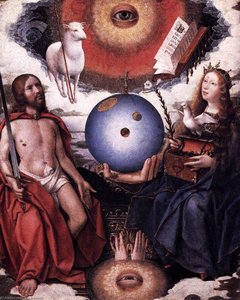
Para além das suas obras devocionais, a capacidade de Provoost de navegar por temas alegóricos complexos é evidente em obras-primas como a Alegoria do Cristianismo. Nesta obra, o artista utiliza um vocabulário sofisticado de símbolos — livros, caixas e esferas celestiais — para comunicar as intrincadas doutrinas da fé. O seu talento residia na habilidade de equilibrar estas densas camadas intelectuais com uma paleta de cores harmoniosa e uma clareza de forma que permanecia acessível ao espectador. Quer estivesse a retratar a solenidade do Juízo Final ou a ternura íntima de uma Madona Amamentadora, Provoost possuía uma capacidade única de capturar o divino dentro da experiência humana.

A Influência Duradoura da Oficina de Provoost

A verdadeira magnitude da contribuição de Jan Provoost reside não apenas na sua mão individual, mas na vitalidade duradoura da sua oficina. O seu estúdio funcionou como um incubador vital de talento, fomentando um estilo que influenciaria gerações de pintores flamengos. A produção da Oficina de Jan Provoost era caracterizada por uma fusão perfeita entre a piedade Gótica e a estética emergente do Renascimento, garantindo que as tradições dos Primitivos Flamengos evoluíssem em vez de desaparecerem. Através do seu espírito colaborativo e da sua capacidade de atrair tanto alunos como mestres, ele ajudou a sustentar o prestígio artístico de Bruges e Antuérpia durante um período de imensa transição cultural.

Ao refletirmos sobre a sua vida, vemos um artista que era tanto um cientista quanto um criador. Os seus encontros com luminares como Albrecht Dürer em Antuérpia sugerem um homem profundamente envolvido com as mutáveis marés intelectuais da Europa. O legado de Provoost encontra-se na força silenciosa dos seus retratos, na precisão arquitetónica dos seus desenhos e na profundidade luminosa dos seus ícones religiosos. Ele permanece uma figura fundamental, cuja obra serve como uma janela para um momento transformador da história humana, onde a devoção do velho mundo encontrou o espírito inquisitivo do novo.