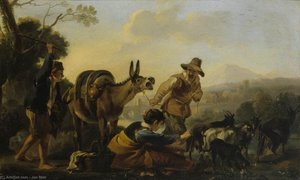
Retrato de Jan Miel

As 71 Pinturas Mais Famosas de Jan Miel, Cada Uma Única

Atualizado em Novembro 2026 · classificado pela nossa pontuação de popularidade (pesquisas, visitas e pedidos de cada obra) · 71 obras de Jan Miel em nosso catálogo

Em resumo

Scene from the Life of Tramps (Lazzaroni) (1650) é a pintura de Jan Miel que mais atrai olhares; a obra original pertence ao Museu Hermitage, São Petersburgo. Depois disso, o olhar recai sobre Hunters at Rest (1650) e Carnival Entertainment (1635). Entre as 71 obras de Jan Miel em nosso catálogo, estas 71 são as mais famosas, cada uma uma original única apresentada com o seu ano, o seu museu e a razão pela qual perdura.

1599 – 1663, Beveren Baroque Mais obras: Museu Hermitage

As 10 principais pinturas de Jan Miel, sob o olhar da galeria

1
Scene from the Life of Tramps (Lazzaroni) (1650) de Jan Miel

Scene from the Life of Tramps (Lazzaroni)

1650 · Oil On Canvas · Museu Hermitage, São Petersburgo

A heavy, ochre light settles over the crumbling stone of ancient ruins. Here, the shadows are thick and deep, swallowing the corners of a chaotic street scene. Figures move through the haze of smoke and dust, their bodies caught in a sudden, sharp glare of sun. A man gestures with urgency, his hands carving shapes into the air, while others sit in the dirt, anchored by the weight of their…

2
Hunters at Rest (1650) de Jan Miel

Hunters at Rest

1650 · Oil On Canvas · Museu Hermitage, São Petersburgo

is an oil on canvas painting by the Flemish artist Jan Miel. Created about 1650, the work captures a quiet moment within a pastoral scene. It depicts a hunting party finding respite amidst the landscape. The scene is anchored by the presence of horses and the sturdy silhouette of a fortified tower.

3
Carnival Entertainment (1635) de Jan Miel

Carnival Entertainment

1635 · Oil On Canvas · Bavarian State Painting Collections, Munique

In "Carnival Entertainment" by Jan Miel, we find ourselves amidst a dense and dynamic urban scene. The composition is crowded, capturing a street festival where a large group of figures occupies the foreground and middle ground. These individuals—musicians, dancers, and various onlookers—are arranged to create a sense of constant movement. The perspective is a ground-level view, which provides a palpable sense of depth through the careful layering of people and…

4
Sine Cerere et Baccho Friget Venus (1645) de Jan Miel

Sine Cerere et Baccho Friget Venus

1645 · Oil

The oil painting titled Sine Cerere et Baccho Friget Venus presents a mythological scene of abundance. Jan Miel rendered this work in 1645. It captures a moment where classical deities gather amidst the symbols of harvest and intoxication. The figures exist within a lush, Baroque-style arrangement of life and plenty.

5
The Veneration of St. Lambert (1648) de Jan Miel

The Veneration of St. Lambert

1648 · Oil On Canvas · Fitzwilliam Museum

The air in the grand, classical space feels heavy with the scent of incense and the weight of sudden grief. In the center of this dramatic scene, St. Lambert lies in repose, his body a pale, still anchor amidst a sea of movement. Above him, the celestial realm breaks through the gloom; an angel descends with fluid, sweeping drapery that seems to catch a wind from another world. The light…

6
Soothsayer at an inn (1644) de Jan Miel

Soothsayer at an inn

1644 · Oil

The air at the roadside inn feels heavy with the scent of dust and old stone. Under a rugged stone archway, a group of travelers huddles in a moment of quiet tension. A woman in a garment of lapis blue leans toward a man, her presence a cool contrast to the earthy ochre and deep crimson that define the crowd. He is the soothsayer, a figure caught in the flickering…

7
Two hunters resting in a landscape (the standing hunter is a woman in men's clothes) (1639) de Jan Miel

Two hunters resting in a landscape (the standing hunter is a woman in men's clothes)

1639 · Oil On Canvas · New York Historical Society, Nova York

The scene unfolds within the oil on canvas work titled Two hunters resting in a landscape (the standing hunter is a woman in men's clothes). This composition emerges from the hand of Jan Miel, a painter who brings a sense of immediate life to the quietude of the hunt. The work is dated 1639, capturing a specific moment of stillness amidst the natural world.

8
Three peasants having fun with music and dance (1639) de Jan Miel

Three peasants having fun with music and dance

1639 · Oil On Panel · Rafael Valls Limited, City of Westminster

Three peasants having fun with music and dance by Jan Miel presents a lively genre scene centered on three figures engaged in rhythmic activity. The composition is dynamic, utilizing an intimate perspective that places the viewer in close proximity to the subjects. Within this shallow space, the central figure is captured mid-motion, a choice that establishes a sense of rhythmic movement throughout the scene. To the left of the main…

10
An Italianate Landscape with Peasants Dancing (1650) de Jan Miel

An Italianate Landscape with Peasants Dancing

1650 · Oil On Canvas · Nostell Priory, Wakefield

We are looking at An Italianate Landscape with Peasants Dancing, a work by Jan Miel. This piece dates to about 1650, a period when the artist was deeply engaged with the stylistic shifts occurring within the Italian Baroque. It is a significant example of how Miel navigated the transition from the gritty, everyday observations of the Bamboccianti to more expansive, classical compositions.

Pinturas famosas de Jan Miel, números 11 a 71

11Falcon hunters in front of an inn in a ruin (1650) de Jan MielFalcon hunters in front of an inn in a ruin1650 12The beggar (1650) de Jan MielThe beggar1650 13Barber and roulette players (1650) de Jan MielBarber and roulette players1650 14Military resting with a fortune teller (1650) de Jan MielMilitary resting with a fortune teller1650 15Carnival parade in Rome (1660) de Jan MielCarnival parade in Rome1660 16Hannibal's dream (1661) de Jan MielHannibal's dream1661 17Figures in the vicinity of architectural ruins (1650) de Jan MielFigures in the vicinity of architectural ruins1650 18The gathering of the hunters (1660) de Jan MielThe gathering of the hunters1660 · Galleria Sabauda 19Boar hunt (1660) de Jan MielBoar hunt1660 · Palácio de Venaria Reale 20Bear hunt (1659) de Jan MielBear hunt1659 · Palácio de Venaria Reale 21Diana the Huntress (1658) de Jan MielDiana the Huntress1658 · Palácio de Venaria Reale 22Adoration of the Shepherds (1650) de Jan MielAdoration of the Shepherds1650 · Museu Estatal Pushkin de Artes Visuais 23Serenade with dancers and musician (1650) de Jan MielSerenade with dancers and musician1650 24The Race of the Berber Horses in Rome (1664) de Jan MielThe Race of the Berber Horses in Rome1664 25Traveling theatre (1700) de Jan MielTraveling theatre1700 26Harbour (1652) de Jan MielHarbour1652 · Museu Hermitage 27La curea - curée - con corte Regale, Carlo Emanuele II e Franesca d (1661) de Jan MielLa curea - curée - con corte Regale, Carlo Emanuele II e Franesca d1661 · Palácio de Venaria Reale 28Dance in the Trattoria (1647) de Jan MielDance in the Trattoria1647 · Academia de Belas Artes de Viena 29LE BARBIER NAPOLITAIN de Jan MielLE BARBIER NAPOLITAINMuseu do Louvre 30St John the Baptist Preaching in the Desert de Jan MielSt John the Baptist Preaching in the DesertNationalmuseum 31The Arch of Constantine in Rome (1648) de Jan MielThe Arch of Constantine in Rome1648 · Barber Institute of Fine Arts 32Scene in front of a tavern (1638) de Jan MielScene in front of a tavern1638 · Museu Nacional de Varsóvia 33Figures Feasting at a Fair in Prati, Outside the Walls of Rome, with the Saint Peter's Basilica and Monte Mario Beyond (1650) de Jan MielFigures Feasting at a Fair in Prati, Outside the Walls of Rome, with the Saint Peter's Basilica and Monte Mario Beyond1650 34Deer hunt (1661) de Jan MielDeer hunt1661 · Palácio de Venaria Reale 35The death of the deer (1660) de Jan MielThe death of the deer1660 · Palácio de Venaria Reale 36The Courtyard of Palazzo Nardini in Rome (1650) de Jan MielThe Courtyard of Palazzo Nardini in Rome1650 · Palazzo Barberini 37Hunters at Rest de Jan MielHunters at RestMuseu do Prado 38Architectural Landscape (1638) de Jan MielArchitectural Landscape1638 · Museu Hermitage 39Carnival Time in Rome (1653) de Jan MielCarnival Time in Rome1653 · Museu do Prado 40The snack de Jan MielThe snackMuseu do Prado 41Cottage with inhabitants de Jan MielCottage with inhabitantsMuseu do Prado 42The local Barber de Jan MielThe local BarberMuseu do Prado 43Popular scene de Jan MielPopular sceneMuseu do Prado 44The Flight into Egypt de Jan MielThe Flight into EgyptStatens Museum For Kunst 45Soldiers Resting de Jan MielSoldiers RestingNationalmuseum 46Peasants Resting de Jan MielPeasants RestingNationalmuseum 47Hunters Resting de Jan MielHunters RestingNationalmuseum 48Fox hunting de Jan MielFox huntingPalácio de Venaria Reale 49Jugglers passing – Carnival de Jan MielJugglers passing – CarnivalMuseu Nacional de Varsóvia 50MARCHAND D'ESCARGOTS de Jan MielMARCHAND D'ESCARGOTS 51Road in the Roman Campagna de Jan MielRoad in the Roman CampagnaMuseu Hermitage 52PAYSAGE AVEC FIGURES de Jan MielPAYSAGE AVEC FIGURES 53Maraudeurs italiens Une halte (autre titre) de Jan MielMaraudeurs italiens Une halte (autre titre) 54Pastorale avec bergère endormie de Jan MielPastorale avec bergère endormie 55The fugitive Erminia asks a fellow countryman for admission de Jan MielThe fugitive Erminia asks a fellow countryman for admission 56A Assembleia (1660) de Jan MielA Assembleia1660 · Château de Versailles 57The vihuela player de Jan MielThe vihuela playerMuseu do Prado 58LA DINEE DES VOYAGEURS de Jan MielLA DINEE DES VOYAGEURSMuseu do Louvre 59Genre Scene (1650) de Jan MielGenre Scene1650 · Museu Hermitage 60Landscape with herders de Jan MielLandscape with herdersMuseu do Prado 61LA HALTE MILITAIRE de Jan MielLA HALTE MILITAIREMuseu do Louvre 62Landscape with a Battle between Two Rams (1640) de Jan MielLandscape with a Battle between Two Rams1640 · Metropolitan Museum of Art 63Hunters at Rest de Jan MielHunters at RestMuseu Hermitage 64Shepherds and herd in a mountainous landscape de Jan MielShepherds and herd in a mountainous landscapeMusée Calvet 65Carnival in the Piazza Colonna, Rome de Jan MielCarnival in the Piazza Colonna, RomeWadsworth Atheneum 66Roman Lime Kiln with Peasants Gambling de Jan MielRoman Lime Kiln with Peasants Gambling 67Italian Peasants outside a Tavern de Jan MielItalian Peasants outside a TavernRoyal Collection 68Un savetier de Jan MielUn savetier 69The bowls players de Jan MielThe bowls players 70LE MENDIANT de Jan MielLE MENDIANTMuseu do Louvre 71Charlatan de Jan MielCharlatanMuseu Hermitage

Pinturas famosas de Jan Miel, período por período

Os temas que cativaram o olhar de Jan Miel

Os quatro temas que mais se repetem nestas obras originais, cada um com o seu melhor exemplo.

Os museus que guardam os originais de Jan Miel

Os 8 museus que detêm a maioria das pinturas desta página.

Museus Cidade Obras de Jan Miel Pinturas desta lista
Museu Hermitage, São PetersburgoMuseu Hermitage São Petersburgo 8 Scene from the Life of Tramps (Lazzaroni), Hunters at Rest, Harbour
Museu do Prado, MadridMuseu do Prado Madrid 8 Hunters at Rest, Carnival Time in Rome, The snack
Palácio de Venaria Reale, Venaria RealePalácio de Venaria Reale Venaria Reale 7 Boar hunt, Bear hunt, Diana the Huntress
Museu do Louvre, ParisMuseu do Louvre Paris 4 LE BARBIER NAPOLITAIN, LA DINEE DES VOYAGEURS, LA HALTE MILITAIRE
Nationalmuseum, EstocolmoNationalmuseum Estocolmo 4 St John the Baptist Preaching in the Desert, Soldiers Resting, Peasants Resting
Museu Nacional de Varsóvia, VarsóviaMuseu Nacional de Varsóvia Varsóvia 2 Scene in front of a tavern, Jugglers passing – Carnival
Bavarian State Painting Collections, MuniqueBavarian State Painting Collections Munique 1 Carnival Entertainment
Fitzwilliam MuseumFitzwilliam Museum 1 The Veneration of St. Lambert

Jan Miel ao longo das décadas: uma obra original única para cada uma

Obras por década

Escolha uma década para ver a obra original que a define.

Pinturas de Jan Miel: perguntas para a galeria

Qual é a obra mais famosa de Jan Miel?Revelar a resposta

Scene from the Life of Tramps (Lazzaroni) (1650), Museu Hermitage, São Petersburgo. Hunters at Rest (1650) e Carnival Entertainment (1635) vêm a seguir.

Com que idade Jan Miel criou Scene from the Life of Tramps (Lazzaroni)?Revelar a resposta

51 anos: Scene from the Life of Tramps (Lazzaroni) data de 1650, e Jan Miel nasceu em 1599.

Quais são as dez pinturas mais famosas de Jan Miel?Revelar a resposta

Scene from the Life of Tramps (Lazzaroni), Hunters at Rest, Carnival Entertainment, Sine Cerere et Baccho Friget Venus, The Veneration of St. Lambert, Soothsayer at an inn, Two hunters resting in a landscape (the standing hunter is a woman in men's clothes), Three peasants having fun with music and dance, The Travelers' Dinner. Peasants Eating Near an Inn or Resting e An Italianate Landscape with Peasants Dancing. O ranking acima apresenta o ano e o museu de cada uma.

Quantas obras de Jan Miel são conhecidas?Revelar a resposta

Nosso catálogo contém 71 obras de Jan Miel, datadas de 1635 a 1661.

Onde se pode ver os originais mais famosos de Jan Miel?Revelar a resposta

Principalmente em Museu Hermitage (São Petersburgo), Museu do Prado (Madrid) e Palácio de Venaria Reale (Venaria Reale). A tabela de museus acima lista todos eles.

Em que período Jan Miel criou as suas pinturas mais conhecidas?Revelar a resposta

Em 1650s: 18 das 71 obras nesta página foram feitas então, sendo Scene from the Life of Tramps (Lazzaroni) delas.

Qual pintura famosa de Jan Miel é a mais antiga e qual é a mais recente?Revelar a resposta

Nesta página, a mais antiga é Carnival Entertainment (1635) e a mais recente é Hannibal's dream (1661).

Quais temas Jan Miel preferia?Revelar a resposta

People (21), Landscape (15) e Architecture (14), entre as 71 obras nesta página.

Com quais materiais Jan Miel mais pintou?Revelar a resposta

Oil On Canvas, para 34 das 71 obras nesta página.

A qual movimento pertence a obra de Jan Miel?Revelar a resposta

Baroque, a julgar pelos originais nesta página.

Quais originais de Jan Miel posso ver no Museu Hermitage?Revelar a resposta

Scene from the Life of Tramps (Lazzaroni), Hunters at Rest e Harbour: o Museu Hermitage, São Petersburgo detém 8 das obras desta página.

Jan Miel: um retrato do artista

Jan Miel: A Ponte entre o Realismo Holandês e a Grandiosidade Barroca

Jan Miel (1599–1663) ergue-se como uma figura fundamental no cenário artístico do século XVII, personificando a fascinante confluência entre a tradição flamenga e a inovação italiana. Nascido em Beveren, na Bélgica — embora Antuérpia e 's-Hertogenbosch permaneçam como possíveis locais de seu nascimento — os primeiros anos de vida de Miel permanecem envoltos em uma relativa obscuridade, deixando detalhes biográficos escassos. No entanto, o que emerge das pesquisas acadêmicas é uma jornada artística notável, marcada por uma evolução estilística e esforços colaborativos que consolidaram seu lugar no vibrante meio cultural de Roma e Turim.

Seus anos formativos foram dedicados ao aperfeiçoamento de seu ofício, principalmente em Antuérpia, onde absorveu as influências de proeminentes mestres flamengos como Anthony van Dyck. Embora o alcance preciso de seu treinamento permaneça incerto, ele sem dúvida instilou nele um apreço pela observação meticulosa e por uma técnica refinada — qualidades que caracterizariam grande parte de sua obra subsequente. Essa base fundamental no desenho clássico e na retratística forneceu o conjunto de ferramentas essencial para uma carreira que, eventualmente, transcenderia as fronteiras regionais.

A Transformação Romana e o Espírito Bamboccianti

A chegada de Miel a Roma, por volta de 1636, sinalizou um momento transformador em sua trajetória artística. Ele rapidamente se juntou aos Bentvueghels, uma influente associação de artistas holandeses e flamengos residentes na Cidade Eterna. Dentro desta irmandade, ele adotou o memorável apelido de ‘bieco’, um monônimo que refletia seu olhar distintivo e semicerrado — uma característica que se tornaria sinônima de sua persona artística. Esta afiliação promoveu conexões profundas dentro de uma comunidade artística mais ampla, profundamente impactada pelo estilo Bamboccianti de Pieter van Laer.

Este movimento dedicava-se a retratar cenas da vida cotidiana entre as classes baixas em Roma e seus arredores, evitando a grandeza idealizada da arte do Alto Renascimento em favor de algo muito mais visceral e imediato. Miel abraçou essa tendência de todo o coração, produzindo pinturas de gênero cativantes que capturavam o espírito da existência urbana com um realismo e uma sensibilidade notáveis. Suas obras frequentemente apresentavam:

  • Cenas de rua vivas, povoadas por viajantes, mercadores e trabalhadores.
  • Um uso magistral da luz para evocar a atmosfera empoeirada e ensolarada dos becos romanos.
  • O jogo sutil da emoção humana dentro de cenários lotados e caóticos.
  • Uma atenção meticulosa às texturas de tecidos, pedras e terra.

Evolução rumo ao Classicismo e à Grandiosidade Palaciana

À medida que sua carreira progredia, a visão artística de Miel passou por uma metamorfose significativa. Embora tenha permanecido um mestre das cenas de gênero, ele começou a se afastar do realismo cru dos Bamboccianti em direção a pinturas históricas mais classicistas. Essa mudança refletia uma tendência mais ampla na arte europeia, onde a energia bruta do Barroco era cada vez mais temperada por um desejo de ordem, nobreza e alegoria clássica.

Esta evolução eventualmente o conduziu a nomeações prestigiosas, sendo a mais notável o serviço como artista da corte de Carlos Emanuel II, Duque de Saboia. A serviço da corte de Turim, o trabalho de Miel assumiu um caráter mais formal e magnífico. A intimidade de suas cenas romanas anteriores deu lugar a composições de maior escala e complexidade, projetadas para refletir o poder e o prestígio de seu patrono real. Este período representa o ápice de sua realização profissional, onde suas raízes flamengas no detalhe encontraram as narrativas grandiosas e abrangentes exigidas pela aristocracia europeia.

A importância histórica de Jan Miel reside em sua habilidade de navegar por esses mundos díspares. Ele foi um artista capaz de encontrar beleza nas lutas humildes de um menino de rua romano e dignidade nos contos épicos da antiguidade. Ao construir uma ponte entre o realismo meticuloso do Norte e o classicismo dramático do Sul, Miel deixou uma marca indelével no cânone do século XVII, garantindo seu legado como um verdadeiro cosmopolita da era Barroca.