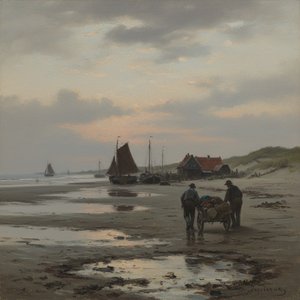
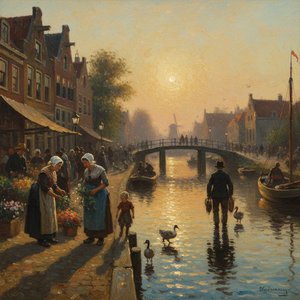
Early Life, Family and Artistic Training
Jan Derk Huibers was born on 27 December 1829 in Deventer. He grew up in a household headed by his father, Jan Derk Huibers, a merchant, and his mother, Maria Elisabet née Fonck. His early years in Deventer provided the foundation for a life spent observing the world through line and form.
His formal training began in the quiet hours of the evening. He attended local drawing school classes, where he studied under the guidance of Jacob Jansen Vredenburg. These early lessons in drafting and observation shaped his hand before he moved toward more formal institutions. He eventually left the familiar surroundings of his birthplace to pursue a deeper study of the craft.
His education took him to the Royal Academy of Fine Arts in Antwerp, where he refined his technical skills. From there, he moved to the Rijksakademie in Amsterdam to continue his training. These years of study in different cities allowed him to develop the precision and draftsmanship that would define his later work as a painter and teacher.
Professional Career and Teaching Roles
After finishing his studies in Amsterdam, he joined the ranks of Arti et Amicitiae. His life became increasingly tied to the instruction of others. In 1868, he took up a position as a teacher at the drawing school run by the Maatschappij tot Nut van 't Algemeen. This role was followed by another teaching post in Zwolle, which he held from 1872 onwards. He spent much of his time guiding hands through the mechanics of drawing and composition.
His influence on formal education grew as the institutions around him expanded. In 1881, he became one of the first instructors at the newly established Rijksnormaalschool voor Teekenonderwijzers. This position placed him at the center of teacher training. Beyond the classroom, he contributed to the administration of his craft, serving as a board member for the Association for Drawing Education. His work was marked by this dual commitment to both the practice of painting and the structured teaching of art.
Later Years, Students and Death
By 1901, the active teaching years of Jan Derk Huibers came to a close as he retired from his various professional positions. He spent his remaining years away from the formal classroom settings of Amsterdam and Zwolle, settling into a quieter life. He passed away at his home in Zeist on 7 April 1918, at the age of eighty-eight.
His influence lived on through the hands of those he taught. Many of his students went on to establish their own paths in the art world, including Leo Gestel and Xeno Münninghoff. These individuals carried forward the technical foundations he helped instill during his decades as an instructor and board member for drawing education.
His connection to his birthplace remains visible in the local landscape. In Deventer, a street has been named after him, marking his place in the geography of the town where his life began.
Perguntas e Respostas
Como posso encontrar obras de Jan Derk Huibers em uma paleta específica?
Para encontrar obras de Jan Derk Huibers em uma paleta específica, acesse a página de Por paleta de cores do artista.
Como posso encontrar obras de Jan Derk Huibers sobre um tema específico?
A página Por palavras-chave de Jan Derk Huibers agrupa as obras do artista por palavras-chave.
Em quais movimentos Jan Derk Huibers atuou?
Os movimentos em que Jan Derk Huibers atuou podem ser conferidos na página de Todos os Movimentos do artista, que agrupa as obras por movimento.
Posso visitar um museu virtual das obras de Jan Derk Huibers?
As obras de Jan Derk Huibers podem ser visualizadas em uma galeria 3D na página Galeria 3D do artista.