Retrato de Jacopo Amigoni

Pinturas de Jacopo Amigoni: As 80 mais famosas, sob o olhar de uma galeria

Atualizado em Novembro 2026 · classificado pela nossa pontuação de popularidade (pesquisas, visitas e pedidos de cada obra) · 80 obras de Jacopo Amigoni em nosso catálogo

Em resumo

Aos olhos da galeria, a pintura mais famosa de Jacopo Amigoni é Portrait of a Young Clergyman (1745), cuja obra original está exposta no Museum Boijmans Van Beuningen, em Roterdã. Peter I with Minerva (with the Allegorical Figure of Glory) (1732) e Elector Max Emanuel Receives a Turkish Embassy (1688) completam o trio que todos reconhecem. Dos 80 trabalhos de Jacopo Amigoni em nosso catálogo, a galeria apresenta abaixo as 80 obras mais famosas, cada uma original, com seu ano, seu museu e o que a torna única.

1682 – 1752, Nápoles Rococo Mais obras: Bavarian State Painting Collections

As 10 principais pinturas de Jacopo Amigoni na galeria

1
Portrait of a Young Clergyman (1745) de Jacopo Amigoni

Portrait of a Young Clergyman

1745 · Oil · Museum Boijmans Van Beuningen, Roterdã

This formal 18th-century portrait, executed in a Rococo style, presents a bust-length depiction of a young man, likely a clergyman. The subject is positioned slightly off-center, turned toward the viewer's right while casting his gaze back toward the center. The composition is defined by a restrained and somber color palette, where deep blacks and dark browns within the clothing and background create a sharp contrast against the luminous, pale tones…

2
Peter I with Minerva (with the Allegorical Figure of Glory) (1732) de Jacopo Amigoni

Peter I with Minerva (with the Allegorical Figure of Glory)

1732 · Oil On Canvas · Museu Hermitage, São Petersburgo

This oil on canvas work is titled Peter I with Minerva (with the Allegorical Figure of Glory). It was executed by the artist Jacopo Amigoni. The painting is also recognized by several other titles, including Peter the Great with Minerva and Peter I with Minerva. Through these various designations, the work captures a specific intersection of historical portraiture and classical allegory.

3
Elector Max Emanuel Receives a Turkish Embassy (1688) de Jacopo Amigoni

Elector Max Emanuel Receives a Turkish Embassy

1688 · Oil On Canvas · Bavarian State Painting Collections, Munique

The oil painting titled Elector Max Emanuel Receives a Turkish Embassy captures a moment of high diplomacy. Created by the Italian painter Jacopo Amigoni, this work functions as a fragment or detail of a larger composition. It depicts the Elector Max Emanuel receiving a Turkish legation, a scene of formal encounter between two distinct worlds. The brushwork traces the meeting of European and Ottoman figures within a structured, ceremonial space.

4
Europa (1695) de Jacopo Amigoni

Europa

1695

In this work, Europa, Jacopo Amigoni explores a moment of profound change. The painting captures the mythological scene of Europa and the Bull, a narrative centered on the intersection of the divine and the mortal. Dating to about 1695, the piece focuses on the tension inherent in the encounter between the woman and the animal. It is a study of the sudden shift from the pastoral to the mythic.

5
Jacob and Rachel (1701) de Jacopo Amigoni

Jacob and Rachel

1701 · Oil On Canvas · Museu Nacional de Varsóvia, Varsóvia

In this dramatic oil painting, the biblical narrative of Jacob and Rachel unfolds before the viewer. Created by Jacopo Amigoni about 1701, the work captures a moment of intense human connection and tension. The scene centers on the intimate interaction between a young woman and a man, while an elderly man sits nearby, grounding the composition in a landscape that feels both vast and immediate. Every gesture and facial expression…

6
Herminia and the shepherds (1700) de Jacopo Amigoni

Herminia and the shepherds

1700 · Oil On Canvas

The scene unfolds in a painting titled Herminia and the shepherds, a work that captures a moment of dramatic interaction within a pastoral setting. This oil painting, also known by the name Herminia bei den Hirten, brings a sense of movement to the canvas as the central figure engages with those around her. The atmosphere feels heavy with the weight of a story being told through gesture and gaze.

7
mythological scene (1700) de Jacopo Amigoni

mythological scene

1700 · Oil On Canvas

This 18th-century oil painting, titled mythological scene, was executed by the Italian artist Jacopo Amigoni. The work is presented here as a monochrome reproduction, allowing for a focused study of its form and composition. It dates to about 1700, a period when Amigoni was establishing his presence within the European art landscape.

8
dancing nymph (1700) de Jacopo Amigoni

dancing nymph

1700 · Oil

In this work, titled dancing nymph, Jacopo Amigoni centers the composition around a luminous, semi-nude female figure caught in a moment of dance. She is positioned in a contrapposto stance, her body twisting with a natural grace that directs the viewer's eye through the movement. In her left hand, she holds a tambourine aloft, while her right hand reaches up to touch her hair. Light and voluminous drapery swirls around…

9
Sleeping Christ Child with Instruments of the Passion (1713) de Jacopo Amigoni

Sleeping Christ Child with Instruments of the Passion

1713 · Oil · Bavarian State Painting Collections, Munique

The scene unfolds in the quietude of "Sleeping Christ Child with Instruments of the Passion," a work that captures a profound stillness. Here, the infant Christ rests in a deep slumber, his small form a focal point of peace amidst the heavy symbolism surrounding him. This painting, created by Jacopo Amigoni, invites a close gaze into a moment of profound vulnerability and divine destiny.

10
Mary with Child (1713) de Jacopo Amigoni

Mary with Child

1713 · Oil On Canvas · Bavarian State Painting Collections, Munique

In Mary with Child by Jacopo Amigoni, the composition is a close-up, intimate portrait centered on a woman holding an infant. Mary is positioned slightly to the left of the frame, looking down toward the child with a serene and tender expression. The infant is held in her arms, facing away from the viewer, with its body angled toward her chest. This arrangement creates a tight, focused grouping of the…

Pinturas de Jacopo Amigoni, classificadas de 11 a 80

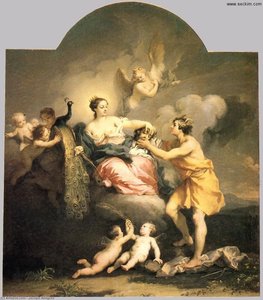
11Elector Max Emanuel Receives the Turkish Embassy (Oil Sketch) (1713) de Jacopo AmigoniElector Max Emanuel Receives the Turkish Embassy (Oil Sketch)1713 · Bavarian State Painting Collections 12Preaching of John the Baptist (1713) de Jacopo AmigoniPreaching of John the Baptist1713 · Bavarian State Painting Collections 13Adoration of the Magi (1713) de Jacopo AmigoniAdoration of the Magi1713 · Bavarian State Painting Collections 14Mary with the Child and the Infant John (1713) de Jacopo AmigoniMary with the Child and the Infant John1713 · Bavarian State Painting Collections 15Mary with Child (1713) de Jacopo AmigoniMary with Child1713 · Bavarian State Painting Collections 16Design for Ceiling Painting (1713) de Jacopo AmigoniDesign for Ceiling Painting1713 · Bavarian State Painting Collections 17Baptism of Christ (1713) de Jacopo AmigoniBaptism of Christ1713 · Bavarian State Painting Collections 18Mary with Child (1713) de Jacopo AmigoniMary with Child1713 · Bavarian State Painting Collections 19Saint John Preaching in the Desert (1713) de Jacopo AmigoniSaint John Preaching in the Desert1713 · Bavarian State Painting Collections 20Saint Joseph with the Christ Child (1713) de Jacopo AmigoniSaint Joseph with the Christ Child1713 · Bavarian State Painting Collections 21Portrait of Abbot Magnus Pachinger of Benediktbeuern (1713) de Jacopo AmigoniPortrait of Abbot Magnus Pachinger of Benediktbeuern1713 · Bavarian State Painting Collections 22Moses and the Brazen Serpent (1725) de Jacopo AmigoniMoses and the Brazen Serpent1725 · Musée des Beaux-Arts de Strasbourg 23Portrait of Sigismund Streit (1739) de Jacopo AmigoniPortrait of Sigismund Streit1739 · Gemäldegalerie 24Marcus Curius Dentatus refuses the gifts of the Samnites (1738) de Jacopo AmigoniMarcus Curius Dentatus refuses the gifts of the Samnites1738 · Museum Bredius 25Boys Playing with a Goat (1735) de Jacopo AmigoniBoys Playing with a Goat1735 · Royal Collection 26Frederick, Prince of Wales (1707-51) (1735) de Jacopo AmigoniFrederick, Prince of Wales (1707-51)1735 · Royal Collection 27Anne, Princess Royal and Princess of Orange (1709-1759) (1734) de Jacopo AmigoniAnne, Princess Royal and Princess of Orange (1709-1759)1734 · Royal Collection 28Bacchus and Ariadne (1740) de Jacopo AmigoniBacchus and Ariadne1740 · Art Gallery of New South Wales 29Abraham's Sacrifice of Isaac (1742) de Jacopo AmigoniAbraham's Sacrifice of Isaac1742 · Gemäldegalerie 30Susanna and the Elders (1742) de Jacopo AmigoniSusanna and the Elders1742 · Gemäldegalerie 31Bathseba at her bath receives the message of David (1742) de Jacopo AmigoniBathseba at her bath receives the message of David1742 · Gemäldegalerie 32Portrait of the singer Farinelli (Carlo Broschi) 1705-1782 (1740) de Jacopo AmigoniPortrait of the singer Farinelli (Carlo Broschi) 1705-17821740 · Musée Carnavalet 33Maria Anna Caroline of Baviera (1696-1750) as nun (1750) de Jacopo AmigoniMaria Anna Caroline of Baviera (1696-1750) as nun1750 · Bavarian State Painting Collections 34The Infanta María Antonia Fernanda, Daughter of Philip V (1750) de Jacopo AmigoniThe Infanta María Antonia Fernanda, Daughter of Philip V1750 · Museu do Prado 35Portrait group: The singer Farinelli and friends (1750) de Jacopo AmigoniPortrait group: The singer Farinelli and friends1750 · National Gallery of Victoria 36Portrait of a Lady as Diana (1757) de Jacopo AmigoniPortrait of a Lady as Diana1757 · Gemäldegalerie 37Portrait of the Marquis de la Ensenada (1750) de Jacopo AmigoniPortrait of the Marquis de la Ensenada1750 · Museu do Prado 38Jupiter and Callisto (1750) de Jacopo AmigoniJupiter and Callisto1750 · Museu Hermitage 39The Holy Face (1701) de Jacopo AmigoniThe Holy Face1701 · Museu do Prado 40Venus and Adonis (1740) de Jacopo AmigoniVenus and Adonis1740 · Gallerie dell'Accademia di Venezia 41Apollo and the Muses (1700) de Jacopo AmigoniApollo and the Muses1700 · Museo de Arte de Ponce 42Mercury About to Slay Argus (1730) de Jacopo AmigoniMercury About to Slay Argus1730 43Jael and Sisera (1739) de Jacopo AmigoniJael and Sisera1739 44Venus and Adonis (detail) (1740) de Jacopo AmigoniVenus and Adonis (detail)1740 · Gallerie dell'Accademia di Venezia 45The Last Supper de Jacopo AmigoniThe Last SupperBavarian State Painting Collections 46The Birth of Adonis de Jacopo AmigoniThe Birth of AdonisNational Gallery of Ireland 47Apollo and the Muses de Jacopo AmigoniApollo and the MusesMuseu de Belas Artes de Boston 48Peter I, Emperor of Russia de Jacopo AmigoniPeter I, Emperor of RussiaNational Portrait Gallery of Sweden 49Children playing with a little bird de Jacopo AmigoniChildren playing with a little birdCa' Rezzonico – Museu do Século XVIII em Veneza 50The Triumph of the Arts de Jacopo AmigoniThe Triumph of the Arts 51Diana and Callisto de Jacopo AmigoniDiana and Callisto 52Abraham and the three Angels de Jacopo AmigoniAbraham and the three Angels 53Lady Sophia Bentinck (1701–1748), Duchess of Kent de Jacopo AmigoniLady Sophia Bentinck (1701–1748), Duchess of Kent 54Flora and Zephyr (1730) de Jacopo AmigoniFlora and Zephyr1730 · Metropolitan Museum of Art 55Persée délivrant Andromède de Jacopo AmigoniPersée délivrant AndromèdeMusée Hyacinthe Rigaud 56Joseph in the Pharaoh's Palace de Jacopo AmigoniJoseph in the Pharaoh's PalaceMuseu do Prado 57Queen caroline de Jacopo AmigoniQueen caroline 58Caroline Wilhelmina of Brandenburg-Ansbach de Jacopo AmigoniCaroline Wilhelmina of Brandenburg-AnsbachNational Portrait Gallery 59Princess anne de Jacopo AmigoniPrincess anne 60The Rape of Europa de Jacopo AmigoniThe Rape of EuropaOsterley Park And House 61Peter I (1672–1725), 'Peter the Great', Tsar of Russia, with Minerva de Jacopo AmigoniPeter I (1672–1725), 'Peter the Great', Tsar of Russia, with Minerva 62Jupiter and Io with Cupid and Attendant Putti de Jacopo AmigoniJupiter and Io with Cupid and Attendant Putti 63Argus Guarding Io Who Has Been Transformed into a White Heifer de Jacopo AmigoniArgus Guarding Io Who Has Been Transformed into a White Heifer 64Mercury about to Kill Argus Having Lulled Him to Sleep de Jacopo AmigoniMercury about to Kill Argus Having Lulled Him to Sleep 65Coriolanus Entreated by His Womenfolk de Jacopo AmigoniCoriolanus Entreated by His WomenfolkCalke Abbey 66Princess caroline elizabeth de Jacopo AmigoniPrincess caroline elizabethIckworth 67Solomon Sacrificing to His Wives' Idols de Jacopo AmigoniSolomon Sacrificing to His Wives' IdolsOsterley Park And House 68Mrs Elizabeth Thompson, nee Croft of Stillington de Jacopo AmigoniMrs Elizabeth Thompson, nee Croft of Stillington 69Queen Caroline of Brandenburg-Anspach de Jacopo AmigoniQueen Caroline of Brandenburg-AnspachGaleria Nacional de Retratos de Escócia 70Aeneas and Achates Wafted in a Cloud before Dido, Queen of Carthage, with Cupid at Her Feet de Jacopo AmigoniAeneas and Achates Wafted in a Cloud before Dido, Queen of Carthage, with Cupid at Her FeetOsterley Park And House 71James Howe, Benjamin Tilden and Richard John Thompson de Jacopo AmigoniJames Howe, Benjamin Tilden and Richard John Thompson 72Cupids at Play de Jacopo AmigoniCupids at Play 73Portrait of a Lady de Jacopo AmigoniPortrait of a Lady 74Sir thomas reeve de Jacopo AmigoniSir thomas reeve 75Allegory of Charity de Jacopo AmigoniAllegory of CharityAntony House 76Portrait of a Gentlemen in Blue Jacket de Jacopo AmigoniPortrait of a Gentlemen in Blue Jacket 77Rainha Carolina de Ansbach de Jacopo AmigoniRainha Carolina de AnsbachDurham University 78Venus and Adonis de Jacopo AmigoniVenus and AdonisAlte Pinakothek 79Juno Receiving the Head of Argos (1730) de Jacopo AmigoniJuno Receiving the Head of Argos1730 80Portrait of the Soprano Carlo Broschi, known as Il Farinelli (1752) de Jacopo AmigoniPortrait of the Soprano Carlo Broschi, known as Il Farinelli1752 · Staatsgalerie Stuttgart

Pinturas famosas de Jacopo Amigoni, período por período

Os temas que cativaram o olhar de Jacopo Amigoni

Os quatro temas que mais se repetem nestas obras originais, cada um com o seu melhor exemplo.

Os museus que guardam os originais de Jacopo Amigoni

Os 8 museus que detêm a maioria das pinturas desta página.

Museus Cidade Obras de Jacopo Amigoni Pinturas desta lista
Bavarian State Painting Collections, MuniqueBavarian State Painting Collections Munique 16 Elector Max Emanuel Receives a Turkish Embassy, Sleeping Christ Child with Instruments of the Passion, Mary with Child
Gemäldegalerie, BerlimGemäldegalerie Berlim 5 Portrait of Sigismund Streit, Abraham's Sacrifice of Isaac, Susanna and the Elders
Museu do Prado, MadridMuseu do Prado Madrid 4 The Infanta María Antonia Fernanda, Daughter of Philip V, Portrait of the Marquis de la Ensenada, The Holy Face
Royal Collection, LondresRoyal Collection Londres 3 Boys Playing with a Goat, Frederick, Prince of Wales (1707-51), Anne, Princess Royal and Princess of Orange (1709-1759)
Osterley Park And House, LondresOsterley Park And House Londres 3 The Rape of Europa, Solomon Sacrificing to His Wives' Idols, Aeneas and Achates Wafted in a Cloud before Dido, Queen of Carthage, with Cupid at Her Feet
Museu Hermitage, São PetersburgoMuseu Hermitage São Petersburgo 2 Peter I with Minerva (with the Allegorical Figure of Glory), Jupiter and Callisto
Gallerie dell'Accademia di Venezia, VenezaGallerie dell'Accademia di Venezia Veneza 2 Venus and Adonis, Venus and Adonis (detail)
Museum Boijmans Van Beuningen, RoterdãMuseum Boijmans Van Beuningen Roterdã 1 Portrait of a Young Clergyman

Jacopo Amigoni, uma pintura emblemática por década

Obras por década

Escolha uma década para ver a obra original que a define.

Pinturas de Jacopo Amigoni: a galeria responde

Qual pintura de Jacopo Amigoni é a mais famosa de todas?Revelar a resposta

Portrait of a Young Clergyman (1745), Museum Boijmans Van Beuningen, Roterdã. Peter I with Minerva (with the Allegorical Figure of Glory) (1732) e Elector Max Emanuel Receives a Turkish Embassy (1688) vêm a seguir.

Qual era a idade de Jacopo Amigoni ao concluir Portrait of a Young Clergyman?Revelar a resposta

63 anos: Portrait of a Young Clergyman data de 1745, e Jacopo Amigoni nasceu em 1682.

Quais são as 10 principais pinturas de Jacopo Amigoni?Revelar a resposta

Portrait of a Young Clergyman, Peter I with Minerva (with the Allegorical Figure of Glory), Elector Max Emanuel Receives a Turkish Embassy, Europa, Jacob and Rachel, Herminia and the shepherds, mythological scene, dancing nymph, Sleeping Christ Child with Instruments of the Passion e Mary with Child. O ranking acima apresenta o ano e o museu de cada uma.

Quantas obras Jacopo Amigoni criou?Revelar a resposta

Nosso catálogo contém 80 obras de Jacopo Amigoni, datadas de 1695 a 1752.

Onde estão expostos os originais mais famosos de Jacopo Amigoni?Revelar a resposta

Principalmente em Bavarian State Painting Collections (Munique), Gemäldegalerie (Berlim) e Museu do Prado (Madrid). A tabela de museus acima lista todos eles.

Quando é que Jacopo Amigoni criou as suas pinturas mais famosas?Revelar a resposta

Em 1710s: 13 das 80 obras nesta página foram feitas então, sendo Sleeping Christ Child with Instruments of the Passion delas.

Quais são as obras mais famosas de Jacopo Amigoni no início e no fim de sua carreira?Revelar a resposta

Nesta página, a mais antiga é Europa (1695) e a mais recente é Portrait of the Soprano Carlo Broschi, known as Il Farinelli (1752).

Quais temas Jacopo Amigoni mais explorou?Revelar a resposta

Man (20), Woman (20) e Drapery (20), entre as 80 obras nesta página.

Em qual técnica Jacopo Amigoni mais trabalhou?Revelar a resposta

Oil On Canvas, para 29 das 80 obras nesta página.

Com qual movimento Jacopo Amigoni está associado(a)?Revelar a resposta

Rococo e Baroque, a julgar pelos originais nesta página.

Quais obras originais de Jacopo Amigoni o Bavarian State Painting Collections possui?Revelar a resposta

Elector Max Emanuel Receives a Turkish Embassy, Sleeping Christ Child with Instruments of the Passion e Mary with Child: o Bavarian State Painting Collections, Munique detém 16 das obras desta página.

Jacopo Amigoni: o artista

Jacopo Amigoni: Um Mestre da Corte Rococó

Nascido em Nápoles por volta de 1682 e falecendo em Madrid em 1752, Jacopo Amigoni ergue-se como uma figura fundamental no mundo da arte do final do Barroco e início do Rococó. Inicialmente formado em Veneza, sua carreira floresceu por toda a Europa, estabelecendo-o como um dos retratistas e cenógrafos mais requisitados de sua era. A jornada de Amigoni foi marcada por um movimento constante – dos ateliers venezianos às opulentas cortes da Baviera, Inglaterra, Espanha e além – com cada localidade deixando sua marca distinta em seu estilo evolutivo e em suas temáticas.

No início de sua carreira, Amigoni produziu obras que abrangiam tanto narrativas mitológicas quanto cenas religiosas. Essas peças primordiais demonstram uma habilidade técnica emergente e um apreço pela composição dramática. No entanto, à medida que o século XVIII avançava e ele ganhava reconhecimento entre os patronos aristocráticos, seu foco deslocou-se para pinturas mais íntimas, de estilo salão – representações de deuses em poses lânguidas, temas alegóricos e retratos que capturavam a essência da nobreza europeia. Sua capacidade de renderizar tecidos luxuosos, joias cintilantes e rostos expressivos tornou-se a marca registrada de seu estilo singular.

Um Pintor de Corte Através dos Continentes

A carreira de Amigoni está intrinsecamente ligada às suas viagens. Ele começou a trabalhar na Baviera por volta de 1717, inicialmente para a corte no Castelo de Nymphenburg, encontrando mais tarde uma posição prestigiosa no Castelo de Schleissheim, de 1725 a 1729. Seu tempo nesses locais germânicos consolidou sua reputação na criação de obras ricamente detalhadas e tecnicamente proficientes. De 1726 em diante, viajou para Veneza, continuando a servir proeminentes famílias venezianas como os Streit e Savoia, produzindo um corpo significativo de obras para suas residências.

O meio do século XVIII testemunhou as extensas viagens de Amigoni pela Inglaterra. Ele passou vários anos em Londres, trabalhando para diversos patronos, incluindo Lord Tankerville, e até contribuindo para a cena teatral em Covent Garden. Sua presença na Inglaterra foi notável; ele envolveu-se em um intercâmbio vívido com críticos contemporâneos como James Ralph, cujas críticas mordazes destacavam tanto a beleza quanto os excessos percebidos na obra de Amigoni. Este período também o viu desempenhar um papel crucial ao encorajar Canaletto a mudar-se para a Inglaterra, utilizando suas conexões dentro do mundo da arte inglesa.

Sua jornada continuou em Paris, em 1736, onde encontrou o célebre castrato Farinelli, produzindo dois retratos notáveis do cantor e de sua comitiva. Mais tarde, passou um tempo em Madrid, tornando-se pintor da corte de Fernando VI da Espanha e diretor da Real Academia de San Fernando – uma posição que lhe conferiu considerável influência dentro do estabelecimento artístico espanhol. Ele também encontrou a obra de François Lemoyne e Boucher, absorvendo elementos de seus estilos distintos.

Estilo e Influências

O estilo de Amigoni é caracterizado por sua suntuosidade, brilho técnico e um domínio magistral da cor e da luz. Suas pinturas são frequentemente imbuídas de um senso de teatralidade, empregando o dramático chiaroscuro para criar profundidade e destacar figuras-chave na composição. Ele era particularmente hábil em renderizar texturas – desde as dobras de mantos de veludo até o brilho das joias – contribuindo significativamente para a sensação opulenta de suas obras.

Embora influenciado pelas tradições barrocas de artistas como Giuseppe Nogari, Amigoni desenvolveu uma sensibilidade distintamente Rococó, caracterizada pela elegância, graça e ênfase no detalhe decorativo. Seus retratos não são meras representações de semelhança; eles capturam as personalidades e o status social de seus sujeitos com uma sensibilidade notável. Sua obra demonstra um olhar aguçado para a moda e uma compreensão das tendências estéticas predominantes de sua época.

Legado e Obras Notáveis

O legado de Jacopo Amigoni estende-se além de sua produção prolífica. Ele mentorou vários jovens artistas promissores, incluindo Charles Joseph Flipart, Michelangelo Morlaiter e Pietro Antonio Novelli, garantindo a continuidade de sua linhagem artística. Sua influência pode ser vista no trabalho de gerações posteriores de pintores.

Entre suas obras mais celebradas estão “Juno Recebendo a Cabeça de Argos” (1730), uma representação dramática da deusa romana, e “Abraão e os Três Anjos”, um retrato poderoso da intervenção divina. Sua “Alegoria da Caridade” exemplifica sua habilidade em transmitir temas alegóricos complexos com elegidade e graça. Seu retrato de Farinelli permanece como um exemplo particularmente digno de nota de sua habilidade em capturar a personalidade e o carisma de seus sujeitos.

A vida de Amigoni culminou em Madrid, onde faleceu em 1752. Sua filha, Caterina Amigoni Castellini, continuou a tradição artística da família como pastelista, consolidando ainda mais o nome Amigoni no mundo da arte. Suas obras continuam a ser admiradas por sua beleza, habilidade técnica e pelo retrato evocativo da vida aristocrática europeia durante a era Rococó.