Retrato de George Stubbs

As 100 Pinturas Mais Famosas de George Stubbs, Cada Uma Única

Atualizado em Novembro 2026 · classificado pela nossa pontuação de popularidade (pesquisas, visitas e pedidos de cada obra) · 223 obras de George Stubbs em nosso catálogo

Em resumo

Whistlejacket (1762) é a pintura de George Stubbs que mais atrai olhares; a obra original pertence ao National Gallery, Londres. Depois disso, o olhar recai sobre Leão Atacando um Cavalo (1765) e Caçador de Cavalos com Duas Spaniels (1777). Entre as 223 obras de George Stubbs em nosso catálogo, estas 100 são as mais famosas, cada uma uma original única apresentada com o seu ano, o seu museu e a razão pela qual perdura.

1724 – 1806, Liverpool Classical romanticism Mais obras: Yale Center for British Art

As 10 principais pinturas de George Stubbs, sob o olhar da galeria

1
Whistlejacket (1762) de George Stubbs

Whistlejacket

1762 · Óleo sobre tela · National Gallery, Londres

Nesta obra de 1762 em óleo sobre tela, George Stubbs apresenta Whistlejacket, um magnífico cavalo puro-sangue castanho que parece emergir da própria trama da pintura. O animal pertence ao Marquês de Rockingham, e sua presença é imediata e imponente. Ele não está apenas parado; ele se ergue, capturado em um movimento súbito e poderoso que desafia a imobilidade do meio artístico. A estrutura muscular do animal pulsa com vida própria,…

2
Leão Atacando um Cavalo (1765) de George Stubbs

Leão Atacando um Cavalo

1765 · Óleo sobre tela · Yale University Art Gallery, Hartford

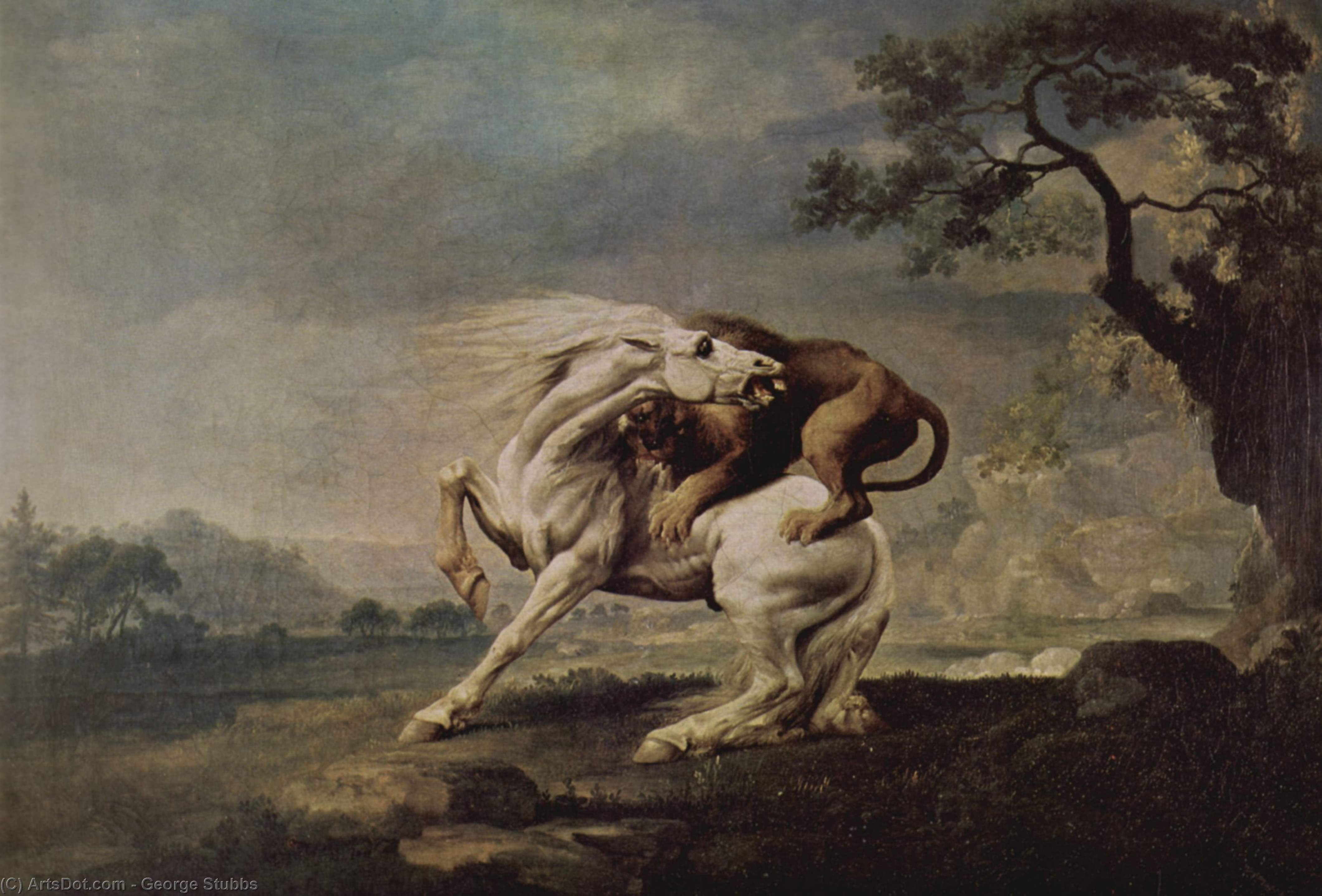
Em meio à complexidade do mundo da arte, algumas obras transcendem o tempo, capturando não apenas um momento, mas uma força primordial que ressoa profundamente em nossa alma. "O Leão e o Cavalo" (1765), de George Stubbs, é precisamente uma dessas pinturas. Mais do que uma representação de animais selvagens em combate, esta obra monumental é um mergulho visceral na luta pela sobrevivência, no instinto puro e na beleza crua…

3
Caçador de Cavalos com Duas Spaniels (1777) de George Stubbs

Caçador de Cavalos com Duas Spaniels

1777 · Óleo sobre tela

George Stubbs, um dos pintores mais revolucionários do século XVIII, nos presenteia com "A Bay Hunter com Dois Spaniels" (1777), uma obra que transcende a mera representação animal para se tornar um estudo profundo sobre o poder, a beleza e a relação entre homem e natureza. A pintura captura um momento de intensa concentração e graça, onde a força do cavalo bay se equilibra com a lealdade e agilidade dos…

4
A Caçada do Grosvenor (1762) de George Stubbs

A Caçada do Grosvenor

1762 · Óleo sobre tela

Uma Cena Cativante da Tradição de Caça do Século XVIII Imersa em um retrato vívido de uma cena de caça britânica por excelência do século XVIII, esta obra magistral captura um momento dinâmico de camaradagem e ação. Nela, caçadores montados, trajando vestimentas da época, percorrem uma paisagem exuberante sob um dossel de vibrantes folhas de outono. A cena exala energia e propósito, refletindo a importância cultural da caça tanto como…

5
Tiger (1771) de George Stubbs

Tiger

1771 · Oil On Canvas · Virginia Museum of Fine Arts, Richmond

George Stubbs’s “Tiger,” painted in 1771, isn’t merely a depiction of an animal; it's a visceral exploration of power, instinct, and the sublime. This oil painting, now housed within the collections of Google Arts & Culture, immediately commands attention with its dramatic composition and masterful use of light and shadow. The scene unfolds within a shadowy forest, a carefully constructed stage for the tiger’s predatory grace – a creature rendered…

6
Horse Frightened by a Lion (1770) de George Stubbs

Horse Frightened by a Lion

1770 · Acrylic On Canvas · Walker Art Gallery, Liverpool

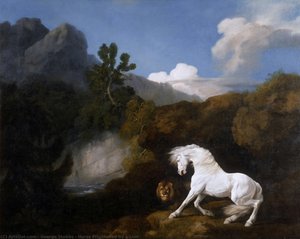
George Stubbs's "Horse Frightened by a Lion," painted in 1770, isn’t merely a depiction of animals; it’s a visceral exploration of primal fear and the raw power of nature. This monumental oil painting, measuring an impressive 1261 x 1001 cm, commands attention with its masterful use of chiaroscuro – the dramatic interplay of light and shadow – characteristic of the Baroque period yet imbued with a distinctly Romantic sensibility. The…

7
Whistlejacket (1762) de George Stubbs

Whistlejacket

1762 · Oil

In the grand tradition of British sporting art, few works command the room with as much raw vitality and anatomical precision as George Stubbs’s Whistlejacket. Painted in 1762, this monumental canvas transcends the boundaries of a mere portrait, offering instead a breathtaking study of power, grace, and kinetic energy. The subject, a magnificent bay Thoroughbred, is captured in a moment of suspended animation, galloping across a space that feels both…

8
Lord Grosvenor (1765) de George Stubbs

Lord Grosvenor

1765 · Acrylic On Canvas · Kimbell Art Museum, Fort Worth

George Stubbs' "Lord Grosvenor’s Arabian Stallion with a Groom," painted in 1765, isn’t merely a portrait; it’s a meticulously crafted tableau vivant—a snapshot of aristocratic leisure and the profound connection between man and beast. Stubbs, already recognized as the foremost painter of horses of his era, transcends simple representation, instead offering a deeply considered study of anatomy, movement, and psychological nuance. This work exemplifies his pioneering approach to animal painting,…

9
A Lion Attacking a Stag (1766) de George Stubbs

A Lion Attacking a Stag

1766 · Oil On Canvas · Yale Center for British Art, New Haven

Subject and Composition The canvas opens to a dramatic tableau in which a lion, the undisputed monarch of the savannah, has seized a stag mid‑flight. The predator’s muscular frame dominates the foreground, its jaws poised as if about to deliver the decisive bite. Below, the stag’s antlers curl like twisted branches, its body caught in a moment of frantic escape. A solitary bird perches on a branch near the upper…

10
Baronet (1794) de George Stubbs

Baronet

1794 · Oil On Canvas · Yale Center for British Art, New Haven

To gaze upon this depiction of a man mounted on his magnificent steed is to be swept away by the very energy of the late eighteenth century. George Stubbs, master chronicler of equine grace and human dignity, captures a moment brimming with aristocratic vitality. The central figure, the titular Baronet, commands attention not merely through his striking red jacket—a bold splash of color against the muted tones of the background—but…

Pinturas famosas de George Stubbs, números 11 a 100

11A Lion attacking a Horse (1770) de George StubbsA Lion attacking a Horse1770 · Yale University Art Gallery 12Lion Devouring a Horse (1763) de George StubbsLion Devouring a Horse1763 · Tate Gallery 13Horse Devoured by a Lion (1763) de George StubbsHorse Devoured by a Lion1763 · Tate Britain 14Foxhound (1760) de George StubbsFoxhound1760 · Yale Center for British Art 15The Fall of Phaëton (1777) de George StubbsThe Fall of Phaëton1777 · National Trust 16Study of a Fowl, Lateral View, with skin and underlying fascial layers removed, from 'A Comparative Anatomical Exposition of the Structure of the Human Body with that of a Tiger and a Common Fowl' de George StubbsStudy of a Fowl, Lateral View, with skin and underlying fascial layers removed, from 'A Comparative Anatomical Exposition of the Structure of the Human Body with that of a Tiger and a Common Fowl'Yale Center for British Art 17Freeman, The Earl of Clarendon's Gamekeeper, with a Dying Doe and Hound (1800) de George StubbsFreeman, The Earl of Clarendon's Gamekeeper, with a Dying Doe and Hound1800 · Yale Center for British Art 18Prince of Wales Phaeton (1793) de George StubbsPrince of Wales Phaeton1793 19Studies for or after "The third Duke of Richmond with the Charleton Hunt" (1750) de George StubbsStudies for or after "The third Duke of Richmond with the Charleton Hunt"1750 · Yale Center for British Art 20A Dark Bay Thoroughbred in a Landscape (1762) de George StubbsA Dark Bay Thoroughbred in a Landscape1762 21King Charles Spaniel (1769) de George StubbsKing Charles Spaniel1769 22O Óxe Lincolnshire (1790) de George StubbsO Óxe Lincolnshire1790 · Walker Art Gallery 23'Molly Long Legs' with Her Jockey (1762) de George Stubbs'Molly Long Legs' with Her Jockey1762 · Walker Art Gallery 24Reaper (1795) de George StubbsReaper1795 · Yale Center for British Art 25Captain Samuel Sharpe Pocklington with His Wife, Pleasance, and possibly His Sister, Frances (1769) de George StubbsCaptain Samuel Sharpe Pocklington with His Wife, Pleasance, and possibly His Sister, Frances1769 · National Gallery of Art 26Mares and Foals in a River Landscape (1768) de George StubbsMares and Foals in a River Landscape1768 27Viscount Gormanston's White Dog (1781) de George StubbsViscount Gormanston's White Dog1781 28Margaret Newton (née Coningsby), Countess of Coningsby in the Costume of the Charlton Hunt (1760) de George StubbsMargaret Newton (née Coningsby), Countess of Coningsby in the Costume of the Charlton Hunt1760 · Yale Center for British Art 29Self-Portrait (1759) de George StubbsSelf-Portrait1759 · Yale Center for British Art 30Horse Attacked by a Lion (Episode C) (1768) de George StubbsHorse Attacked by a Lion (Episode C)1768 · Yale Center for British Art 31White Poodle in a Punt (1780) de George StubbsWhite Poodle in a Punt1780 · National Gallery of Art 32Viscount Gormanston's White Dog - George Stubbs (2026) de George StubbsViscount Gormanston's White Dog - George Stubbs2026 33James Stanley (1755) de George StubbsJames Stanley1755 34Two gentlemen going a shooting, with a view of Creswell Crags (1767) de George StubbsTwo gentlemen going a shooting, with a view of Creswell Crags1767 · Museu Nacional de Varsóvia 35Two Gentlemen Going a Shooting, with a View of Creswell Crags, Taken on the Spot (1767) de George StubbsTwo Gentlemen Going a Shooting, with a View of Creswell Crags, Taken on the Spot1767 · Yale Center for British Art 36Two Gentlemen Shooting (1769) de George StubbsTwo Gentlemen Shooting1769 · Museus Reais de Belas Artes da Bélgica 37John Christian Santhague (d1. 821) (1782) de George StubbsJohn Christian Santhague (d1. 821)1782 · Royal Collection 38Sir Sidney Medows (1701-92) (1778) de George StubbsSir Sidney Medows (1701-92)1778 · Royal Collection 39Phaeton with a Pair of Cream Ponies and a Stable-Lad (1780) de George StubbsPhaeton with a Pair of Cream Ponies and a Stable-Lad1780 · Yale Center for British Art 40George IV (1762-1830), when Prince of Wales (1791) de George StubbsGeorge IV (1762-1830), when Prince of Wales1791 · Royal Collection 41A Bay Horse with a Groom (1791) de George StubbsA Bay Horse with a Groom1791 · Royal Collection 42Portrait of a Gentleman (1791) de George StubbsPortrait of a Gentleman1791 · Royal Collection 43Lion and Lione (1770) de George StubbsLion and Lione1770 · Yale Center for British Art 44Self-Portrait (1775) de George StubbsSelf-Portrait1775 45Cheetah with two Indian servants and a deer (1765) de George StubbsCheetah with two Indian servants and a deer1765 46The Marquess of Rockingham's Arabian Stallion (1780) de George StubbsThe Marquess of Rockingham's Arabian Stallion1780 · Scottish National Gallery 47Pavian and Albino Makake (1780) de George StubbsPavian and Albino Makake1780 48The Marquess of Rockingham (1780) de George StubbsThe Marquess of Rockingham1780 · Scottish National Gallery 49George Stubbs (1781) de George StubbsGeorge Stubbs1781 · National Portrait Gallery 50Hound Coursing a Stag (1762) de George StubbsHound Coursing a Stag1762 · Philadelphia Museum of Art 51Horse Attacked by a Lion (1762) de George StubbsHorse Attacked by a Lion1762 52Greenland Falcon (1780) de George StubbsGreenland Falcon1780 · Yale Center for British Art 53Isabella Salstonstall as Una in Spenser's 'Faerie Queene' (1782) de George StubbsIsabella Salstonstall as Una in Spenser's 'Faerie Queene'1782 · Museu Fitzwilliam 54Study of the Human Figure, Anterior View, from 'A Comparative Anatomical Exposition of the Structure of the Human Body with that of a Tiger and a Common Fowl' de George StubbsStudy of the Human Figure, Anterior View, from 'A Comparative Anatomical Exposition of the Structure of the Human Body with that of a Tiger and a Common Fowl'Yale Center for British Art 55A Foxhound (1760) de George StubbsA Foxhound1760 · Yale Center for British Art 56A Gentleman driving a Lady in a Phaeton (1787) de George StubbsA Gentleman driving a Lady in a Phaeton1787 57The Farmer's Wife and the Raven, from John Gay's 'Fables' (1786) de George StubbsThe Farmer's Wife and the Raven, from John Gay's 'Fables'1786 · Yale Center for British Art 58Gimcrack with John Pratt up on Newmarket Heath (1765) de George StubbsGimcrack with John Pratt up on Newmarket Heath1765 · Museu Fitzwilliam 59'Lustre' Held by a Groom (1762) de George Stubbs'Lustre' Held by a Groom1762 · Yale Center for British Art 60The Moose de George StubbsThe Moose 61James Stanley (b.c.1722) (1755) de George StubbsJames Stanley (b.c.1722)1755 · Walker Art Gallery 62A Chestnut Racehorse de George StubbsA Chestnut Racehorse 63Lord and Lady in a Phaeton (1787) de George StubbsLord and Lady in a Phaeton1787 · National Gallery 64George Fothergill de York (1746) de George StubbsGeorge Fothergill de York1746 · Ferens Art Gallery 65Bulls Fighting (1786) de George StubbsBulls Fighting1786 · Yale Center for British Art 66Labourers (1761) de George StubbsLabourers1761 · Yale Center for British Art 67James Stanley (1755) de George StubbsJames Stanley1755 · Walker Art Gallery 68The Milbanke and Melbourne Families (1769) de George StubbsThe Milbanke and Melbourne Families1769 · National Gallery 69Joseph Smyth Esquire, Lieutenant of Whittlebury Forest, Northamptonshire, on a Dapple Grey Horse (1764) de George StubbsJoseph Smyth Esquire, Lieutenant of Whittlebury Forest, Northamptonshire, on a Dapple Grey Horse1764 · Museu Fitzwilliam 70Harvest (1785) de George StubbsHarvest1785 71Portrait of a dark brown and white Newfoundland spaniel (1743) de George StubbsPortrait of a dark brown and white Newfoundland spaniel1743 72Untitled (Hound Chasing a Hare) (1765) de George StubbsUntitled (Hound Chasing a Hare)1765 · Auckland Art Gallery Toi o Tāmaki 73Horse Frightened by a Lion (1762) de George StubbsHorse Frightened by a Lion1762 · Yale Center for British Art 74Turf, with Jockey up, at Newmarket (1765) de George StubbsTurf, with Jockey up, at Newmarket1765 · Yale Center for British Art 75Newmarket Heath, with a Rubbing-down House (1765) de George StubbsNewmarket Heath, with a Rubbing-down House1765 · Yale Center for British Art 76Mares and Foals in a Wooded Landscape (1762) de George StubbsMares and Foals in a Wooded Landscape1762 77Horse Attacked by a Lion (1765) de George StubbsHorse Attacked by a Lion1765 78Cheetah and Stag with Two Indians (1765) de George StubbsCheetah and Stag with Two Indians1765 79Lord Grosvenor's Arabian Stallion with a Groom (1765) de George StubbsLord Grosvenor's Arabian Stallion with a Groom1765 80Newmarket Heath, with a Rubbing Down House (1765) de George StubbsNewmarket Heath, with a Rubbing Down House1765 81Mares and foals are anxious before a looming storm (1765) de George StubbsMares and foals are anxious before a looming storm1765 82Frontal view of the skeleton of a horse, study No. 10 from 'The Anatomy of the Horse' (1766) de George StubbsFrontal view of the skeleton of a horse, study No. 10 from 'The Anatomy of the Horse'1766 83A Repose after Shooting (1770) de George StubbsA Repose after Shooting1770 · Yale Center for British Art 84Portrait of John Nelthorpe as a child (1775) de George StubbsPortrait of John Nelthorpe as a child1775 85Pumpkin with a Stable Lad (1774) de George StubbsPumpkin with a Stable Lad1774 86'Pumpkin' (1773) de George Stubbs'Pumpkin'1773 · Ascott House 87Portrait of a Huntsman (1768) de George StubbsPortrait of a Huntsman1768 88The Moose (1773) de George StubbsThe Moose1773 · The Hunterian Museum and Art Gallery 89Mares and Foals under an Oak Tree (1775) de George StubbsMares and Foals under an Oak Tree1775 90Mares and Foals in a Mountainous Landscape (1769) de George StubbsMares and Foals in a Mountainous Landscape1769 91Lady Reading in a Wooded Park (1770) de George StubbsLady Reading in a Wooded Park1770 92A Horse Frightened by a Lion (1770) de George StubbsA Horse Frightened by a Lion1770 93Otho, with John Larkin up (1768) de George StubbsOtho, with John Larkin up1768 94Portrait of Isabella Saltonstall (1775) de George StubbsPortrait of Isabella Saltonstall1775 95The Third Duke of Dorset's Hunter with a Groom and a Dog (1768) de George StubbsThe Third Duke of Dorset's Hunter with a Groom and a Dog1768 · Metropolitan Museum of Art 96Mother and Child (1774) de George StubbsMother and Child1774 97Lion and Lioness (1771) de George StubbsLion and Lioness1771 · Museu de Belas Artes de Boston 98A Lion and Tiger (1779) de George StubbsA Lion and Tiger1779 · Walker Art Gallery 99Lord Clanbrassil with Hunter Mowbrary (1769) de George StubbsLord Clanbrassil with Hunter Mowbrary1769 · The Vestey Gallery of British Sporting Art 100Firetail com seu Treinador na Casa de Esfolamento em Newmarket Heath (1773) de George StubbsFiretail com seu Treinador na Casa de Esfolamento em Newmarket Heath1773 · Iziko South African National Gallery

Pinturas famosas de George Stubbs, período por período

Os temas que cativaram o olhar de George Stubbs

Os quatro temas que mais se repetem nestas obras originais, cada um com o seu melhor exemplo.

Os museus que guardam os originais de George Stubbs

Os 8 museus que detêm a maioria das pinturas desta página.

Museus Cidade Obras de George Stubbs Pinturas desta lista
Yale Center for British Art, New HavenYale Center for British Art New Haven 33 A Lion Attacking a Stag, Baronet, Foxhound
Walker Art Gallery, LiverpoolWalker Art Gallery Liverpool 9 Horse Frightened by a Lion, O Óxe Lincolnshire, 'Molly Long Legs' with Her Jockey
Royal Collection, LondresRoyal Collection Londres 16 John Christian Santhague (d1. 821), Sir Sidney Medows (1701-92), George IV (1762-1830), when Prince of Wales
National Gallery, LondresNational Gallery Londres 4 Whistlejacket, Lord and Lady in a Phaeton, The Milbanke and Melbourne Families
Museu Fitzwilliam, CambridgeMuseu Fitzwilliam Cambridge 3 Isabella Salstonstall as Una in Spenser's 'Faerie Queene', Gimcrack with John Pratt up on Newmarket Heath, Joseph Smyth Esquire, Lieutenant of Whittlebury Forest, Northamptonshire, on a Dapple Grey Horse
National Gallery of Art, WashingtonNational Gallery of Art Washington 2 Captain Samuel Sharpe Pocklington with His Wife, Pleasance, and possibly His Sister, Frances, White Poodle in a Punt
Scottish National Gallery, EdimburgoScottish National Gallery Edimburgo 2 The Marquess of Rockingham's Arabian Stallion, The Marquess of Rockingham
Tate Gallery, LondresTate Gallery Londres 2 Lion Devouring a Horse

George Stubbs ao longo das décadas: uma obra original única para cada uma

Obras por década

Escolha uma década para ver a obra original que a define.

Pinturas de George Stubbs: perguntas para a galeria

Qual é a obra mais famosa de George Stubbs?Revelar a resposta

Whistlejacket (1762), National Gallery, Londres. Leão Atacando um Cavalo (1765) e Caçador de Cavalos com Duas Spaniels (1777) vêm a seguir.

Com que idade George Stubbs criou Whistlejacket?Revelar a resposta

38 anos: Whistlejacket data de 1762, e George Stubbs nasceu em 1724.

Quais são as dez pinturas mais famosas de George Stubbs?Revelar a resposta

Whistlejacket, Leão Atacando um Cavalo, Caçador de Cavalos com Duas Spaniels, A Caçada do Grosvenor, Tiger, Horse Frightened by a Lion, Whistlejacket, Lord Grosvenor, A Lion Attacking a Stag e Baronet. O ranking acima apresenta o ano e o museu de cada uma.

Quantas obras de George Stubbs são conhecidas?Revelar a resposta

Nosso catálogo contém 223 obras de George Stubbs, datadas de 1743 a 1800.

Onde se pode ver os originais mais famosos de George Stubbs?Revelar a resposta

Principalmente em Yale Center for British Art (New Haven), Walker Art Gallery (Liverpool) e Royal Collection (Londres). A tabela de museus acima lista todos eles.

Em que período George Stubbs criou as suas pinturas mais conhecidas?Revelar a resposta

Em 1760s: 44 das 100 obras nesta página foram feitas então, sendo Whistlejacket delas.

Qual pintura famosa de George Stubbs é a mais antiga e qual é a mais recente?Revelar a resposta

Nesta página, a mais antiga é Portrait of a dark brown and white Newfoundland spaniel (1743) e a mais recente é Freeman, The Earl of Clarendon's Gamekeeper, with a Dying Doe and Hound (1800).

Quais temas George Stubbs preferia?Revelar a resposta

Landscape (25), Horse (22) e Horses (14), entre as 100 obras nesta página.

Com quais materiais George Stubbs mais pintou?Revelar a resposta

Oil On Canvas, para 38 das 100 obras nesta página.

A qual movimento pertence a obra de George Stubbs?Revelar a resposta

Classical romanticism, a julgar pelos originais nesta página.

Quais originais de George Stubbs posso ver no Yale Center for British Art?Revelar a resposta

A Lion Attacking a Stag, Baronet e Foxhound: o Yale Center for British Art, New Haven detém 24 das obras desta página.

George Stubbs: um retrato do artista

Vida Inicial, Família e Formação

Liverpool, Reino Unido, 1724. George Stubbs chega ao mundo como filho de John Stubbs, um curtidor de couro, e Mary. Sua infância transcorre entre os limites do negócio familiar, lidando com peles e ferramentas. Essa exposição precoce às propriedades físicas das peles animais oferece uma base tátil para uma curiosidade em constante desenvolvimento. Aos 15 anos, a inclinação para a representação visual torna-se impossível de ignorar. Ele inicia sua trajetória artística não por meio de academias formais, mas através de um impulso implacável e autodidata para compreender a mecânica da vida.

O caminho é tortuoso. Um breve aprendizado com Hamlet Winstanley, um pintor e gravador de Lancashire, oferece um vislumbre do ofício profissional, mas permanece como um capítulo curto. Stubbs busca algo mais rigoroso do que a mera imitação. Ele se desloca para York, onde o foco se desloca da aparência superficial para a estrutura interna. Sob a orientação do cirurgião Charles Atkinson, no Hospital do Condado de York, ele inicia um estudo profundo da anatomia. Este período de dissecação transforma sua abordagem, convertendo o artista em um estudioso dos sistemas esquelético e muscular.

Ele permanece, em grande parte, autodidata, construindo sua proficiência técnica ao observar o trabalho de contemporâneos do século XVIII. Ele absorve os métodos de grandes artistas como Joshua Reynolds e Thomas Gainsborough, mas seu foco permanece ancorado no científico. Ele não deseja apenas pintar um sujeito; ele quer compreender a tensão do tendão e o posicionamento do osso sob a pele. Esta intersecção entre o cirúrgico e o estético define o seu desenvolvimento inicial.

Patronos, Ateliê e Encomendas

O sucesso de George Stubbs abre as portas da aristocracia inglesa. Em 1759, o 3º Duque de Richmond encomenda três grandes telas, um movimento que consolida definitivamente o seu prestígio profissional. A sua habilidade extraordinária em retratar a realidade física dos animais atrai rapidamente o olhar de importantes patronos aristocráticos. Assim, o artista transita da periferia do mundo das artes para os círculos mais íntimos da elite, produzindo obras para diversos duques e lordes. Este fluxo constante de encomendas de alto status proporciona a estabilidade financeira necessária para estabelecer uma presença permanente na capital, levando-o a adquirir uma casa em Marylebone, em Londres, onde permaneceria pelo resto de sua vida.

A demanda por sua expertise técnica estende-se aos níveis mais elevados da sociedade, culminando no reconhecimento através do patrocínio real. A sua reputação é construída sobre a capacidade de satisfazer os desejos específicos de proprietários que veem nos seus cavalos verdadeiros símbolos de status. Estes patronos não procuram meros semblantes; eles exigem a precisão anatômica que apenas George Stubbs consegue entregar. O seu ateliê transforma-se, então, num centro de produção significativa, atendendo aos gostos de uma classe obcecada pela excelência equestre e pelo refinamento da criação de animais de linhagem nobre.

Técnica e Estilo

George Stubbs opera na intersecção entre a investigação científica e as belas-artes. Sua abordagem fundamenta-se em um realismo pioneiro, profundamente enraizado na realidade física da forma animal. Ao combinar a exatidão anatômica com detalhes expressivos, ele transcende o mero semblante para capturar a própria mecânica da vida. Através de gradações sutis de sombra, o artista consegue infundir vida em cada músculo e tendão, retratando a estrutura subjacente de seus temas com uma clareza que é o reflexo direto de seus profundos estudos de anatomia.

Essa obsessão pela mecânica do movimento manifesta-se, com frequência, em cenas de alta tensão. O artista torna-se obcecado pelo tema do cavalo selvagem ameaçado por um leão, um assunto que explora através de diversas variações. Estas representações de um leão atacando um cavalo constituem exemplos precoces e significativos do movimento Romântico. Nestas obras, o foco desloca-se do retrato estático para a energia visceral da sobrevivência, utilizando a tensão da musculatura para impulsionar toda a composição.

Obras-Primas e Legado

O ano de 1766 marca uma mudança definitiva na intersecção entre a arte e a ciência. George Stubbs publica A Anatomia do Cavalo, um tratado revolucionário que transcende a mera observação. O livro contém 18 ilustrações detalhadas, fruto de anos dedicados à dissecação de carcaças para compreender a mecânica da vida. Este trabalho estabelece-o como uma autoridade na estrutura equina, fornecendo uma linguagem visual para a musculatura e os tendões que definem um animal vivo.

No mesmo ano, o foco desloca-se do interno para o visceral. Um Leão Atacando um Cervo captura um momento de sobrevivência bruta e espontânea. A tensão é palpável na representação do predador e da presa. Este tema de conflito — o cavalo selvagem ameaçado por um leão — torna-se uma obsessão recorrente, surgindo em várias iterações ao longo de sua carreira. É um estudo de poder e movimento que preenche a lacuna entre a documentação científica e o florescente movimento Romântico.

O apogeu de sua retratística equestre chega com Whistlejacket. Encomendada pelo 2º Marquês de Rockingham, a pintura retrata um cavalo saltitante contra um fundo neutro, rompendo com as convenções da época. A presença do sujeito é imediata. Por volta de 1780, ele produz o Árabe do Marquês de Rockingham, consolidando ainda mais seu status nos círculos da alta sociedade da era. Sua habilidade de capturar a essência de um animal específico permanece como sua contribuição mais duradoura ao gênero.

  • Whistlejacket
  • A Anatomia do Cavalo (1766)
  • Um Leão Atacando um Cervo (1766)
  • O Árabe do Marquês de Rockingham (c. 1780)

Onde Ver as Obras Hoje

O legado da precisão anatômica de George Stubbs sobrevive nos salões de grandes instituições internacionais. Em Londres, a National Gallery abriga Whistlejacket, um retrato de grandes proporções de um cavalo de corrida puro-sangue. A Tate Gallery também mantém diversas de suas pinturas em sua coleção. Estas obras oferecem um olhar direto sobre a precisão que definiu sua carreira.

Do outro lado do Atlântico, o Yale Center for British Art, em New Haven, detém um número significativo de suas obras. Esta coleção proporciona uma visão concentrada de sua produção artística. No Reino Unido, a Walker Art Gallery, em Liverpool, preserva suas pinturas, devolvendo sua imaginação à região de seu nascimento. A influência de George Stubbs estende-se para além da tela, alcançando o domínio científico; seu livro, The Anatomy of the Horse, permanece como uma obra de referência fundamental para o estudo da anatomia equina.