- Início

- Impressão em tela
- William Blake
- Job´s despair 1
 Encomendar pintura Comprar imagem em alta resolução
 Enviar
 Compartilhar
 Detalhes da obra
 Adicionar aos favoritos

 Baixar
 Semelhantes
 Raio X
 Slideshow
Job´s despair 1

 Ver mais
Giclê / Impressão de Arte
Impressão giclée ou em tela de qualidade de museu, com produção rápida e opções flexíveis de acabamento.




































Escolha entre os nossos tamanhos pré-definidos que respeitam as proporções originais da obra de arte.

Você pode inserir suas próprias dimensões para se ajustar a uma moldura ou espaço específico. Se o tamanho selecionado não corresponder às proporções da imagem original, iremos recortar a obra de arte ou estender a imagem com uma borda espelhada ou preenchimento sólido. Um mockup digital será enviado para sua aprovação antes do início da produção.
Por favor, observe que a visualização na tela não reflete o recorte ou a extensão real. Apenas o mockup mostrará com precisão a composição final.
Embora tamanhos personalizados estejam disponíveis, recomendamos selecionar uma dimensão da lista predefinida para preservar as proporções originais.
Entrega mundial () em 2 semanas, em vez das 4/5 semanas padrão. (22 Julho)

Envio Expresso Gratuito para todo o Mundo

Tela de Linho Premium

Seguro de envio completo

Garantia de Reembolso de Impostos Alfandegários

Garantia de Fidelidade de Cores

Política de Devolução de 60 Dias (Apenas para Defeitos)

Garantia de 100% de Reembolso

Desconto para múltiplas unidades
 A opção de vidro está disponível apenas para tamanhos inferiores a 110 cm

Job´s despair 1
Giclê / Impressão de Arte
Dimensões da Reprodução
-


Preço Total Final
-
Descrição da Obra
Job´s Despair 1: A Romantic Lament
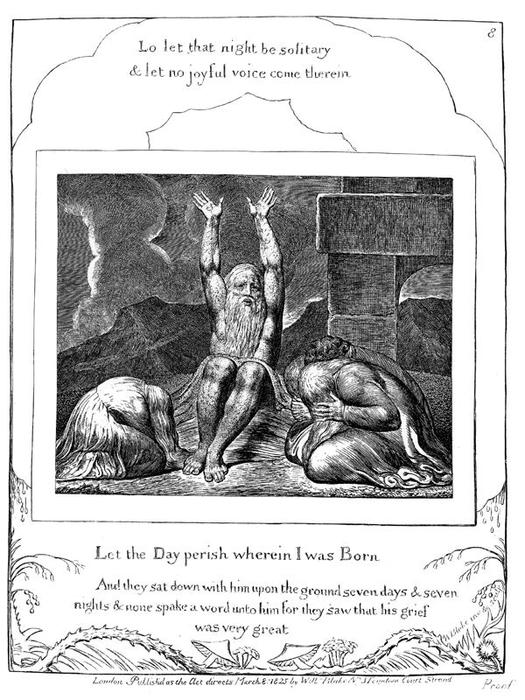
William Blake’s “Job’s Despair” stands as a cornerstone of Romantic art, encapsulating the era's preoccupation with profound emotion and spiritual questioning. Executed in black and white etching on paper around 1825, this artwork transcends mere visual representation; it embodies a visceral response to biblical narrative—specifically Job’s agonizing suffering following divine retribution.
- Artist: William Blake (British, London 1757–1827 London)
- Medium: Etching on Paper
- Dimensions: Unknown
- Date: Circa 1825
Blake’s masterful technique—characterized by meticulous hatching and cross-hatching—captures the bleakness of Job's predicament with breathtaking precision. Fine lines delineate forms, building up tonal values that convey not just visual appearance but also palpable sorrow. The border itself is ornate, reflecting Blake’s stylistic penchant for decorative embellishment and reinforcing the artwork’s formal grandeur.
Composition & Symbolism
The composition immediately commands attention with Job dominating the central plane, arms outstretched in supplication—a gesture laden with grief and desperation. Surrounding him are figures of comforters, arranged in poses mirroring his anguish, creating a dynamic interplay of emotion. Behind Job looms a monumental rectangular block, interpreted as representing divine judgment or perhaps an impenetrable barrier to solace.
Blake’s deliberate asymmetry contributes to the artwork's dramatic impact, while the border serves as a visual constraint, emphasizing the emotional core of the scene. Recurring motifs—such as swirling clouds and stylized drapery—further amplify the sense of turmoil and spiritual struggle.
Romantic Ideals & Blake’s Visionary Style
"Job's Despair" firmly establishes Blake as a champion of Romantic ideals: an unwavering belief in emotion, imagination, and the sublime. His distinctive style—marked by intricate line work and symbolic imagery—is evident throughout, mirroring his broader artistic mission to explore the depths of human experience and wrestle with existential questions.
Research into similar artworks like “Job’s Comforters” and “Job’s Evil Dreams 1” reveals Blake's consistent engagement with themes of faith, loss, and divine retribution. These pieces demonstrate his ability to transform biblical stories into emotionally resonant visual narratives—a testament to his enduring legacy as a visionary artist.
Historical Context & Artistic Influence
Created during the Romantic period (roughly 1798-1837), “Job’s Despair” reflects the broader cultural anxieties of its time – disillusionment with Enlightenment rationalism alongside an intensified interest in spirituality and emotion. Blake's etching stands as a precursor to later Expressionist explorations of psychological torment, cementing his position as a pivotal figure in art history.
Consider commissioning a high-quality reproduction of “Job’s Despair” to infuse your interior space with the artwork’s evocative atmosphere and profound symbolic depth. Its enduring power continues to inspire viewers today—a timeless masterpiece capturing the essence of human suffering and spiritual yearning.
Biografia do Artista
A Visionary’s Journey: The Life and Art of William Blake
William Blake, born in London on November 28, 1757, was a figure perpetually out of step with his time, yet destined to become one of the most celebrated artists and poets of the Romantic Age. His life unfolded against the backdrop of a rapidly changing England—a world grappling with industrialization, political upheaval, and shifting spiritual beliefs. From humble beginnings as the son of a hosier, Blake’s early years were marked by an intensely vivid imagination and a propensity for visionary experiences that would profoundly shape his artistic trajectory. Though largely self-taught in formal academics, he received drawing instruction at a young age, quickly revealing a talent that hinted at the extraordinary path ahead. His apprenticeship with engraver James Basire proved pivotal, providing him not only with technical mastery but also an understanding of printmaking techniques he would later revolutionize. These early influences—the Gothic grandeur of Westminster Abbey, the classical forms of Raphael and Michelangelo—served as foundational elements in his developing aesthetic, though Blake was never one to remain bound by convention.The Illuminated World: Technique and Innovation
Blake’s artistic innovation wasn't merely about subject matter; it resided fundamentally in *how* he created. Dissatisfied with conventional engraving methods, he developed a unique process known as “illuminated printing.” This involved etching both text and illustrations onto copper plates, then hand-coloring the resulting prints—a laborious but deeply personal approach that allowed for complete artistic control. This wasn’t simply illustration accompanying poetry; it was an integrated art form where image and verse were inextricably linked, each enhancing the meaning of the other. His relief etching technique, born from a claimed visionary experience following his brother's death, further distinguished his work, granting it a distinctive textural quality and allowing for greater artistic freedom than traditional methods. Beyond printmaking, Blake also worked with watercolors and tempera paints, often depicting biblical scenes or fantastical subjects imbued with symbolic weight. A key characteristic of his style was a deliberate rejection of linear perspective in favor of a more emotive, symbolic representation—a flattening of space that drew the viewer into the heart of his visionary world. He sought to capture not just what he saw but what he *felt*, channeling spiritual insight into every brushstroke and line of text.Themes of Innocence, Experience, and Rebellion
The core of Blake’s artistic output lies in its exploration of profound themes: the duality of innocence and experience, the constraints of reason versus the liberating power of imagination, and a fierce critique of societal norms.- Songs of Innocence and of Experience (1794), perhaps his most accessible work, presents a contrasting vision of childhood—one idyllic and untainted, the other marked by hardship and corruption.
- The Marriage of Heaven & Hell (1793) is a provocative prose poem that challenges conventional morality, celebrating energy, desire, and rebellion against restrictive doctrines.
- His illustrations for Dante’s *Divine Comedy* showcase his dramatic vision and ability to translate complex narratives into powerful visual imagery.
A Legacy Rediscovered: Blake's Enduring Influence
During his lifetime, William Blake remained largely marginalized, misunderstood by many of his contemporaries. His work was often dismissed as eccentric or even mad. He struggled financially throughout much of his life, relying on commissions and the support of a small circle of patrons like Thomas Butts. However, in the decades following his death on August 12, 1827, Blake’s reputation began to grow steadily. The Pre-Raphaelites, captivated by his visionary style and symbolic imagery, embraced him as a kindred spirit. Later movements—Symbolism and Modernism—found resonance in his emphasis on imagination, subjective experience, and spiritual themes. Today, William Blake is recognized as a pivotal figure in the Romantic movement, an artist whose work continues to inspire poets, painters, and thinkers across disciplines. His exploration of complex philosophical and religious ideas through art remains profoundly relevant, challenging us to question conventional wisdom and embrace the power of individual vision. Blake’s legacy isn't simply about his artistic achievements; it is about his unwavering commitment to creative freedom—a testament to the enduring power of imagination in a world often dominated by reason and constraint.
William Blake
1757 - 1827 , Reino Unido
Informações Rápidas
- Artistic Movement Or Style: Romantismo
- Artists Who Influenced This Artist:
- Rafael
- Michelangelo
- Date Of Birth: 1757
- Date Of Death: 1827
- Full Name: William Blake
- Nationality: Britânico
- Notable Artworks:
- Canções da Innocência e da Experiência
- O Casamento do Céu e do Inferno
- O Tigre
- Jerusalém
- Place Of Birth: Londres, Reino Unido
Artigos Relacionados
John Varley I: Intimate Observation & the British Romantic Landscape
Explore the serene landscapes of John Varley I, a key figure in British Romanticism. Discover his unique watercolour style, collaboration with William Blake & lasting artistic legacy. Learn about collecting Varley's work.

Sir William Blake Richmond: A Visionary of Aestheticism & Symbolism
Explore the life & art of Sir William Blake Richmond, a pivotal figure bridging Pre-Raphaelitism and Aestheticism. Discover his stunning portraits, mosaics at St Paul's Cathedral, and lasting influence on Victorian art.

Engraving: A Historical Survey of Technique, Artistic Expression & Enduring Legacy
Explore the rich history of engraving with OriginalUniqueArt. Discover techniques, iconic artists like Dürer & Callot, collecting tips, and expert guidance for preserving your art investment. Learn about intaglio printing & more!
As 10 Gravuras Mais Icônicas da História da Arte | OriginalUniqueArt
Descubra as 10 gravuras mais influentes da história, de Rembrandt a Goya! Explore a técnica, o contexto e a beleza atemporal dessas obras-primas. Encontre reproduções de alta qualidade para decorar sua casa com arte clássica em OriginalUniqueArt.com.

The Enduring Power of Illustration: A Historical Survey of Narrative Art & Visual Storytelling
Explore the rich history of illustration! From ancient cave paintings to Art Nouveau masterpieces, discover how visual storytelling has shaped culture. Expert insights & stunning examples.