Alternar para Impressão
 Ler mais







































 Para obras de arte ou reproduções com mais de 105 cm (aproximadamente 41 polegadas) em qualquer um dos lados, a moldura será enviada como um kit desmontado. Este método garante uma entrega segura e evita danos durante o transporte.


Victor ManBorn in Cluj-Napoca, Romania, in 1974.He lives and works in Berlin, Germany, and Cluj-Napoca.Only gradually does the eye find its bearings as the contours of the images emerge from the black, gray, and green tones of Victor Man’s intimate, small-format paintings. This gradual process of recognition transforms these images into a threshold, a place of transition into another, inner reality. The space that opens up under the cover of darkness within Man’s works leads viewers into a mysterious world that merges the mundane and the fantastical, mythology and fetish, individual experience and art-historical references, male and female, man and beast. This magical cosmos includes portraits and still lifes as well as beautiful, occult-like, and even erotic subjects. The paintings, attracting and drawing the viewer into their worlds, however, never provide explanations. Instead in their play of suggestions and references, the possibility is ever present to reverse their meaning in the eye of the viewer. In that sense a seemingly harmless still life depicting a bunch of slender, moderate branches in a vase, as in his Virgács (St. Nicolas) (2011), transforms into an object of fear after decoding the reference in the title to Saint Nicholas and his counterpart Krampus, who punishes those who have been bad. When Man draws from literary sources and art he usually favors sources that deal with the thresholds of human existence. The human body—transformed, constrained, tortured, amputated—is often at the center of his timeless and mysterious paintings. A recurring motif is that of decapitation: a seated figure, cut off at the neck by the painting’s format, holds a disembodied head in its lap. Whether the figure is female or male remains unclear. This motif evokes images of Judith and Holofernes or Salome and John the Baptist. The gender ambiguity of the main figure reveals Man’s interest in the Surrealists and their experiments with gender-bending imagery. Some of Man’s
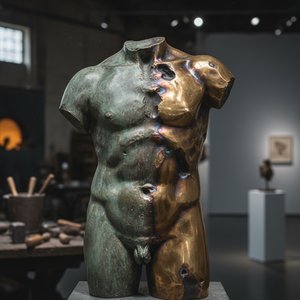
Victor Joseph DeManet (1895-1964) was a Belgian sculptor whose oeuvre embodies a profound engagement with psychological exploration and symbolic representation. Born in Brussels, Belgium, he achieved international acclaim for his distinctive approach to figurative sculpture, particularly his series “Luminary Petals on a Wet, Black Bough,” which captivated audiences at the Olympic Art Competitions of 1924, 1932 and 1936.
- Style: DeManet’s artistic vision leans heavily into Surrealism, characterized by dreamlike imagery and unsettling juxtapositions—a deliberate departure from traditional realism. He skillfully employs abstraction to convey emotional depth and psychological complexity.
- Technique: Primarily working in marble with gold leaf outlining, DeManet meticulously crafted his sculptures using a technique that demanded precision and patience. The delicate application of gold adds luminosity and textural richness to the stone surface, enhancing its visual impact.
The overarching thematic concern of “Luminary Petals” is rooted in explorations of human vulnerability and transformation—concepts frequently revisited by DeManet throughout his career. Recurring motifs include depictions of severed figures—often presented in a contemplative posture—holding disembodied heads, mirroring narratives from biblical tales like Judith and Holofernes and Salome.
The deliberate ambiguity surrounding the gender identity of the central figure underscores DeManet’s fascination with Surrealist aesthetics. This stylistic choice serves as a conduit for examining societal perceptions of masculinity and femininity, prompting viewers to contemplate the multifaceted nature of human experience.
Considered a pivotal figure in Belgian sculpture, Victor Man’s legacy resides not merely in his artistic accomplishments but also in his unwavering commitment to confronting existential anxieties through evocative imagery. His sculptures continue to inspire contemplation and provoke dialogue about themes of mortality, identity, and the subconscious—a testament to his enduring influence on modern art.
Perguntas e Respostas
Como "Sem título (após Giorgione)" se insere na trajetória artística de Victor Joseph Demanet?
"Sem título (após Giorgione)" compartilha com as outras obras de Victor Joseph Demanet o seu estilo Surrealist Symbolism e os temas recorrentes: surrealist references, mythological imagery, psychological exploration, ritualistic motifs, symbolic decapitation, artistic legacy, dark aesthetic, intense emotion.
Que tema e atmosfera combinam em "Sem título (após Giorgione)", de Victor Joseph Demanet?
"Sem título (após Giorgione)", de Victor Joseph Demanet retrata mythology, transformation, decapitation, symbolism, darkness, fear, ritual, em uma atmosfera Dramático. O tema e a ambientação descrevem, juntos, a obra.
Onde posso comprar reproduções pintadas à mão de "Sem título (após Giorgione)", de Victor Joseph Demanet?
Você pode encomendar uma reprodução pintada à mão de "Sem título (após Giorgione)", de Victor Joseph Demanet diretamente em sua página de Reprodução Pintada à Mão: uma reprodução a óleo pintada à mão sobre tela de linho, feita sob encomenda.
 Visualizar na parede
 Compartilhar
 Compartilhar
 Detalhes
 Guia
Guia

 Baixar imagem
 Semelhantes
 Raio X
 Ver diaporama
 Q&A
Q&A Estatísticas