

 Visualizar em escala
 Enviar
 Compartilhar
 Ver detalhes
 Guia de Obras do Aluno

 Baixar imagem
 Semelhantes
 Raio X
 Apresentação de slides
 Estatísticas
Night Snow in Kanbara, #16


 Ver mais
Reprodução em Óleo Feita à Mão
Óleo sobre tela pintado à mão no tamanho e moldura de sua escolha, feito sob encomenda pelos nossos artistas. ( Alternar para Impressão Ver Imagem Digital)




P118B $10

P118H $10

P118W $10

P438Z $10

P508JH $12

P508YH $12

P805H $10

P805Z $10

P919BZ $10

P919G $10

P919XJ $10

P959ZH $10

P968JZ $12

W106C $8

W218G $10

W218JH $8

W218Y $10

W307PJ $10

W316G $10

W316PJ $8

W316Y $10

W398PJ $8

W4111J $10

W500HY $15

W500JH $15

W692G $12

W849H $8

W940BG $15

W953PJ $8




Escolha entre os nossos tamanhos pré-definidos que respeitam as proporções originais da obra de arte.

Pode inserir as suas próprias dimensões para se adequar a uma moldura ou espaço específico. Se o tamanho selecionado não corresponder às proporções da imagem original, iremos cortar a obra de arte ou estender a pintura com elementos adicionais pintados à mão. Um esboço digital será enviado para sua aprovação antes do início da produção.
Tenha em atenção que a pré-visualização no ecrã não reflete o corte ou extensão real. Apenas o esboço mostrará com precisão a composição final.
Embora tamanhos personalizados estejam disponíveis, recomendamos selecionar uma dimensão da lista predefinida para preservar as proporções originais.
Após o pedido, a equipa OriginalUniqueArt.com enviará um e-mail ao cliente para solicitar instruções e fornecer uma prévia do esboço.
Entrega mundial () em 3 a 4 semanas, em vez das 5 semanas padrão. (25 Setembro). Sem comprometer a qualidade.

Envio expresso gratuito para todo o mundo

Tela de Linho Premium

Seguro de transporte total

Garantia de Reembolso de Impostos Alfandegários

Garantia de Fidelidade de Cor

Política de Devolução em 100 Dias (Apenas para Defeitos)

Garantia de reembolso de 100%

Desconto para múltiplas unidades
 A opção de vidro está disponível apenas para tamanhos inferiores a 110 cm

Night Snow in Kanbara, #16
Técnica de Reprodução
Dimensões da Reprodução
-


Preço Total
$ 300
A Winter's Embrace: Utagawa Hiroshige’s *Night Snow in Kanbara, #16*
Utagawa Hiroshige’s *Night Snow in Kanbara, #16*, created in 1834, is more than a depiction of a snowy Japanese landscape; it's a carefully constructed meditation on the beauty and resilience inherent in nature. Born Andō Tokutarō in Tokyo during a period of significant social and artistic transformation, Hiroshige’s journey from aspiring samurai to celebrated *ukiyo-e* master reveals a profound understanding of how to capture not just visual reality but also the emotional essence of a scene. This particular print, rendered in the classic Ukiyo-e style, transports us to a tranquil winter vista – a snow-dusted farmhouse nestled amongst towering pines and rolling hills, a scene brimming with quiet industry and timeless serenity.
- Subject Matter: The artwork centers on a quintessential rural Japanese tableau. A farmer diligently carries firewood, livestock graze peacefully in the foreground, and a traditional dwelling stands as a symbol of enduring community.
- Composition & Technique: Hiroshige masterfully employs a horizontal layout to emphasize the expansive snowy terrain, utilizing layered lines to create depth and perspective – a hallmark of Ukiyo-e’s approach to representing three-dimensional space on a two-dimensional surface. The geometric shapes—rectangles for the house, rounded hills—are simplified forms that contribute to the print's overall clarity and balance.
The Art of *Ukiyo-e*: Woodblock Printing and Poetic Vision
*Ukiyo-e*, meaning “pictures of the floating world,” flourished in Edo (Tokyo) during the 17th to 19th centuries, offering a vibrant snapshot of Japanese life. This print exemplifies the technique’s core principles: carving intricate designs into wooden blocks, applying dense layers of ink, and then pressing paper onto the block to create an image. The grainy texture, born from this meticulous process, adds a tactile quality to the artwork, hinting at the physical labor involved in its creation. Hiroshige's skill lies not just in replicating a scene but in imbuing it with a poetic sensibility – a characteristic that elevated *ukiyo-e* beyond mere illustration and established it as a respected art form.
Historical Context: Night Snow in Kanbara, #16 was created during a period of relative peace and prosperity under the Tokugawa shogunate. However, this era also witnessed increasing Western influence, which ultimately contributed to the decline of *ukiyo-e*. Despite these challenges, Hiroshige’s work continued to resonate with audiences, securing his place as one of Japan's most beloved artists.Symbolism and Emotional Resonance
The muted palette of whites, grays, and blacks, punctuated by subtle greens, evokes a sense of quiet contemplation. The scene’s stillness—the snow-covered landscape, the unhurried movements of the farmer—creates an atmosphere of profound peace. Symbolically, *Night Snow in Kanbara, #16* speaks to themes of winter's resilience, the beauty of nature, and the enduring spirit of rural life. It is a reminder that even amidst harsh conditions, there exists a quiet dignity and harmony.
- Atmospheric Perspective: Hiroshige skillfully utilizes atmospheric perspective – diminishing detail and color in the distance – to create a convincing illusion of depth and space.
- Symbolic Elements: The farmer carrying firewood represents hard work and self-sufficiency, while the livestock symbolize prosperity and abundance.
A Timeless Masterpiece for Your Collection
This hand-painted reproduction captures the essence of Hiroshige’s artistic vision with exceptional detail and fidelity. Perfect for adorning a study, living room, or gallery space, *Night Snow in Kanbara, #16* offers a window into Edo Japan and a timeless celebration of nature's beauty. Its serene composition and evocative imagery make it an ideal addition to any art collection or interior design scheme.
Biografia do Artista
A Poetic Vision of Edo Japan: The Life and Art of Utagawa Hiroshige
Utagawa Hiroshige, born Andō Tokutarō in 1797 in the bustling city of Edo (modern Tokyo), stands as a pivotal figure in the world of *ukiyo-e*, or “pictures of the floating world.” Though deeply rooted in the traditions of Japanese woodblock printing, Hiroshige transcended mere replication, imbuing his landscapes with a poetic sensibility that resonated profoundly both within Japan and, later, across the Western art world. His life unfolded during a period of relative peace and prosperity under the Tokugawa shogunate, yet also one marked by increasing social change and eventual westernization – forces that would ultimately contribute to the decline of *ukiyo-e* even as they amplified Hiroshige’s enduring legacy. Initially destined for a more conventional path within a samurai family—his father served as a fire warden—Hiroshige's artistic inclinations led him to apprenticeship under Utagawa Toyohiro, a master of the Utagawa school. This proved a crucial turning point, steering him away from the popular depictions of courtesans and actors favored by many *ukiyo-e* artists toward a focus on landscape, a genre he would ultimately redefine.From Genre Scenes to Evocative Landscapes
Hiroshige’s early work adhered to the conventions of his school, featuring portraits and scenes from daily life. However, it was his embrace of landscape that truly distinguished him. Influenced by earlier masters like Hokusai—whose *Thirty-six Views of Mount Fuji* had already captivated audiences—Hiroshige developed a unique style characterized by atmospheric perspective, subtle color palettes, and a profound sensitivity to the changing seasons. He didn’t merely depict places; he evoked their mood, capturing the essence of a particular moment in time. The series *The Fifty-three Stations of the Tōkaidō* (1833–1834), perhaps his most celebrated achievement, exemplifies this approach. This monumental work documented the journey along the Tōkaidō road, the main route connecting Edo and Kyoto, not as a straightforward travelogue but as a series of evocative vignettes—a sudden rain shower at Shono, a distant view of Mount Fuji from Kanaya, the bustling activity at Odawara. Each print is imbued with a sense of transience and quiet beauty, inviting viewers to experience the journey alongside the travelers. He masterfully employed *bokashi*, a technique involving multiple impressions to create subtle gradations of color, adding depth and atmosphere to his compositions. The use of layered blocks allowed him to build up complex textures and tonal variations, creating an illusion of three-dimensionality that was remarkably effective in capturing the nuances of light and shadow.A Master of Atmosphere and Technique
Hiroshige’s technical skill was as remarkable as his artistic vision. He wasn't simply interested in accurate representation; he sought to capture the *feeling* of a place. His use of color, though often restrained compared to some of his contemporaries, was crucial in achieving this effect. He frequently employed multiple blocks for a single color, allowing him to create nuanced shades and atmospheric effects that were incredibly difficult to replicate. The delicate washes of blue in his depictions of rain or mist, the warm hues of autumn foliage—these weren’t accidental; they were carefully considered elements designed to evoke specific emotions and sensations. Beyond *bokashi*, Hiroshige was adept at utilizing blank space – *ma* – a concept central to Japanese aesthetics, allowing areas of the print to “breathe” and enhancing the overall sense of tranquility. His series *One Hundred Famous Views of Edo* (1856–1858) further showcased his mastery, offering intimate glimpses into the life and landscapes of his beloved city. These prints weren’t simply depictions of buildings and streets; they were carefully constructed compositions that captured the energy and dynamism of Edo’s urban sprawl.Influence and Legacy
Hiroshige's work profoundly impacted both Japanese and Western art. His innovative use of color, atmospheric perspective, and his focus on capturing fleeting moments resonated with artists like Hokusai, whose *Thirty-Six Views of Mount Fuji* shared a similar aesthetic sensibility. The popularity of Hiroshige’s landscapes contributed to the rise of *Japonisme* in Europe during the late 19th century, inspiring Impressionist painters such as Monet and Degas to explore new ways of representing light, color, and atmosphere. Vincent van Gogh was particularly captivated by Hiroshige's prints, creating numerous copies that demonstrated his deep admiration for the Japanese master’s ability to convey emotion through landscape. Hiroshige’s legacy extends beyond individual artists; he helped establish landscape printmaking as a respected genre within *ukiyo-e*, paving the way for future generations of artists to explore this medium. His work continues to be celebrated today for its beauty, elegance, and profound sense of atmosphere.Notable Works
- The Fifty-three Stations of the Tōkaidō: Hiroshige’s most famous series, depicting the journey along the main road between Edo and Kyoto.
- One Hundred Famous Views of Edo: A captivating portrayal of life and landscapes in his beloved city.
- Influence on Vincent van Gogh's Japonaiserie Series: Including “Flowering Plum Tree after Hiroshige,” demonstrating Van Gogh’s deep admiration for the Japanese master.

Hiroshige
1797 - 1858 , Japão
Informações Rápidas
- Artistic Movement Or Style: *Ukiyo-e*
- Artists Or Movements Influenced By This Artist:
- Manet
- Monet
- Van Gogh
- Artists Who Influenced This Artist: ['Hokusai']
- Date Of Birth: 1797
- Date Of Death: 1858
- Full Name: Utagawa Hiroshige
- Nationality: Japonesa
- Notable Artworks:
- Cinquenta e três Estações do Tōkaidō
- Cem Vistas Famosas de Edo
- Place Of Birth: Tokyo, Japão
Artigos Relacionados

Katsushika Hokusai: As 25 Obras-Primas que Definem um Mestre da Arte Japonesa
Descubra as 25 obras-primas de Katsushika Hokusai, o mestre do ukiyo-e! Explore a história por trás de 'A Grande Onda' e outras gravuras japonesas icônicas. Encontre reproduções de arte exclusivas para decorar sua casa com elegância em OriginalUniqueArt.com.
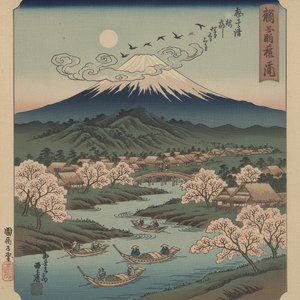
Ukiyo-e's Poetic Visionary: Hiroshige Ando & the Transformation of Landscape in 19th-Century Japan
Explore the life & art of Ando Hiroshige, Japan's last great ukiyo-e master. Discover his iconic landscapes, poetic style, and profound influence on Western Impressionism. Learn about The Fifty-Three Stations & more!
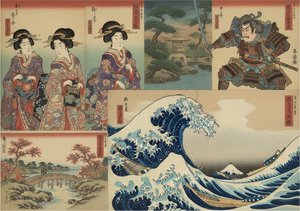
Ukiyo-e: Exploring Japan's Floating World & Enduring Artistic Legacy
Explore the captivating world of Ukiyo-e – Japan's iconic woodblock prints! Discover masters like Hokusai & Hiroshige, learn about Edo period culture, and find expert art collecting guidance at OriginalUniqueArt.

Floating Worlds: The Captivating Magic and Timeless Legacy of Japanese Ukiyo-e Art
Explore the ephemeral beauty of Japanese Ukiyo-e art. From the dynamic warriors of Kuniyoshi to serene landscapes, discover the profound history, masterful techniques, and global influence of these iconic woodblock prints in our deep cultural retrospective.
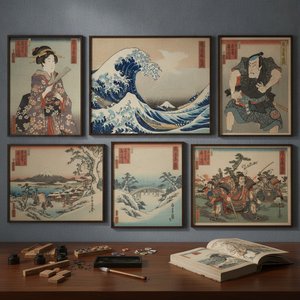
Ukiyo-e: The Art of the Floating World and the Legacy of Japanese Woodblock Masters
Explore the profound history of Ukiyo-e, from Hokusai's iconic waves to the vibrant culture of Edo Japan. Discover the intricate craft of woodblock printing and the enduring legacy of these Japanese masterpieces through our expert art history guide.


