American Realism · 1891
Weda Cook (Thomas Eakins, 1891)
Thomas Eakins (1844–1916) criou Weda Cook. Data de 1891. Pertence ao movimento American Realism. É feito em Oil On Canvas.
- 1891
- Oil On Canvas

 Visualizar na parede

 Pintura a Óleo Feita à Mão
 Compartilhar
 Compartilhar
 Ficha técnica


 Baixar imagem
 Semelhantes
 Raio X
 Ver diaporama
 Perguntas e Respostas

 Estatísticas
Weda Cook, em resumo
- Título
- Weda Cook
- Artista
- Thomas Eakins (1844–1916)
- Artista nascido em
- Filadélfia, Estados Unidos
- Data
- 1891
- Técnica
- Oil On Canvas
- Movimento
- American Realism
- Período
- 19th Century
- Tema
- portrait, woman, pink dress, eakins style, 19th century, american art
O que Weda Cook retrata?
The Unflinching Gaze: Capturing Modernity in Thomas Eakins' Weda Cook
To stand before Thomas Eakins’ Weda Cook is not merely to observe a portrait; it is to confront a moment of profound, unvarnished reality. Painted in 1891, this oil on canvas transcends the simple act of likeness, offering instead a deep psychological study wrapped in the elegance of late Victorian fashion. Eakins, the master of American realism, possessed an almost scientific dedication to capturing the human form and spirit with breathtaking accuracy. The subject herself, Weda Cook, is rendered with a poise that seems both natural and meticulously composed. Her long hair cascades around her shoulders, framing a face that meets the viewer’s gaze with an intensity that refuses easy interpretation. It is this directness—this refusal to simply smile for posterity—that makes the painting such a compelling piece of art history.
Technique and The Art of Realism
Eakins' technical mastery in Weda Cook is evident in every visible brushstroke. He was a proponent of realism, eschewing the romantic flourishes that sometimes characterized his contemporaries for something far more grounded: truth. Observe the texture of the pink dress; Eakins has managed to convey the weight and drape of the fabric while simultaneously suggesting its delicate nature. The handling of light across her skin is masterful, giving her complexion a luminous quality that seems almost alive. This attention to detail—the subtle shading around the eyes, the precise rendering of the hair strands—speaks to an artist who studied anatomy as rigorously as he studied composition. For those interested in acquiring a reproduction, understanding this commitment to visible technique allows one to appreciate the painstaking effort required to translate such depth onto canvas.
Historical Echoes and Social Portraiture
The late 19th century was a period of immense social flux in America, and Eakins chronicled that change through his subjects. Weda Cook serves as a beautiful artifact from this era, capturing the societal expectations placed upon women while simultaneously celebrating their individual presence. The seriousness etched into her expression suggests a woman of substance, perhaps navigating the complex currents of turn-of-the-century society. Unlike idealized portraits meant solely for vanity, Eakins’ work feels engaged with the world around him—a testament to the dignity found in everyday American life. It invites us to consider not just who she was, but what it meant to be a woman of her standing during that transformative time.
Emotional Resonance and Interior Placement
Emotionally, the painting resonates with a quiet power. There is an undeniable gravity emanating from Weda Cook that draws the viewer in, compelling them to look closer, to decipher the meaning behind that steady gaze. For collectors or interior designers seeking art that anchors a space with intellectual weight, Weda Cook offers more than mere decoration; it offers conversation. Imagine this piece gracing a formal drawing-room or a sophisticated study—its presence would lend an air of cultivated history and thoughtful depth to the surroundings. It is a work that demands contemplation, rewarding the viewer with layers of observation upon every viewing.
Imagens em alta resolução de Weda Cook

Thomas Eakins, Weda Cook (1891). Domínio público.
Perguntas sobre Weda Cook respondidas
Em que ano foi criado "Weda Cook", de Thomas Eakins?
"Weda Cook", de Thomas Eakins foi criado em 1891.
Qual é a técnica utilizada em "Weda Cook", de Thomas Eakins?
A técnica de "Weda Cook", de Thomas Eakins é Oil On Canvas. As reproduções visam reproduzir a aparência desta técnica.
O que representa "Weda Cook"?
"Weda Cook", de Thomas Eakins retrata: portrait, woman, pink dress, eakins style, 19th century, american art.
"Weda Cook", de Thomas Eakins está em domínio público?
Quanto aos direitos autorais, "Weda Cook" está em em domínio público — seus direitos autorais expiraram.
Quem criou "Weda Cook"?
O artista por trás de "Weda Cook" é Thomas Eakins. A obra está catalogada sob o nome de Thomas Eakins.
A qual movimento artístico "Weda Cook", de Thomas Eakins pertence?
O movimento associado a "Weda Cook", de Thomas Eakins é American Realism. Esta classificação situa a obra entre artistas e obras de arte relacionados.
A que período da carreira de Thomas Eakins pertence "Weda Cook"?
Dentro da trajetória de Thomas Eakins, "Weda Cook" pertence ao período Mature Period. Esta fase permite compará-la com outras obras do artista.
Qual era a idade de Thomas Eakins ao criar "Weda Cook" em 1891?
Quando "Weda Cook" foi criada em 1891, Thomas Eakins — nascido(a) em 1844 — tinha 47 anos.
Por que o status de direitos autorais de "Weda Cook" é como é?
"Weda Cook", de Thomas Eakins está em em domínio público — seus direitos autorais expiraram. O período de direitos autorais conta a partir do falecimento do artista, ocorrido em 1916.
Sobre o artista, Thomas Eakins

1844–1916, Estados Unidos
Thomas Eakins
A Vida de Thomas Eakins Nascido em Filadélfia, Pensilvânia, em 25 de julho de 1844, Thomas Eakins viveu uma existência profundamente enraizada na cidade de seu nascimento. Ele foi um homem de múltiplas disciplinas, atuando como pintor, fotógrafo, escultor e educador de belas artes. Embora seus interesses frequentemente o levassem ao exterior em busca de estudos, a geografia de sua existência permaneceu, em grande parte, centrada na Filadélfia. Ele transitou pelos círculos intelectuais e sociais da cidade, observando as pessoas e as realidades físicas que definiam a paisagem local.
Também de Thomas Eakins
 A Clínica da Grossa1875
 Natação1885
 Max Schmitt na Canoa Simples1871
 Portrait of Samuel Murray1889
Ensaios sobre Weda Cook
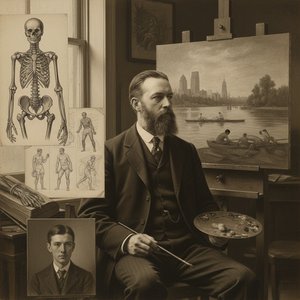 Thomas Eakins: Realism, Anatomy & the American Spirit – A Comprehensive Exploration of Life and LegacyExplore the life & legacy of Thomas Eakins, a pivotal American Realist painter. Discover his groundbreaking techniques, anatomical precisio…
 Mastering Reality: A Definitive Guide to the Timeless Elegance of Academic RealismExplore the profound beauty of Academic Realism. Discover the technical mastery, historical significance, and timeless techniques that defi…
 The Emotional Resonance of Wall Art: Elevating Interior Design from Aesthetic to Experiential LuxuryDiscover how curated wall art transforms interiors into emotionally resonant experiences. Explore the psychology of color, bespoke commissi…