Contemporary Realism · 1900
Frank Jay St. John (Thomas Eakins, 1900)
Thomas Eakins (1844–1916) criou Frank Jay St. John. Data de 1900. Pertence ao movimento Contemporary Realism. É feito em Oil On Canvas. Está conservada no Fine Arts Museums of San Francisco, em São Francisco, Estados Unidos da América.
- 1900
- Oil On Canvas
- Fine Arts Museums of San Francisco, São Francisco

 Visualizar na parede

 Pintura a Óleo Feita à Mão
 Compartilhar
 Compartilhar
 Ficha técnica


 Baixar imagem
 Semelhantes
 Raio X
 Ver diaporama
 Perguntas e Respostas

 Estatísticas
Frank Jay St. John, em resumo
- Título
- Frank Jay St. John
- Artista
- Thomas Eakins (1844–1916)
- Artista nascido em
- Filadélfia, Estados Unidos
- Data
- 1900
- Técnica
- Oil On Canvas
- Onde ver
- Fine Arts Museums of San Francisco, São Francisco, Estados Unidos da América
- Movimento
- Contemporary Realism
- Período
- 19th Century
- Tema
- portraiture, intellectualism, observation, anatomy, interior, reflection
O que Frank Jay St. John retrata?
The Anatomy of a Soul: Eakins’s Unflinching Realism
In the quiet, shadowed corners of art history, few works possess the psychological weight and anatomical precision found in Thomas Eakins’s 1900 masterpiece, Frank Jay St. John. This portrait is far more than a mere recording of a man’s likeness; it is a profound exploration of character, rendered through the lens of an artist who sought to bridge the gap between scientific observation and emotional truth. As one of the most significant figures in American Realism, Eakim approached his canvas with the meticulous eye of a surgeon, a trait that is palpably present in every brushstroke of this evocative piece. The painting captures St. John not in a moment of performative grandeur, but in a state of quiet introspection, inviting the viewer to peer into the very essence of his being.
The composition is masterfully orchestrated to create a sense of subtle tension and depth. St. John sits within a chair positioned diagonally across the canvas, a choice that breaks the static nature of traditional portraiture and introduces a dynamic visual energy. His posture—legs crossed and body slightly slumped—speaks volumes about the subject's temperament, suggesting a man comfortable in his own skin yet lost in deep thought. This physical presence is anchored by a subdued, somber color palette dominated by rich blacks, deep browns, and earthy tones. These dark hues do not merely serve as a backdrop; they sculpt the contours of St. John’s form, emphasizing the weight of his limbs and the intellectual gravity of his expression.
Symbolism and the Passage of Time
Beyond the immediate visual impact, Frank Jay St. John is layered with symbolic nuances that reward the attentive observer. The choice of black attire is far from accidental; in the context of Eakins’s era, such clothing served as a visual shorthand for intellect, seriousness, and social standing. This sartorial decision reinforces the portrait's atmosphere of solemnity and dignity. Even the background elements are carefully curated to deepen the narrative. Two framed pictures hang upon the wall behind him, acting as windows into a broader, unseen world, while their placement subtly directs the viewer’s gaze back toward the central figure.
Perhaps most poignant is the inclusion of a clock, tucked near the top left corner of the composition. This small but significant detail serves as a memento mori, a gentle yet persistent reminder of the relentless passage of time. It elevates the painting from a static portrait to a philosophical meditation on mortality and the fleeting nature of human existence. For the collector or the interior designer, this layer of meaning provides an intellectual depth that transforms a piece of decor into a conversation starter—a window into the complexities of the human condition that remains as relevant today as it was at the turn of the twentieth century.
A Timeless Addition to the Modern Interior
For those seeking to curate a space defined by sophistication and historical resonance, a high-quality reproduction of this Eakins masterpiece offers unparalleled inspiration. The painting’s ability to command attention through subtlety rather than spectacle makes it an ideal centerpiece for a variety of refined settings. Whether placed in a scholarly study, a quiet library, or a contemporary living space, the work brings with it an aura of contemplative elegance and academic prestige.
The texture of the oil on canvas, even when captured through masterful reproduction, retains that essential "fleshiness" and light-catching quality that Eakins was so famous for. To possess such a work is to invite the spirit of American Realism into one's home—a commitment to honesty, beauty, and the enduring power of the human gaze. It is an investment not just in art, but in an atmosphere of profound, quiet strength.
Em qual museu se encontra Frank Jay St. John?
Fine Arts Museums of San Francisco
São Francisco, Estados Unidos da América
A História dos Fine Arts Museums of San Francisco A trajetória dos Fine Arts Museums of San Francisco teve o seu início com a fundação da instituição em 1871. Ao longo das décadas, este legado expandiu-se através da abertura do de Young Museum, em 1895, e da Legion of Honor, em 1924. Durante várias décadas, estas duas entidades distintas operaram de forma independente, até que, em 1972, foram formalmente unificadas sob a liderança de Ian McKibbin White, consolidando uma visão artística partilhada.


Imagens em alta resolução de Frank Jay St. John

Thomas Eakins, Frank Jay St. John (1900), Fine Arts Museums of San Francisco. Domínio público.
Perguntas sobre Frank Jay St. John respondidas
Onde posso ver a obra original "Frank Jay St. John", de Thomas Eakins?
A obra original "Frank Jay St. John" pode ser vista no Fine Arts Museums of San Francisco, São Francisco, Estados Unidos da América.
Em que ano foi criado "Frank Jay St. John"?
"Frank Jay St. John", de Thomas Eakins foi criado em 1900.
Qual é a técnica utilizada em "Frank Jay St. John", de Thomas Eakins?
"Frank Jay St. John" é executada em Oil On Canvas.
O que "Frank Jay St. John", de Thomas Eakins retrata?
Os temas de "Frank Jay St. John" são portraiture, intellectualism, observation, anatomy, interior, reflection, detail, composition.
A imagem de "Frank Jay St. John", de Thomas Eakins pode ser reproduzida livremente?
Quanto aos direitos autorais, "Frank Jay St. John" está em em domínio público — seus direitos autorais expiraram.
Quem criou "Frank Jay St. John"?
"Frank Jay St. John" foi criado por Thomas Eakins. As informações nesta página descrevem a obra original de Thomas Eakins.
A qual estilo pertence "Frank Jay St. John"?
"Frank Jay St. John", de Thomas Eakins pertence ao movimento Contemporary Realism. Este movimento fornece o contexto estilístico da obra.
A que período da carreira de Thomas Eakins pertence "Frank Jay St. John"?
"Frank Jay St. John" pertence ao Mature Period da carreira de Thomas Eakins. Esta classificação relaciona a obra ao desenvolvimento do artista.
Qual era a idade de Thomas Eakins ao criar "Frank Jay St. John" em 1900?
Thomas Eakins tinha 56 anos quando criou "Frank Jay St. John" em 1900. A idade é calculada a partir do ano de nascimento do artista, 1844.
Sobre o artista, Thomas Eakins

1844–1916, Estados Unidos
Thomas Eakins
A Vida de Thomas Eakins Nascido em Filadélfia, Pensilvânia, em 25 de julho de 1844, Thomas Eakins viveu uma existência profundamente enraizada na cidade de seu nascimento. Ele foi um homem de múltiplas disciplinas, atuando como pintor, fotógrafo, escultor e educador de belas artes. Embora seus interesses frequentemente o levassem ao exterior em busca de estudos, a geografia de sua existência permaneceu, em grande parte, centrada na Filadélfia. Ele transitou pelos círculos intelectuais e sociais da cidade, observando as pessoas e as realidades físicas que definiam a paisagem local.
Também de Thomas Eakins
 A Clínica da Grossa1875
 Natação1885
 Max Schmitt na Canoa Simples1871
 Portrait of Samuel Murray1889
Ensaios sobre Frank Jay St. John
 American contemporary realist paintersMasterpieces by Chuck Close and Amy Sherald define American contemporary realism. Explore the full collection online at OriginalUniqueArt.c…
 The Two Johns: Distinguishing the Iconography of Saint John the Baptist and the Evangelist in Western ArtMaster the subtle iconography of Saint John the Baptist and the Evangelist. Explore these Renaissance masters with our expert guide.
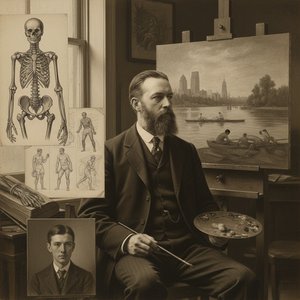 Thomas Eakins: Realism, Anatomy & the American Spirit – A Comprehensive Exploration of Life and LegacyExplore the life & legacy of Thomas Eakins, a pivotal American Realist painter. Discover his groundbreaking techniques, anatomical precisio…