Obter pintura a óleo
 Tudo sobre Venus e Adonis







































 Para obras de arte ou reproduções com mais de 105 cm (aproximadamente 41 polegadas) em qualquer um dos lados, a moldura será enviada como um kit desmontado. Este método garante uma entrega segura e evita danos durante o transporte.


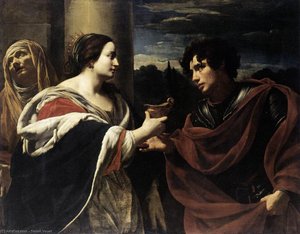
Venus and Adonis: A Baroque Symphony of Desire and Mortality
Simon Vouet’s “Venus and Adonis,” completed in 1642, transcends mere depiction; it embodies the very essence of French Baroque art—a masterful fusion of Italian influences and profound emotional resonance. This iconic scene from Ovid's *Metamorphoses* captures the pivotal moment where Venus attempts to persuade Adonis to abandon his pursuit of hunting, foreshadowing his tragic fate. Vouet doesn’t simply portray mythology; he delves into universal themes of love, longing, and the inevitable passage of time with breathtaking sensitivity.Style & Technique: The Dramatic Embrace of Tenebrism
Vouet's artistic vision was decisively shaped by the Italian Baroque tradition, particularly the pioneering work of Caravaggio. Observe how Vouet employs tenebrism—a technique characterized by stark contrasts between light and dark—to amplify the scene’s dramatic intensity. The figures emerge from a shadowy forest backdrop illuminated by strategically positioned shafts of light that sculpt Adonis' muscular physique and accentuate Venus’s flowing drapery, drawing the viewer’s eye directly to their expressive faces. Vouet’s brushwork is remarkably fluid and graceful, demonstrating an unparalleled understanding of anatomy and perspective—skills honed during his formative years in Rome where he absorbed the stylistic innovations of masters like Guido Reni and Carracci.Historical Context: A Shift Towards Emotion and Grandeur
The seventeenth century witnessed a significant transformation within French artistic sensibilities. Prior to Vouet’s arrival, French art leaned towards Mannerism—a style marked by stylized forms and intellectual abstraction. However, Vouet’s return to Paris in 1627 as “Premier Peintre du Roi” signaled a decisive move toward the Baroque's embrace of dynamism and emotional fervor. Commissioned by Louis XIII, this monumental painting reflects the aristocratic tastes of the era—a preference for mythological subjects rendered with opulent grandeur and imbued with spiritual contemplation. It stands as a testament to Vouet’s role in establishing French Baroque as a dominant artistic force.Symbolism: The Dance Between Eros and Thanatos
Beyond its technical brilliance, “Venus and Adonis” is laden with symbolic significance. Venus embodies feminine beauty and sensual desire—a force attempting to persuade Adonis, representing youthful vigor and earthly pleasures, to forsake his dangerous obsession. The forest setting symbolizes the wilderness of human passions and the vulnerability inherent in confronting mortality. Vouet’s masterful composition reinforces this duality, positioning the figures within a carefully orchestrated interplay of light and shadow that underscores the tragic inevitability of Adonis' demise—a poignant reminder of the ephemeral nature of earthly beauty and joy.Emotional Impact: Capturing the Sublime
Vouet succeeds in conveying an overwhelming sense of emotion – awe and melancholy – capturing what Edmund Burke termed “the sublime.” The painting compels viewers to confront uncomfortable truths about desire, loss, and the inescapable grip of fate. Its luminous colors and dramatic lighting heighten the visual impact, transporting us back to 17th-century France and immersing us in the artistic fervor of its time. "Venus and Adonis" remains a timeless masterpiece, continuing to inspire admiration for its beauty and provoke contemplation on the complexities of human experience.Perguntas e Respostas
Venus e Adonis é uma pintura feita à mão ou uma impressão?
Pintada à mão: um pintor profissional reproduz Venus e Adonis em óleo sobre tela de linho.
Qual tamanho devo escolher para Venus e Adonis?
Os tamanhos variam de 37.1 x 26.9 cm (€178) a 247.1 x 179.4 cm (€1459); a tabela nesta página lista as principais opções e seus respectivos preços.
Qual é o prazo de entrega?
O prazo de entrega é de 4 a 5 semanas, com envio expresso gratuito para todo o mundo; uma opção de produção urgente está disponível nesta página. Você pode devolvê-la em até 100 dias para obter o reembolso total, sem qualquer condição.
Onde está a obra original Venus e Adonis?
O original faz parte da coleção do J. Paul Getty Museum, Los Angeles.
Qual técnica Simão Vouet utilizou em Venus e Adonis?
Acrílico sobre tela
 Visualizar na parede

 Compartilhar
 Compartilhar
 Detalhes
 Ficha técnica


 Baixar imagem
 Semelhantes
 Raio X
 Ver diaporama
 Perguntas e Respostas

 Estatísticas