Visualizar na parede
 Compartilhar
 Compartilhar
 Detalhes
 Guia
Guia

 Baixar imagem
 Semelhantes
 Raio X
 Ver diaporama
 Estatísticas
Les Amoureux de l


 Ler mais
A obra de arte exibida nesta página é protegida por leis de direitos autorais, o que significa que não podemos criar ou vender legalmente uma reprodução idêntica. Esta proteção é aplicada por meio de acordos internacionais, tais como a Convenção de Berna e pelas leis nacionais, incluindo as estabelecidas por Lei de Direitos Autorais dos EUA - Título 17.
Como uma alternativa respeitosa e legal, oferecemos obras de arte personalizadas e pintadas à mão, inspiradas na obra original. Nossos artistas profissionais e experientes estudam cuidadosamente o estilo, a atmosfera e a essência artística da obra original para criar uma peça nova e única que evoque a mesma sensação — permanecendo como uma criação original por direito próprio.
Este método cumpre plenamente as regulamentações de direitos autorais, pois não envolve a cópia ou duplicação da obra protegida. Em vez disso, trata-se de uma reinterpretação criativa — uma nova pintura que é influenciada pela original, mas não idêntica a ela.
Reprodução em Óleo Feita à Mão
Óleo sobre tela pintado à mão no tamanho e moldura de sua escolha, feito sob encomenda pelos nossos artistas. ( Alternar para Impressão Alternar para Imagem Digital)




P118B €10

P118H €10

P118W €10

P438Z €10

P508JH €12

P508YH €12

P805H €10

P805Z €10

P919BZ €10

P919G €10

P919XJ €10

P959ZH €10

P968JZ €12

W106C €8

W218G €10

W218JH €8

W218Y €10

W307PJ €10

W316G €10

W316PJ €8

W316Y €10

W398PJ €8

W4111J €10

W500HY €15

W500JH €15

W692G €12

W849H €8

W940BG €15

W953PJ €8




Escolha entre os nossos tamanhos pré-definidos que respeitam as proporções originais da obra de arte.

Insira a largura e a altura desejadas para se ajustarem à sua moldura ou parede. Como esta obra é pintada à mão, para um tamanho com proporções diferentes, o artista poderá pintar um pouco mais ao redor da imagem ou reduzir ligeiramente a composição — você escolhe. Enviamos uma maquete digital para sua aprovação antes de iniciar a pintura. A imagem exibida nesta página não representa o resultado real — apenas a maquete mostra o resultado final.
Após o pedido, a equipa OriginalUniqueArt.com enviará um e-mail ao cliente para solicitar instruções e fornecer uma prévia do esboço.
Entrega mundial () em 3 a 4 semanas, em vez das 5 semanas padrão. (26 Outubro). Sem comprometer a qualidade.

Envio expresso gratuito para todo o mundo

Tela de Linho de Alta Qualidade

Seguro de transporte completo

Garantia de Reembolso de Impostos Alfandegários

Garantia de Fidelidade Cromática

Política de Devolução em 100 Dias (Apenas para Defeitos)

Garantia de reembolso de 100%

Oferta de desconto por quantidade
 A opção de vidro está disponível apenas para tamanhos inferiores a 110 cm

Les Amoureux de l
Técnica de Reprodução
Tamanho da Reprodução
-


Preço Total
€ 285
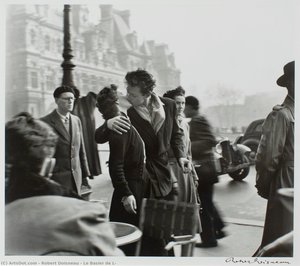
Les Amoureux de l'Opera: A Parisian Moment Frozen in Time
Robert Doisneau’s “Les Amoureux de l’Opera” transcends mere photographic documentation; it embodies the spirit of postwar Paris—a city grappling with optimism and melancholy, yearning for connection amidst urban anonymity. Captured in 1950, this iconic image depicts a young couple embracing on the steps of Hôtel de Ville (City Hall), bathed in diffused daylight that lends an ethereal quality to the scene.
- Composition & Perspective: Doisneau skillfully employs a slightly low angle perspective, emphasizing the grandeur of Hôtel de Ville and drawing the viewer upwards towards its imposing façade. Diagonal lines created by the staircase intersect with horizontal lines formed by the building’s walls, guiding the eye across the frame and establishing a dynamic visual rhythm.
- Technical Mastery: The photograph's brilliance lies in Doisneau’s masterful use of slow shutter speed—a technique known as ‘motion blur.’ This deliberate manipulation captures fleeting movement, transforming the blurred figures in the background into streaks of light that heighten the image’s sense of immediacy and transient beauty.
- Color Palette & Texture: Entirely monochrome, “Les Amoureux de l’Opera” utilizes a subtle tonal range—ranging from deep blacks to bright whites—to convey mood and atmosphere. The smooth surface of the stone steps contrasts with the softer texture created by the blurred figures, adding depth and tactile interest to the composition.
Historical Context & Artistic Style
Doisneau’s work emerged from a period marked by significant social change in France following World War II. He was part of a generation that embraced documentary photography as a means of portraying everyday life and capturing the emotional resonance of ordinary experiences. Doisneau's style aligns with the principles of humanist realism—a movement characterized by its commitment to depicting human subjects truthfully and sympathetically, often focusing on marginalized communities.
Symbolism & Emotional Resonance
"Les Amoureux de l’Opera" speaks powerfully to themes of love, intimacy, and vulnerability. The couple's embrace symbolizes connection amidst the bustling cityscape—a poignant reminder that even in moments of isolation, human relationships endure. Doisneau’s deliberate use of motion blur underscores the ephemeral nature of time and experience, inviting viewers to contemplate the beauty found within fleeting instants.
Influence & Legacy
Doisneau's photograph has become a symbol of Parisian charm and romantic idealism. It continues to inspire artists and designers alike—serving as a testament to Doisneau’s ability to transform ordinary scenes into unforgettable images that capture the essence of human emotion and artistic vision. Its enduring popularity underscores its significance within the broader canon of twentieth-century art.
Perguntas e Respostas
Qual tamanho de impressão devo escolher para "Les Amoureux de l" no meu quarto?
A combinação recomendada para "Les Amoureux de l", de Robert Doisneau: uma impressão de Grande em um(a) Sala de Estar.
Qual é a luminosidade percebida de "Les Amoureux de l", de Robert Doisneau?
No geral, "Les Amoureux de l" é registrado como equilibrada. A luminosidade percebida descreve o quão clara ou escura a obra parece ser.
A que movimento e a que época pertence "Les Amoureux de l", de Robert Doisneau?
"Les Amoureux de l" pertence ao movimento Documentary Photography, e seu criador atuou na era Modern.
Biografia do Artista
A Parisian Chronicler: The Life and Legacy of Robert Doisneau
Robert Doisneau, born in Gentilly, France, in 1912, wasn’t merely a photographer; he was a visual poet of the streets, a chronicler of everyday life who captured the heart and soul of post-war Paris with an unparalleled blend of humanism, irony, and playful observation. His journey began amidst personal hardship – orphaned at a young age, raised by an unloving aunt – yet it blossomed into a career that celebrated the resilience and charm of the human spirit. Initially drawn to the technical arts, Doisneau trained in engraving and lithography at the École Estienne, skills that would later inform his compositional eye. However, it was the allure of the streets, the spontaneous narratives unfolding before him, that truly ignited his artistic passion. He began tentatively, reportedly photographing cobblestones to overcome initial shyness, gradually building confidence to capture the lives of children and adults in their natural environment.From Advertising to Artistic Vision
Doisneau’s early career was a pragmatic blend of necessity and opportunity. He navigated the world of advertising, working first as a draughtsman at Atelier Ullmann and later as a photographer for Renault. While these roles provided financial stability, they also fueled his growing interest in people and their interactions. His time at Renault, though ultimately cut short by his habitual tardiness, proved formative, exposing him to the possibilities of photography beyond mere commercial application. The late 1930s saw him join the Rapho photographic agency, a pivotal moment that allowed him to pursue street photography more seriously. This period coincided with the looming shadow of World War II, and Doisneau’s life took on another layer of complexity as he served in the French army and actively participated in the Resistance, utilizing his skills to forge documents for those fleeing persecution. It was a time of immense risk and moral responsibility, shaping his commitment to documenting the lives of ordinary people with dignity and respect.The Humanist Lens: Style and Influences
Doisneau’s photographic style is instantly recognizable – a masterful blend of candid observation, carefully composed framing, and a gentle, often ironic, perspective. He wasn't interested in grand narratives or dramatic events; instead, he found beauty and meaning in the mundane, the fleeting moments of everyday life. Influenced by masters like André Kertész, Eugène Atget, and Henri Cartier-Bresson, Doisneau developed his own unique voice, one that prioritized human connection over technical perfection. He possessed an extraordinary ability to anticipate and capture decisive moments, often with a touch of humor or whimsy. His work frequently features amusing juxtapositions, contrasting social classes, and eccentric characters, all set against the backdrop of bustling Parisian streets and cafes. Le Baiser de l'Hôtel de Ville (The Kiss by the Town Hall), his most iconic image from 1950, perfectly encapsulates this approach – a spontaneous moment of intimacy amidst the chaos of city life, an enduring symbol of love and freedom. He famously stated, “The marvels of daily life are so exciting; no movie director can arrange the unexpected that you find in the street.”A Legacy of Empathy and Observation
Throughout his career, Doisneau consistently championed the overlooked and marginalized. He had a particular fondness for children, portraying their play with seriousness and respect, recognizing their inherent dignity and freedom from adult constraints. His photographs offer a poignant glimpse into a post-war Paris rebuilding itself, grappling with social change, yet retaining its unique charm and spirit. While he briefly experimented with fashion photography for Vogue, his heart remained on the streets, capturing the authentic pulse of Parisian life. Despite receiving an invitation to join Magnum Photos from Henri Cartier-Bresson, Doisneau chose to remain with Rapho, valuing the agency’s independence and allowing him greater creative freedom. He was appointed a Chevalier (Knight) of the Legion of Honour in 1984, a testament to his significant contribution to French culture. Robert Doisneau passed away in 1994, leaving behind a vast body of work that continues to inspire and captivate audiences worldwide. His photographs are not simply records of a time and place; they are enduring celebrations of the human condition, reminding us to find beauty and meaning in the everyday moments that shape our lives.
Robert Doisneau
1922 - 1994 , France
Dados Rápidos
- Full Name: Robert Doisneau
- Nationality: French
- Date Of Birth: 1922
- Date Of Death: 1994
- Place Of Birth: Gennevilliers, France
- Notable Artworks: ["Le Baiser de l'hôtel de ville"]
- Artistic Movement Or Style: Humanist photography
- Artists Who Influenced This Artist:
- André Kertész
- Eugène Atget
- Henri Cartier-Bresson
Artigos Relacionados
Shadow & Soul: Why Black & White Photography Remains the Ultimate Power Move in Modern Art
Discover why black & white photography remains a powerful force in contemporary art. Explore the impact of light, shadow, and texture through a visual journey of monochrome mastery and learn how to elevate your space with timeless grayscale aesthetics.
Timeless Shadows: The Artistry, History, and Emotional Resonance of Black and White Photography
Explore the profound artistry of black and white photography. From historical mastery to the interplay of light and shadow, discover how monochrome captures timeless emotion and form through a sophisticated lens of art history.

Monochrome Visions: Exploring the Aesthetic & Historical Significance of Black & White Photography
Explore the rich history & artistic power of black and white photography. From early techniques to iconic masters like Ansel Adams, discover why monochrome continues to captivate art lovers today. Expert insights for collectors.
Beyond Color: The Timeless Power and Artistry of Black and White Photography
Explore the profound artistry of black and white photography. From the chemistry of gelatin silver to the chiaroscuro of the Old Masters, discover how monochrome captures the eternal essence of light, form, and emotion for the discerning art collector.

Os 10 Quadros Mais Famosos Dominados pelo Branco: Arte e Decoração
Descubra os 10 quadros mais famosos dominados pelo branco, de Monet a Kandinsky! Explore a história da arte, técnicas e o poder da paleta neutra. Encontre reproduções de alta qualidade para sua decoração em OriginalUniqueArt.com.