Orphism · 1939
Rythm (Robert Delaunay, 1939)
Robert Delaunay (1885–1941) criou Rythm. Data de 1939. Pertence ao movimento Orphism. É feito em Oil On Canvas. Está conservada no Museu de Arte Moderna da Cidade de Paris, em Paris, França.
- 1939
- Oil On Canvas
- Museu de Arte Moderna da Cidade de Paris

 Visualizar na parede

 Pintura a Óleo Feita à Mão
 Compartilhar
 Compartilhar
 Ficha técnica


 Baixar imagem
 Semelhantes
 Raio X
 Ver diaporama
 Perguntas e Respostas

 Estatísticas
Rythm, em resumo
- Título
- Rythm
- Artista
- Robert Delaunay (1885–1941)
- Artista nascido em
- Paris, França
- Data
- 1939
- Técnica
- Oil On Canvas
- Onde ver
- Museu de Arte Moderna da Cidade de Paris, Paris, França
- Movimento
- Orphism
- Período
- Modern
- Tema
- circle, pattern, shapes, spiral, swirl, colors
O que Rythm retrata?
The Composition of Form and Color
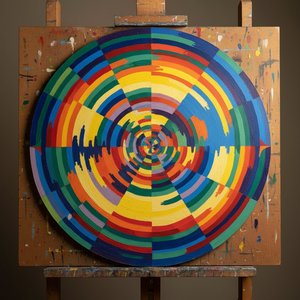
The painting Rythm, dated 1939, presents a central circular structure composed of intersecting geometric shapes and varied color segments. This primary circle is divided into multiple sections, each containing distinct patterns and internal designs. Smaller circles are nested within the larger circular framework, creating a layered effect of concentricity. Two additional circles appear in the periphery: one in the upper right corner and another in the lower left corner. The arrangement of these shapes suggests a spiral or a swirling motion. The surface is characterized by a variety of hues that interact through their proximity, creating a sense of movement across the canvas.
The technique relies on the application of color to define form rather than using line to outline recognizable objects. The artist utilizes the principles of Orphism, focusing on the interaction of light and chromatic intensity. The shapes are not static; they are organized to create a visual rhythm through the interplay of curves and counter-curves. This method uses the physical action of looking to activate the vision, as the eye moves between the contrasting colors and the varying thicknesses of the circular discs.
Historical Context and Artistic Intent
Created in 1939, this work belongs to a period when the artist had moved toward a more radical, non-objective form of abstraction. This phase of production followed a return to the circular forms that characterized earlier explorations of harmony. The composition reflects a departure from figurative subjects, focusing instead on the expressive potential of color alone. The organization of these shapes and their spatial relationships determine the visual tempo of the piece.
The work is situated within the School of Paris movement. It reflects a theoretical interest in how color functions as an active force capable of shaping perception. By utilizing contrasting complementary colors, such as red and green or blue and orange, the painting creates a synchromic effect. This approach seeks to move beyond the representation of the physical world, aiming instead to establish a direct connection between the viewer's eye and the agitation of light and color.
Em qual museu se encontra Rythm?
Museu de Arte Moderna da Cidade de Paris
Paris, França
Um Importante Museu Municipal em Paris O Museu de Arte Moderna da Cidade de Paris é um importante museu municipal localizado no número 11 da Avenue du Président Wilson, no 16º arrondissement de Paris. A instituição é dedicada ao estudo e à preservação da arte moderna e contemporânea dos séculos XX e XXI. Desde 1 de janeiro de 2013, a instituição é um dos 14 museus da Cidade de Paris incorporados à instituição pública Paris Musées.


Imagens em alta resolução de Rythm

Robert Delaunay, Rythm (1939), Museu de Arte Moderna da Cidade de Paris. Domínio público.
Perguntas sobre Rythm respondidas
Onde posso ver a obra original "Rythm", de Robert Delaunay?
A obra original "Rythm" pode ser vista no Museu de Arte Moderna da Cidade de Paris, Paris, França.
Em que ano foi criada a obra "Rythm", de Robert Delaunay?
"Rythm", de Robert Delaunay foi criado em 1939.
Qual técnica foi utilizada em "Rythm", de Robert Delaunay?
Robert Delaunay utilizou a técnica de Oil On Canvas para "Rythm". A técnica define a natureza material da obra original.
Quais temas aparecem em "Rythm", de Robert Delaunay?
"Rythm", de Robert Delaunay retrata: circle, pattern, shapes, spiral, swirl, colors.
"Rythm", de Robert Delaunay está em domínio público?
"Rythm", de Robert Delaunay está em em domínio público — seus direitos autorais expiraram. Este status determina como a imagem da obra pode ser reproduzida.
Quem é o artista por trás de "Rythm"?
O artista por trás de "Rythm" é Robert Delaunay. A obra está catalogada sob o nome de Robert Delaunay.
A qual estilo pertence "Rythm"?
"Rythm", de Robert Delaunay pertence ao movimento Orphism. Este movimento fornece o contexto estilístico da obra.
A que fase da trajetória de Robert Delaunay "Rythm" pertence?
Dentro da trajetória de Robert Delaunay, "Rythm" pertence ao período Late Period. Esta fase permite compará-la com outras obras do artista.
Qual era a idade de Robert Delaunay quando "Rythm" foi criada?
Robert Delaunay criou "Rythm" aos 54 anos. O artista nasceu em 1885 e a obra data de 1939.
Sobre o artista, Robert Delaunay

1885–1941, França
Robert Delaunay
Um Pioneiro da Cor Abstrata: A Vida e a Arte de Robert Delaunay Robert Delaunay, nascido em Paris em 1885, emergiu como uma figura fundamental nas mudanças artísticas radicais do início do século XX. Embora inicialmente atraído por formas mais tradicionais de pintura, sua jornada o conduziu a uma exploração da cor e da luz que acabaria por definir seu legado e contribuir significativamente para o nascimento da arte abstrata. Delaunay não estava interessado apenas em representar o mundo; ele buscava capturar sua própria essência através de uma linguagem vibrante de formas geométricas e tons luminosos, cofundando o movimento Orfismo com sua esposa, Sonia Delaunay, e outros que compartilhavam de sua visão. Sua vida precoce foi marcada por certa instabilidade – seus pais se divorciaram quando ele era jovem e ele foi criado por parentes – mas isso talvez tenha fomentado um espírito independente que lhe seria útil ao desafiar as convenções artísticas.
Também de Robert Delaunay
 A Cidade de Paris1912
 Torre Eiffel1914
 The Eiffel Tower1910
 Window1912

Ensaios sobre Rythm
 Orphism: A Symphony of Color and Form – Exploring the Abstract Roots of Modern ArtExplore Orphism, the vibrant abstract art movement pioneered by Robert & Sonia Delaunay. Discover its unique color theory, lasting influenc…
 Mastering Abstraction: The Top 25 Essential Works by Wassily KandinskyExplore 25 iconic Kandinsky masterpieces and the birth of abstraction. Discover the full collection online at OriginalUniqueArt.com.
 Sonia Delaunay: A Life in Color – Exploring the Rhythms of Abstraction and SynesthesiaExplore the vibrant world of Sonia Delaunay, a pioneer of abstract art and co-founder of Orphism. Discover her revolutionary use of color, …