

 Visualizar na parede
 Compartilhar
 Compartilhar
 Detalhes
 Guia
Guia

 Baixar imagem
 Semelhantes
 Raio X
 Ver diaporama
 Q&A
Q&A Estatísticas
Landscape (Wanaka)
 Watercolor
- WallArt
- Impressionism
 1939
1939 22.0 x 27.0 cm
 Te Papa
 Ler mais
A obra de arte exibida nesta página é protegida por leis de direitos autorais, o que significa que não podemos criar ou vender legalmente uma reprodução idêntica. Esta proteção é aplicada por meio de acordos internacionais, tais como a Convenção de Berna e pelas leis nacionais, incluindo as estabelecidas por Lei de Direitos Autorais dos EUA - Título 17.
Este método cumpre plenamente as regulamentações de direitos autorais, pois não envolve a cópia ou duplicação da obra protegida. Em vez disso, trata-se de uma reinterpretação criativa — uma nova pintura que é influenciada pela original, mas não idêntica a ela.
Giclée / Impressão de Arte
Impressão giclée ou em tela de qualidade de museu, com produção rápida e opções flexíveis de acabamento. ( Comprar pintura feita à mão Alternar para Imagem Digital)




P118B €10

P118H €10

P118W €10

P438Z €10

P508JH €12

P508YH €12

P805H €10

P805Z €10

P919BZ €10

P919G €10

P919XJ €10

P959ZH €10

P968JZ €12

W106C €8

W218G €10

W218JH €8

W218Y €10

W307PJ €10

W316G €10

W316PJ €8

W316Y €10

W398PJ €8

W4111J €10

W500HY €15

W500JH €15

W692G €12

W849H €8

W940BG €15

W953PJ €8




Escolha entre os nossos tamanhos pré-definidos que respeitam as proporções originais da obra de arte.

Insira a largura e a altura desejadas para se ajustarem à sua moldura ou parede. Uma impressão pode ser apenas cortada, nunca ampliada além da imagem original; portanto, um tamanho com proporções diferentes resultará na perda de parte da imagem. Enviamos uma maquete digital para sua aprovação antes de realizarmos a impressão. A imagem exibida nesta página não mostra o corte real — apenas a maquete o faz.
Entrega mundial () em 2 semanas, em vez das 4/5 semanas padrão. (30 Outubro)

Envio expresso gratuito para todo o mundo

Tela de Linho de Alta Qualidade

Seguro de transporte completo

Garantia de Reembolso de Impostos Alfandegários

Garantia de Fidelidade Cromática

Política de Devolução em 100 Dias (Apenas para Defeitos)

Garantia de reembolso de 100%

Oferta de desconto por quantidade
 A opção de vidro está disponível apenas para tamanhos inferiores a 110 cm

Landscape (Wanaka)
Giclée / Impressão de Arte
Tamanho da Reprodução
-


Preço Total
€ 71
A Moment Frozen in Time: Rita Angus’s “Landscape (Wanaka)”
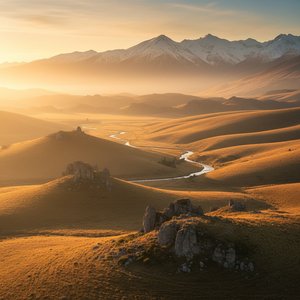
Rita Angus's "Landscape (Wanaka)," painted in 1939, isn’t merely a depiction of a New Zealand vista; it’s a carefully constructed meditation on light, memory, and the profound connection between humanity and the natural world. Captured with her signature hard-edged style – a deliberate rejection of Impressionism's hazy atmosphere – Angus presents a remarkably precise yet deeply felt portrayal of the Wanaka landscape. The painting immediately draws the eye to the rolling tussock hills, rendered in fluid washes of color that suggest both the ruggedness and the surprising softness of the terrain. The purple-tinged mountain ranges in the distance aren’t simply sketched; they're imbued with a sense of ethereal mystery, hinting at the vastness and timelessness of the region.
Angus’s technique is particularly noteworthy. She employs a wet-on-wet watercolor approach, layering translucent washes to build up form and texture. The deliberate use of white paper – leaving sections untouched with unpainted areas – creates a dynamic interplay between color and void, adding a surprising element of lightness and highlighting the delicate structure of the landscape. These ‘holes’ in the paint aren't accidental; they are integral to Angus’s vision, acting as visual punctuation marks that draw attention to key elements and contribute to the painting’s overall sense of immediacy. The fine lines meticulously capturing trees and a distant fence suggest an almost obsessive attention to detail, balanced by the broader, more atmospheric treatment of the hills and mountains.
A Pioneer's Perspective: Contextualizing Angus’s Vision
To fully appreciate “Landscape (Wanaka),” it’s essential to understand Rita Angus’s place in New Zealand art history. Born in 1908, she emerged as a leading figure during a period of intense artistic experimentation and national identity formation. Following her father's work as a construction manager, Angus spent much of her childhood moving between Palmerston North and Napier, an experience that instilled in her a keen observational eye and a sense of independence. Her early training at the Canterbury College School of Art laid the foundation for her distinctive style, influenced by movements like Cubism and Byzantine art – influences she skillfully integrated into her own unique vision.
The painting was created during a time of significant social and political change in New Zealand. The Great Depression loomed large, and there was a growing desire to define a distinctly ‘New Zealand’ aesthetic—one that moved beyond European artistic traditions. Angus's work, with its focus on the landscape and its rejection of romanticized notions of beauty, can be seen as part of this broader movement. Her decision to sign her paintings as Rita McKenzie after a personal upheaval reflects a deliberate assertion of agency and control over her own identity and artistic legacy.
Symbolism in the Landscape: More Than Meets the Eye
Beyond its purely visual appeal, “Landscape (Wanaka)” is rich with symbolic meaning. The vast expanse of green pasture, punctuated by white flowers, evokes a sense of abundance and fertility – a direct reference to the pastoral traditions of New Zealand. The distant mountains, rendered in cooler tones, represent permanence and stability, anchoring the scene within a broader historical context. The carefully placed picket fence, a seemingly minor detail, serves as a subtle reminder of human presence and intervention within this wild landscape.
Furthermore, the painting’s stark clarity can be interpreted as a response to the uncertainties of the era. Angus's deliberate rejection of atmospheric perspective—flattening the depth of field—suggests a desire to confront reality head-on, rather than softening it with illusionistic techniques. The painting isn’t simply about depicting a beautiful scene; it’s about capturing a specific moment in time and conveying a complex range of emotions – from tranquility and serenity to a sense of quiet contemplation.
Bringing “Landscape (Wanaka)” into Your Space
Reproductions of Rita Angus's "Landscape (Wanaka)" offer a remarkable opportunity to bring this evocative artwork into your home or office. The painting’s bold colors, sharp lines, and dynamic composition create a striking visual impact that will undoubtedly become a focal point in any room. The interplay between color and white space adds depth and dimension, while the meticulous detail invites close inspection and contemplation.
Whether you're an art collector seeking to expand your collection or simply looking for a piece of artwork that embodies New Zealand’s unique beauty and artistic spirit, “Landscape (Wanaka)” is a truly exceptional choice. Its timeless appeal and profound emotional resonance ensure that it will continue to captivate viewers for generations to come.
Perguntas e Respostas
Quanta luz as cores de "Landscape (Wanaka)" parecem refletir?
A luminância registrada para "Landscape (Wanaka)", de Rita Angus é Bright Balance.
Posso usar realidade aumentada para ver "Landscape (Wanaka)", de Rita Angus no meu ambiente?
"Landscape (Wanaka)" possui uma prévia em realidade aumentada: a página de Prévia em RA da obra permite visualizá-la no seu próprio espaço através de um dispositivo compatível.
Como posso obter uma versão digital de "Landscape (Wanaka)", de Rita Angus?
Para obter uma versão digital de "Landscape (Wanaka)", de Rita Angus, peça download de imagem digital em alta resolução em sua página Imagem Digital de Alta Resolução.
Biografia do Artista
A Pioneering Vision: The Life and Art of Rita Angus
Rita Angus, a name synonymous with bold vision and uncompromising artistic expression, remains one of the most significant figures in New Zealand’s 20th-century art landscape. Born on March 12, 1908, in Hastings, her life unfolded as a vibrant tapestry woven from nomadic experiences, personal upheaval, and an unwavering dedication to capturing the essence of both the external world and the depths of her own soul. From a childhood marked by frequent relocations due to her father’s carpentry work – a constant shifting of landscapes and identities – emerged an artist with a uniquely observant eye and a spirit fiercely independent. As the eldest of seven children, Rita demonstrated early artistic talent, receiving private lessons that nurtured a passion she would carry throughout her life. Her formal training at Palmerston North Girls' High School from 1922 to 1926 provided a foundational grounding in traditional techniques – life drawing, still-life composition, and landscape painting – under the guidance of skilled instructors who recognized and encouraged her burgeoning abilities. This early education, however, was merely the prelude to a journey of self-discovery and artistic evolution that would ultimately define her singular style.Forging a Distinctive Style: Influences and Innovation
The years following her departure from Palmerston North were pivotal in shaping Rita Angus’s distinctive artistic voice. Her marriage in 1930 to fellow artist Alfred Cook, though initially promising, proved tragically short-lived, dissolving in separation and divorce five years later. This period of personal turbulence coincided with a remarkable surge in her artistic recognition within the Canterbury Society of Arts, where she began exhibiting portraits and landscapes that quickly garnered attention for their unconventional approach. It was during these formative years that Angus began to break free from traditional representational styles, embracing a modernist aesthetic characterized by clear, hard-edged forms, simplified shapes, and a vibrant, emotionally charged color palette. Influenced profoundly by the art of the Renaissance and Medieval periods – particularly the meticulous detail and symbolic depth of Flemish masters – she combined these influences with the radical experimentation of early 20th-century movements like Cubism and Byzantine art. The work of Christopher Perkins, an English painter known for his evocative depictions of New Zealand landscapes, served as another crucial touchstone, inspiring her to capture the unique qualities of light and atmosphere in the region. Crucially, Angus wasn’t simply imitating these influences; she was synthesizing them into a wholly original style – one that prioritized personal vision and emotional expression over strict adherence to academic conventions. Her art became a reflection of her inner world, a visual exploration of love, humanity, and the complexities of existence.Landscapes of the Soul and Portraits of Identity
The 1930s and 1940s witnessed the blossoming of Angus’s artistic maturity, as she continued to explore both the external landscapes of Canterbury and Otago and the internal landscape of her own psyche. Paintings like *Cass* (1936), a deceptively simple depiction of a small railway station, became an enduring symbol of her style – a testament to her ability to distill complex ideas into strikingly clear and evocative forms. During this period, she also created a powerful series of “goddess” paintings (*Rutu*, among them), imbued with symbolic meaning and reflecting her pacifist beliefs. These works weren’t merely representations of figures; they were meditations on themes of strength, resilience, and the interconnectedness of humanity. Her portraiture, equally compelling, moved beyond mere likeness to capture the essence of her subjects – their personalities, emotions, and inner lives. Angus's skill lay in her ability to reveal something profound about a person through a single glance, a subtle gesture, or an arresting expression. Her portraits became intimate windows into the souls of those she depicted, offering glimpses of vulnerability, strength, and quiet dignity.Legacy and Enduring Influence
The later years of Rita Angus’s life were marked by personal challenges, including mental illness that led to hospitalization in the late 1940s. Despite these difficulties, her artistic spirit remained undimmed, and she continued to paint with remarkable intensity until her death on January 25, 1970, in Wellington. While recognition for her work came later than it might have, Rita Angus’s legacy has grown exponentially over the decades. Her paintings are now celebrated not only for their artistic merit but also for their pioneering spirit and unwavering commitment to personal vision. The preservation of her former home in Wellington as the Rita Angus Cottage – a space dedicated to artist residency – stands as a lasting tribute to her life and work, ensuring that future generations will continue to be inspired by her unique perspective. Rita Angus’s art remains a powerful testament to the transformative power of creativity, reminding us that true beauty lies not just in representation but in the expression of our deepest emotions and experiences. Her commitment to art, coupled with her profound belief in its power to express peace, humanity, and individual identity, ensures that her work will resonate with audiences for years to come.
Rita Angus
1908 - 1970 , Nova Zelândia
Dados Rápidos
- Artistic Movement Or Style: Modernismo, Regionalismo
- Artists Who Influenced This Artist: ['Christopher Perkins']
- Date Of Birth: 12 Mar 1908
- Date Of Death: 25 Jan 1970
- Full Name: Henrietta Catherine Angus
- Nationality: Neozelandesa
- Notable Artworks:
- Cass (1936)
- Rutu
- Central Otago
- Fay Birkinshaw
- Place Of Birth: Hastings, Nova Zelândia
Artigos Relacionados

Ephemeral Visions: Exploring the Artistic Legacy & Contemporary Practice of Watercolor Painting
Explore the captivating world of watercolor painting! Discover its rich history, essential techniques, influential artists & collecting tips. A comprehensive guide for art enthusiasts from OriginalUniqueArt.

Aquarelas Imortais: 10 Obras-Primas que Revolucionaram a Arte | OriginalUniqueArt
Descubra as 10 obras-primas em aquarela que revolucionaram a arte! Explore a história de Turner, Cézanne e outros mestres. Encontre reproduções de alta qualidade para decorar sua casa com elegância. OriginalUniqueArt: arte atemporal ao seu alcance.

Ephemeral Visions: Exploring the History & Emotional Resonance of Watercolor Painting
Explore the captivating history of watercolor painting, from ancient techniques to modern masters like Kandinsky & Blake. Discover essential artists, collecting tips & the emotional power of this luminous medium. Expert insights for art enthusiasts.

Ephemeral Visions: Exploring the Artistic Legacy & Nuances of Watercolor Painting
Explore the captivating world of watercolor painting! Discover its rich history, essential techniques, influential artists & collecting tips from art experts. A comprehensive guide for enthusiasts.
Grahame Sydney: Evoking Otago's Soul Through Light & Landscape
Explore the captivating landscapes of Sir Grahame Sydney, a leading New Zealand artist renowned for his magic realism & evocative depictions of Otago's beauty. Discover key works and delve into his artistic legacy.