Menu
Text size

() ·

A painting made for you, by hand

Retrato de Agnolo Doni

Reprodução em Óleo Feita à Mão

Óleo sobre tela pintado à mão no tamanho e moldura de sua escolha, feito sob encomenda pelos nossos artistas. ( Alternar para Impressão Alternar para Imagem Digital)

Descrição do Item

Uma obra-prima renascentista de Rafael! Explore o retrato de Agnolo Doni, suas influências artísticas e o contexto histórico da Florença do século XVI na Pitti Palace.

Biografia do Artista

Rafael: Mestre da Renascença Italiana, conhecido por suas Madonas serenas e obras-primas como "A Escola de Atenas". Explore sua vida em Urbino e seu legado artístico inigualável.

from ·

Chapter 1

How large should it be?

Slide to change the size; the picture on the left shows the frame at its real width. The proportions of the original are kept.

Tamanho padrão
personalizado
CM
INCH

Escolha entre os nossos tamanhos pré-definidos que respeitam as proporções originais da obra de arte.

largura
altura

Insira a largura e a altura desejadas para se ajustarem à sua moldura ou parede. Como esta obra é pintada à mão, para um tamanho com proporções diferentes, o artista poderá pintar um pouco mais ao redor da imagem ou reduzir ligeiramente a composição — você escolhe. Enviamos uma maquete digital para sua aprovação antes de iniciar a pintura. A imagem exibida nesta página não representa o resultado real — apenas a maquete mostra o resultado final.

Chapter 2

How should it arrive?

Choose the edges of the stretched canvas

Choose your frame

Corner sample of the WhiteWrap canvas edge finish, stretched on madeira maciça bars
White €1
Corner sample of the BlurSideWrap canvas edge finish, stretched on madeira maciça bars
Blurside €1
Corner sample of the ExtendedWrap canvas edge finish, stretched on madeira maciça bars
Extended €1
Corner sample of the P118B picture frame: poliestireno moldado, 5 cm wide and 3 cm thick
P118B €10
Corner sample of the P118H picture frame: poliestireno moldado, 5 cm wide and 3 cm thick
P118H €10
Corner sample of the P118W picture frame: poliestireno moldado, 5 cm wide and 3 cm thick
P118W €10
Corner sample of the P438Z picture frame: poliestireno moldado, 5.5 cm wide and 3.5 cm thick
P438Z €10
Corner sample of the P508JH picture frame: poliestireno moldado, 7 cm wide and 3.5 cm thick
P508JH €12
Corner sample of the P508YH picture frame: poliestireno moldado, 7 cm wide and 3.5 cm thick
P508YH €12
Corner sample of the P805H picture frame: poliestireno moldado, 5 cm wide and 3.5 cm thick
P805H €10
Corner sample of the P805Z picture frame: poliestireno moldado, 5 cm wide and 3.5 cm thick
P805Z €10
Corner sample of the P919BZ picture frame: poliestireno moldado, 7 cm wide and 3.5 cm thick
P919BZ €10
Corner sample of the P919G picture frame: poliestireno moldado, 7 cm wide and 3.5 cm thick
P919G €10
Corner sample of the P919XJ picture frame: poliestireno moldado, 7 cm wide and 3.5 cm thick
P919XJ €10
Corner sample of the P959ZH picture frame: poliestireno moldado, 5 cm wide and 3 cm thick
P959ZH €10
Corner sample of the P968JZ picture frame: poliestireno moldado, 6 cm wide and 4 cm thick
P968JZ €12
Corner sample of the W106C picture frame: madeira maciça, 5 cm wide and 3 cm thick
W106C €8
Corner sample of the W218G picture frame: madeira maciça, 5 cm wide and 3 cm thick
W218G €10
Corner sample of the W218JH picture frame: madeira maciça, 5 cm wide and 3 cm thick
W218JH €8
Corner sample of the W218Y picture frame: madeira maciça, 5 cm wide and 3 cm thick
W218Y €10
Corner sample of the W307PJ picture frame: madeira maciça, 6 cm wide and 3 cm thick
W307PJ €10
Corner sample of the W316G picture frame: madeira maciça, 6 cm wide and 3 cm thick
W316G €10
Corner sample of the W316PJ picture frame: madeira maciça, 6 cm wide and 3 cm thick
W316PJ €8
Corner sample of the W316Y picture frame: madeira maciça, 6 cm wide and 3 cm thick
W316Y €10
Corner sample of the W398PJ picture frame: madeira maciça, 5 cm wide and 3 cm thick
W398PJ €8
Corner sample of the W4111J picture frame: madeira maciça, 6.5 cm wide and 3.5 cm thick
W4111J €10
Corner sample of the W500HY picture frame: madeira maciça, 7 cm wide and 5 cm thick
W500HY €15
Corner sample of the W500JH picture frame: madeira maciça, 7 cm wide and 5 cm thick
W500JH €15
Corner sample of the W692G picture frame: madeira maciça, 8 cm wide and 4 cm thick
W692G €12
Corner sample of the W849H picture frame: madeira maciça, 5 cm wide and 3 cm thick
W849H €8
Corner sample of the W940BG picture frame: madeira maciça, 7.5 cm wide and 4.5 cm thick
W940BG €15
Corner sample of the W953PJ picture frame: madeira maciça, 6 cm wide and 3.5 cm thick
W953PJ €8
Corner sample of the H24-GOLD picture frame: madeira entalhada com gesso, 10 cm wide and 6 cm thick
H24-GOLD €30
Corner sample of the H24-SILVER picture frame: madeira entalhada com gesso, 10 cm wide and 6 cm thick
H24-SILVER €30
Corner sample of the H36-GOLD picture frame: madeira entalhada com gesso, 15 cm wide and 6.5 cm thick
H36-GOLD €45
Corner sample of the H36-SILVER picture frame: madeira entalhada com gesso, 15 cm wide and 6.5 cm thick
H36-SILVER €45
Prévia da moldura
Com moldura

Moulding: . Overall size with the frame: .

Chapter 3

Who paints it, and should anything change?

Examples of what can be changed: Replace face with customer photo; Add pet (e.g., replace cat with dog); Include hidden message in background; Change background landscape or elements.
After order, OriginalUniqueArt.com team will email client for instructions and provide a mockup preview

Entrega mundial () em 3 a 4 semanas, em vez das 5 semanas padrão. (31 Outubro). Sem comprometer a qualidade.

Chapter 4

The finishing touches

A nameplate, as in a museum?

Detalhes da Placa de Bronze Gravada

This elegant plaque features the artist's name and the title of the artwork, finely engraved for a timeless presentation.

It is made from bronze with a refined, elegant finish. The text is precisely laser-engraved for a sharp and permanent result. Measuring 9x2 cm, the plaque is compact yet easy to read. It's built to be durable and scratch-resistant, offering a professional, museum-quality look. Mounting is simple thanks to the included adhesive backing.

Detalhes da Placa de Acrílico Transparente

The plaque includes essential engraved details such as the artist's name, the title of the artwork, the date it was created, the type of media used-like oil on canvas or watercolor-a brief description of the piece, and a QR code that links to the complete artwork information.

It is crafted from clear acrylic, offering a sleek, modern appearance. The text is UV-engraved in black to ensure strong visual contrast. With a size of 10x15 cm, it ensures optimal readability. It comes equipped with two metal hooks for secure wall mounting. The plaque is designed to be weather-resistant, making it suitable for various environments, and it includes interactive features that work seamlessly with smartphone scanning.

Detalhes da Placa de Acrílico Preto

This elegant plaque includes engraved information such as the artist's name, the title of the artwork, the date it was created, the type of media used (like oil on canvas or watercolor), a short description of the artwork, and a QR code for quick access to more information.

The plaque itself is made from refined black acrylic with a premium finish. The text is laser-engraved in white for high contrast and readability. Its size is 10x15 cm, designed to be easy to read. It comes with two metal hooks for professional mounting. The design is sleek and fits any interior style. It is also weather-resistant and durable, with built-in digital integration for mobile compatibility.

A protective varnish?

When do you need it?

Chapter 5

Your painting, as you ordered it

Retrato de Agnolo Doni

Técnica de Reprodução

Tamanho da Reprodução

-

Artista Sênior de Elite

Mais detalhes, refinamento e tempo de produção adicional

-

Moldura para Reprodução

-

-

Para obras de arte ou reproduções com mais de 105 cm (aproximadamente 41 polegadas) em qualquer um dos lados, a moldura será enviada como um kit desmontado. Este método garante uma entrega segura e evita danos durante o transporte.

Montagem profissional necessária — este não é um produto DIY (faça você mesmo).
O kit deve ser montado e a tela esticada por um profissional de molduraria experiente, utilizando cola de madeira (não inclusa), um alicate de esticar tela e grampos para manter as travessas alinhadas enquanto a cola seca. A montagem incorreta ou a tensão desigual da tela podem danificar permanentemente a obra de arte e não estão cobertas pela nossa garantia.

  • Todas as barras de madeira maciça estão incluídas, precisamente cortadas ao tamanho certo.

  • Montado com os parafusos fornecidos, além de cola para madeira para as junções dos cantos, que não está inclusa e deve ser providenciada pelo seu moldurista.

  • São necessárias ferramentas profissionais não incluídas: um alicate de estiramento de tela (esticador) e grampos para manter as ripas alinhadas enquanto a cola seca.

Importante:
As junções dos cantos requerem cola para madeira, as ripas devem ser mantidas com grampos até que a cola esteja completamente seca, e o estiramento da tela na moldura montada requer um alicate de esticar tela. Nenhum destes itens está incluído no kit. Por favor, certifique-se de contar com um profissional de molduraria experiente antes de encomendar este tamanho.

Etiqueta de identificação

-

-

Verniz de Proteção

Verniz brilhante (realça as cores e protege contra a luz e a umidade)

-

Personalizar minha obra

Exemplos de alterações possíveis: Substituir o rosto por uma foto do cliente; Adicionar um animal de estimação (ex.: substituir gato por cachorro); Incluir uma mensagem oculta no fundo; Alterar a paisagem ou os elementos do fundo.

-

Urgente

Entrega mundial () em 3 a 4 semanas, em vez das 5 semanas padrão. (31 Outubro). Sem comprometer a qualidade.

-

Envio Expresso

Entrega mundial para em 5 semanas. (7 Novembro).

Com envio incluído

Preço Total

€ 266

Preço Total € 266

A opção de vidro está disponível apenas para tamanhos inferiores a 110 cm

Included with every order

  • Envio expresso gratuito para todo o mundo
  • Tela de Linho de Alta Qualidade
  • Seguro de transporte completo
  • Garantia de Reembolso de Impostos Alfandegários
  • Garantia de Fidelidade Cromática
  • Política de Devolução em 100 Dias (Apenas para Defeitos)
  • Garantia de reembolso de 100%
  • Oferta de desconto por quantidade

Portrait of Agnolo Doni

Raphael’s *Portrait of Agnolo Doni*, painted in 1506, is not merely a likeness but a profound statement about Florentine identity and the burgeoning humanist ideals of the High Renaissance. This captivating oil on panel, currently housed within the esteemed Pitti Palace Museum in Florence, offers a compelling glimpse into the world of a wealthy merchant and reflects Raphael’s mastery of portraiture during his formative years.

Subject & Style: A Man of His Time

Agnolo Doni, depicted with striking directness, is presented as a man of substance and quiet confidence. He isn't adorned with ostentatious displays of wealth; instead, his status is conveyed through the quality of his garments – a dark hat and a vibrant red jacket – and his assured gaze. Raphael eschews the elaborate backgrounds common in earlier portraiture, opting for a subtly rendered landscape that doesn’t distract from the sitter but rather complements his presence. The painting exemplifies the High Renaissance style: characterized by harmonious composition, balanced forms, and an idealized yet realistic portrayal of the human figure. Raphael's ability to capture both physical likeness *and* psychological depth is remarkable.

Technique & Artistic Influences

The execution of this portrait showcases Raphael’s exceptional technical skill. The smooth blending of oil paints creates a luminous quality, particularly noticeable in the rendering of Doni’s skin tones and the rich texture of his clothing. Raphael was deeply influenced by both Leonardo da Vinci and Michelangelo during his time in Florence. From Leonardo, he absorbed techniques for *sfumato* – the subtle blurring of lines to create a soft, atmospheric effect – while from Michelangelo, he gained an appreciation for anatomical accuracy and dynamic poses (though Doni’s pose is deliberately restrained). However, Raphael synthesized these influences into a style uniquely his own—one marked by grace, clarity, and harmonious balance.

Historical Context: Florence in 1506

Florence in 1506 was a vibrant hub of artistic innovation and political intrigue. The city-state, recently experiencing shifts in power, was undergoing a cultural flourishing fueled by wealthy patrons like Agnolo Doni himself. Doni belonged to an established Florentine family involved in commerce and banking. Commissioning this portrait wasn’t simply about vanity; it was a statement of social standing and civic pride. The Pitti Palace Museum, originally built for the Pitti family and later acquired by the Medici, provides a fitting home for this testament to Florentine history.

Symbolism & Emotional Impact

While seemingly straightforward, the portrait contains subtle symbolic elements. The ring on Doni’s finger suggests marital status or perhaps engagement, hinting at his familial responsibilities and social connections. More importantly, the directness of his gaze invites a connection with the viewer – a sense of intimacy rarely found in portraits of this period. The painting evokes a feeling of quiet dignity and intellectual curiosity. It's not an overtly emotional work, but rather one that conveys a sense of inner strength and self-possession.

For art collectors: Raphael’s *Portrait of Agnolo Doni* represents a significant investment in a cornerstone of Renaissance art history. Its provenance, artistic merit, and historical importance make it a highly sought-after piece.

For interior designers: The painting's sophisticated color palette—the deep blacks, rich reds, and subtle earth tones—lends itself beautifully to both traditional and contemporary interiors. It adds a touch of timeless elegance and intellectual gravitas to any space.

Experience the enduring beauty of Renaissance art. A high-quality reproduction allows you to bring the sophistication and historical richness of Raphael’s masterpiece into your home or office.

Photo Description: --Overall Impression-- The artwork is a portrait of a young man in the style of Renaissance painting. It’s a close-up depiction with a focus on his face and hands, set against a softly rendered landscape background. The composition is balanced, with the subject centrally positioned and occupying most of the frame. The use of lines is primarily linear, defining the contours of the figure's face, hair, clothing, and the horizon line in the background. Shapes are predominantly organic – the curves of his face, hair, and hands contrast with the geometric forms of the hat and clothing folds. The texture appears smooth and refined, characteristic of oil painting technique, particularly evident in the skin tones and fabric details. Lighting is soft and diffused, creating subtle gradations of tone and highlighting key features like the eyes and hand. Perspective is relatively shallow, focusing on a frontal view with minimal atmospheric perspective to create depth.

Size: 63 x 45 cm

Date: 1506

Perguntas e Respostas

Em que ambiente sugere-se exibir "Retrato de Agnolo Doni", considerando a sua paleta de cores?

Com sua paleta de cores Tons neutros, "Retrato de Agnolo Doni" é uma sugestão ideal para um(a) Sala de Estar.

A qual estilo pertence "Retrato de Agnolo Doni"?

O movimento associado a "Retrato de Agnolo Doni", de Rafael é High Renaissance. Esta classificação situa a obra entre artistas e obras de arte relacionados.

Qual é a técnica e a data de criação de "Retrato de Agnolo Doni", de Rafael?

"Retrato de Agnolo Doni" foi realizada em 1506, em Óleo sobre painel.

More about this painting

Visualizar na parede Visualizar em RA Alternar para Impressão Alternar para Imagem Digital Compartilhar
Detalhes Guia Adicionar aos favoritos Baixar imagem Semelhantes Raio X Ver diaporama Q&A Estatísticas

In numbers

  • 1506the year it was painted
  • 29frames to choose from
  • standard sizes, in its own proportions
  • 5weeks to paint and deliver it
Rafael

Rafael

1483 - 1520, Itália

Quick facts about Rafael

  • Artistas Influenciados: ['Pintura Neoclássica']
  • Artistas Que Influenciaram:
    • Leonardo da Vinci
    • Michelangelo
  • Data Da Morte: 1520
  • Data De Nascimento: 1483
  • Local De Nascimento: Urbino, Itália
  • Movimento Artístico: Alto Renascimento
  • Nacionalidade: Italiano
  • Nome Completo: Raffaello Sanzio
  • Obras Notáveis: ['A Escola de Atenas']

Biografia do Artista

O Renascimento Urbino: A Formação e Primeiros Anos de Rafael

Raffaello Sanzio da Urbino, mundialmente conhecido como Rafael, emergiu de um cenário cultural extraordinariamente fértil. Nascido em 1483 dentro das muralhas de Urbino, uma pequena mas intelectualmente vibrante cidade-estado no centro da Itália, seus primeiros anos foram imersos em uma atmosfera que prezava tanto a habilidade artística quanto o aprendizado humanista. Seu pai, Giovanni Santi, não era meramente um pintor empregado pelo Duque Federico da Montefeltro – ele era um homem profundamente engajado com as correntes do pensamento renascentista, um poeta que croniquou a vida do Duque e buscou ativamente ideias artísticas inovadoras de toda a Itália e além. Essa imersão em um ambiente cortesão, que valorizava o refinamento e o discurso intelectual, moldou profundamente a sensibilidade do jovem Rafael. A perda de seu pai aos onze anos impôs-lhe responsabilidades, mas também lhe proporcionou uma oportunidade de aprimorar suas habilidades na oficina familiar, absorvendo técnicas e tradições sob a orientação de artistas locais. Mesmo em seus primeiros trabalhos, uma graça gentil e atenção meticulosa aos detalhes – marcas de seu estilo maduro – começaram a emergir.

Da Úmbria a Florença: Absorvendo Novas Influências

A jornada artística de Rafael foi uma de contínua evolução, marcada por períodos de intenso estudo e assimilação. Seu treinamento inicial com Pietro Perugino em Perugia lançou uma base sólida no estilo umbro – caracterizado por sua modelagem suave, composições harmoniosas e cenas religiosas serenas. No entanto, Rafael possuía uma curiosidade insaciável que o impulsionava a buscar novos desafios e expandir seus horizontes artísticos. Em 1504, viajou para Florença, uma cidade então pulsante com a energia da inovação artística. Aqui, encontrou as obras-primas de Leonardo da Vinci e Michelangelo, artistas que estavam ultrapassando os limites da pintura de maneiras sem precedentes. Estudou meticulosamente suas técnicas – o sfumato de Leonardo, seus sutis gradientes de luz e sombra, e a poderosa precisão anatômica e composições dramáticas de Michelangelo. Este período florentino foi um cadinho para Rafael, forçando-o a confrontar novas possibilidades artísticas e sintetizá-las em sua própria visão única. A influência é visível no aumento do dinamismo e da profundidade psicológica de seus trabalhos desse tempo, particularmente em sua série de Madonas.

O Triunfo Romano: Encomendas e Obras-Primas

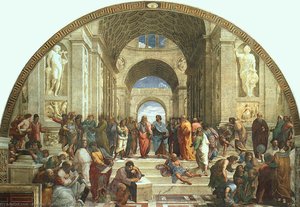
Em 1508, Rafael recebeu uma convocação que alteraria o curso de sua carreira – um convite do Papa Júlio II para ir a Roma. Este marcou o início de seu período mais prolífico e celebrado. A Cidade Eterna lhe ofereceu uma oportunidade sem paralelo de mostrar seus talentos em grande escala, adornando os apartamentos papais no Vaticano com afrescos deslumbrantes. A Escola de Atenas, talvez sua obra mais famosa, é um testemunho de seu domínio da composição, perspectiva e alegoria filosófica. Dentro de seu espaço majestoso, Rafael reuniu figuras da antiguidade clássica – Platão, Aristóteles, Pitágoras, Euclides – criando um vibrante tableau que celebrava a razão humana e a busca pelo conhecimento. Continuou trabalhando para papas subsequentes, incluindo Leão X, empreendendo projetos monumentais como a decoração das Stanze della Segnatura e da Stanza d'Eliodoro. Seus afrescos nessas salas não são meramente decorativos; são declarações profundas sobre o poder papal, crenças religiosas e os ideais do Renascimento.

Uma Síntese de Graça e Grandeza: O Estilo Artístico de Rafael

O estilo artístico de Rafael é frequentemente descrito como uma mistura harmoniosa de graça, clareza e beleza idealizada. Ele possuía uma habilidade extraordinária de sintetizar diversas influências – a tradição umbra, inovações florentinas, antiguidade clássica – em uma estética singularmente equilibrada. Suas composições são meticulosamente planejadas, exibindo um senso de ordem e proporção que reflete sua profunda compreensão dos princípios renascentistas. Suas figuras irradiam dignidade serena e expressividade emocional, incorporando o ideal humanista da perfeição humana. Ele também foi um mestre colorista, empregando tons ricos e luminosos para criar obras que são visualmente cativantes e intelectualmente estimulantes. Ao contrário do estilo frequentemente dramático e turbulento de Michelangelo, o trabalho de Rafael exala uma sensação de calma e harmonia – uma qualidade que o cativou por séculos.

Legado e Influência Duradoura

A morte prematura de Rafael em 1520, aos trinta e sete anos, interrompeu uma carreira repleta de potencial. No entanto, seu legado perdura como uma das figuras mais significativas da história da arte ocidental. Seu trabalho tornou-se uma pedra angular da estética do Alto Renascimento, servindo como um modelo para gerações de artistas. Embora a influência de Michelangelo tenha dominado posteriormente o discurso artístico, a ênfase de Rafael na clareza, harmonia e beleza idealizada experimentou um renascimento durante o período neoclássico, defendido por críticos como Johann Joachim Winckelmann. Hoje, suas pinturas continuam a inspirar admiração, cativando os espectadores com sua brilhante técnica, profundidade emocional e apelo duradouro. Sua influência pode ser vista em inúmeras obras de arte que se seguiram, solidificando seu lugar como um verdadeiro mestre do Renascimento – um pintor que capturou não apenas a semelhança física de seus sujeitos, mas também a própria essência da graça e dignidade humana.

Informações Rápidas

  • Subject or theme: Retrato de gentiluomo
  • Dimensions: 63 x 45 cm
  • Influences:
    • Leonardo da Vinci
    • Michelangelo
  • Title: Portrait of Agnolo Doni
  • Medium: Óleo sobre madeira
  • Year: 1506