
 Visualizar na parede
 Compartilhar
 Compartilhar
 Detalhes
 Guia
Guia

 Baixar imagem
 Semelhantes
 Raio X
 Ver diaporama
 Q&A
Q&A Estatísticas
Family Group


 Ler mais
Giclée / Impressão de Arte
Impressão giclée ou em tela de qualidade de museu, com produção rápida e opções flexíveis de acabamento. ( Comprar pintura feita à mão Alternar para Imagem Digital)




P118B €10

P118H €10

P118W €10

P438Z €10

P508JH €12

P508YH €12

P805H €10

P805Z €10

P919BZ €10

P919G €10

P919XJ €10

P959ZH €10

P968JZ €12

W106C €8

W218G €10

W218JH €8

W218Y €10

W307PJ €10

W316G €10

W316PJ €8

W316Y €10

W398PJ €8

W4111J €10

W500HY €15

W500JH €15

W692G €12

W849H €8

W940BG €15

W953PJ €8




Escolha entre os nossos tamanhos pré-definidos que respeitam as proporções originais da obra de arte.

Insira a largura e a altura desejadas para se ajustarem à sua moldura ou parede. Uma impressão pode ser apenas cortada, nunca ampliada além da imagem original; portanto, um tamanho com proporções diferentes resultará na perda de parte da imagem. Enviamos uma maquete digital para sua aprovação antes de realizarmos a impressão. A imagem exibida nesta página não mostra o corte real — apenas a maquete o faz.
Entrega mundial () em 2 semanas, em vez das 4/5 semanas padrão. (2 Novembro)

Envio expresso gratuito para todo o mundo

Tela de Linho de Alta Qualidade

Seguro de transporte completo

Garantia de Reembolso de Impostos Alfandegários

Garantia de Fidelidade Cromática

Política de Devolução em 100 Dias (Apenas para Defeitos)

Garantia de reembolso de 100%

Oferta de desconto por quantidade
 A opção de vidro está disponível apenas para tamanhos inferiores a 110 cm

Family Group
Giclée / Impressão de Arte
Tamanho da Reprodução
-


Preço Total
€ 71
Family Group (Moore) – A Window Into Domestic Tranquility
The sculpture “Family Group” by Henry Moore, created in 1950, stands as a testament to the enduring fascination with familial bonds and the exploration of human form through abstraction. Unlike traditional portraiture, Moore eschewed meticulous detail, opting instead for a simplified representation that prioritizes gesture and emotional resonance—a deliberate departure from the conventions of his time. The piece’s impact transcends mere visual aesthetics; it invites contemplation on themes of intimacy, vulnerability, and the universal experience of parenthood. Its presence in public spaces like Barclay School continues to inspire dialogue about art's ability to communicate profound ideas.- Sculptor: Henry Moore (1898 – 1976)
- Year Created: 1950
- Material: Bronze
- Dimensions: Approximately 203 cm x 140 cm
Composition and Style – Minimalism Embraces Organic Form
Moore’s approach to sculpture embodies the principles of Abstract Expressionism, rejecting representational accuracy in favor of conveying emotion through simplified geometric shapes. The “Family Group” consists of three reclining figures—a man, a woman, and a child—arranged in a horizontal embrace that suggests comfort and connection. These forms are characterized by smooth curves and undulating surfaces, reminiscent of the human torso and pelvis, reflecting Moore’s lifelong interest in anatomical studies. The sculpture's deliberate lack of ornamentation underscores its focus on pure form and texture, creating an atmosphere of serene contemplation.Technique – Mastering Bronze Casting
Moore skillfully employed a technique known as sand casting—a process that involves creating a mold from compacted sand around a wax model. This method allows for the production of large-scale bronze sculptures with remarkable precision and fluidity. The sculptor meticulously smoothed and polished the surface of each figure, achieving an ethereal quality that enhances its visual impact. The resulting bronze possesses a rich patina—a protective layer of oxidation—that imparts warmth and depth to the sculpture’s color palette.Historical Context – Reflecting Postwar Ideals
“Family Group” emerged during the postwar era, a period marked by optimism about the future and a renewed interest in humanist values. Moore's work aligns with the broader artistic movement of Abstract Expressionism, which sought to express inner emotions through spontaneous gesture and nonfigurative imagery—a reaction against the formalism of earlier decades. The sculpture’s understated elegance reflects the desire for simplicity and authenticity that characterized the cultural landscape of the time, capturing a moment of profound human connection amidst societal change.Symbolism – Embodiment of Domestic Harmony
The sculpture's depiction of a family embodies universal themes of love, caregiving, and familial unity—concepts central to humanist philosophy. The reclining figures represent repose and vulnerability, inviting viewers to consider the importance of nurturing relationships and safeguarding emotional wellbeing. Moore’s masterful use of form communicates an unspoken message about the beauty and significance of human connection, solidifying “Family Group” as a timeless masterpiece that continues to resonate with audiences worldwide.Perguntas e Respostas
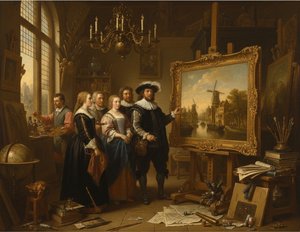
As cores de "Family Group" são vibrantes ou suaves?
A cor de "Family Group" apresenta Balanced Soft de saturação e Balanced de intensidade.
Para qual ambiente "Family Group", de Pieter Jacobsz Codde é recomendado, considerando as suas cores?
Com sua paleta Dark, "Family Group", de Pieter Jacobsz Codde é recomendado para um Living Room. As cores são parte do motivo desta sugestão.
Onde posso ver a obra original "Family Group", de Pieter Jacobsz Codde?
A obra original "Family Group" pode ser vista no Rijksmuseum, Amsterdam, Netherlands.
Biografia do Artista
The Silvery Light of the Dutch Golden Age
Pieter Jacobsz Codde, a name synonymous with the refined elegance of the seventeenth-century Dutch Golden Age, lived a life as textured and layered as the canvases he produced. Born in Amsterdam in 1599 to a family of modest means—his father serving as a city official responsible for port fees—Codde emerged from an environment steeped in the maritime commerce and burgeoning prosperity of the Netherlands. While historical records regarding his early training remain somewhat enigmatic, whispers of an apprenticeship under the legendary Frans Hals have long circulated among art historians. However, more recent scholarship suggests he may have refined his technical prowess under Barent van Someren or Cornelis van der Voort. Regardless of his specific master, Codde’s development was marked by a profound ability to capture the quiet, often silvery-gray tonalities that would become his aesthetic signature.
His early years were not merely defined by the brush, but also by a literary sensibility that added depth to his visual narratives. In the early decades of the 1600s, Codde was known to engage with the poetic and dramatic arts, appearing in publications such as Hollande Nachtegaelken. This intersection of word and image allowed him to approach genre painting not just as a recorder of reality, but as a storyteller capable of weaving classical and amorous themes into the fabric of everyday life. His move to the fashionable Sint Antoniesbreestraat in Amsterdam placed him at the very heart of the artistic community, surrounded by the vibrant energy of a city defining its cultural identity.
Mastery of the Genre and the Guardroom
As his career matured, Codde became a master of several distinct genres, most notably the guardroom scene, the musical company, and the intimate portrait. His work is celebrated for its meticulous attention to detail and a sophisticated use of chiaroscibility—the dramatic interplay of light and shadow that breathes life into inanimate objects and human subjects alike. In his guardroom paintings, he captured the rugged, often tense atmosphere of military life, yet he infused these scenes with a technical grace that elevated them beyond mere reportage. His ability to render the cold glint of steel, the heavy texture of fabric, and the soft glow of candlelight created an immersive experience for the viewer.
Beyond the martial themes, Codde found immense success in depicting the social harmonies of his era. His musical compositions are particularly evocative, capturing moments of shared leisure and artistic devotion. In works such as Dancing Lesson and The Lute Player, one can sense the rhythmic pulse of the music through his precise brushwork. These paintings often feature a delicate, silvery palette that lends a dreamlike, nostalgic quality to the scenes, making them feel both immediate and timeless. Through these small-scale masterpieces, Codde invited the viewer into the private, harmonious corners of Dutch domesticity, where melody and movement converged.
A Legacy Etched in Light and Shadow
The life of Pieter Codde was not without its shadows, mirroring the darker tones found in his more somber compositions. His personal history was marked by turbulence, including a high-profile legal accusation and a divorce that saw his wife move into the home of the painter Paulus Potter. Yet, even amidst personal upheaval, his professional trajectory remained one of significant achievement. By 1657, he had secured a prestigious residence on the Keizersgracht, a testament to the stability and success his talent had afforded him. His later years were spent in the very heart of Amsterdam's grandeur, continuing to refine the techniques that would influence generations of Dutch painters.
The historical significance of Codde lies in his role as a bridge between the raw naturalism of the early Golden Age and the more refined, polished aesthetics of the mid-seventeenth century. His contributions to the development of genre painting provided a blueprint for how light could be used to sculpt emotion and atmosphere. Today, his works reside in some of the world's most esteemed institutions, including:
- The Louvre, where his Dancing Lesson serves as a pinnacle of his musical genre.
- The Rijksmuseum, housing his profound religious works like the Adoration of the Shepherds.
- The Uffizi Gallery, which preserves his delicate conversational scenes.
- The Philadelphia Museum of Art, home to his evocative Lute Player.
Ultimately, Pieter Jacobsz Codde remains a vital figure in the canon of Western art, remembered not just for his technical skill, but for his ability to capture the fleeting, luminous essence of human connection and the quiet dignity of everyday existence.

Pieter Jacobsz Codde
1599 - 1678
Dados Rápidos
- Full Name: Pieter Jacobsz Codde
- Nationality: Dutch
- Date Of Birth: 1599
- Date Of Death: 1678
- Place Of Birth: Amsterdam, Netherlands
- Notable Artworks:
- The Music Lesson
- Dancing Lesson
- Merry Company
- Artistic Movement Or Style: Dutch Golden Age
- Artists Who Influenced This Artist: ['Frans Hals']
- Artists Or Movements Influenced By This Artist: ['Golden Age Art']
Artigos Relacionados

Mastering Light & Shadow: A Journey Through the Dutch Golden Age's Luminous Legacy
Embark on a cultural journey through the Dutch Golden Age. Explore the masterful interplay of light and shadow in 17th-century masterpieces, from Rembrandt to Vermeer, and discover how this era of profound realism continues to inspire fine art collectors today.

A Era de Ouro Holandesa: 10 Mestras-Obras Imperdíveis para Decorar com Arte
Descubra as 10 obras-primas da Era de Ouro Holandesa! Explore a história, técnica e beleza atemporal de Rembrandt, Vermeer e outros mestres. Encontre reproduções de arte exclusivas para decorar sua casa com elegância em OriginalUniqueArt.com.

Golden Light & Dutch Skies: The Timeless Magic of Dutch Golden Age Landscapes
Discover the breathtaking beauty of Dutch Golden Age landscapes. Explore the mastery of light, chiaroscuro, and 17th-century realism through an expert art history lens, celebrating the enduring legacy of the Dutch Masters for discerning collectors and art lovers.
Illuminating Innovation: Exploring the Dutch Golden Age of Painting
Explore the Dutch Golden Age of painting with OriginalUniqueArt. Discover Rembrandt, Vermeer & other Masters. Learn about key characteristics, iconic artworks, and lasting influence. Expert insights for collectors & enthusiasts.

Golden Age Reflections: Dutch Baroque Painting & Cultural Innovation
Explore the Dutch Golden Age of painting! Discover key artists like Vermeer & ter Borch, their innovative techniques, and the rich cultural context behind these Baroque masterpieces. Learn about collecting & appreciating this iconic art period.