

 Visualizar em escala
 Enviar
 Compartilhar
 Ver detalhes
 Guia de Obras do Aluno

 Baixar imagem
 Semelhantes
 Raio X
 Apresentação de slides
 Estatísticas
Cello


 Ver mais
A obra de arte exibida nesta página é protegida por leis de direitos autorais, o que significa que não podemos criar ou vender legalmente uma reprodução idêntica. Esta proteção é aplicada por meio de acordos internacionais, tais como a Convenção de Berna e pelas leis nacionais, incluindo as estabelecidas por Lei de Direitos Autorais dos EUA - Título 17.
Este método cumpre plenamente as regulamentações de direitos autorais, pois não envolve a cópia ou duplicação da obra protegida. Em vez disso, trata-se de uma reinterpretação criativa — uma nova pintura que é influenciada pela original, mas não idêntica a ela.
Giclée / Impressão de Arte
Impressão giclée ou em tela de qualidade de museu, com produção rápida e opções flexíveis de acabamento. ( Encomendar reprodução pintada à mão Ver Imagem Digital)




P118B €10

P118H €10

P118W €10

P438Z €10

P508JH €12

P508YH €12

P805H €10

P805Z €10

P919BZ €10

P919G €10

P919XJ €10

P959ZH €10

P968JZ €12

W106C €8

W218G €10

W218JH €8

W218Y €10

W307PJ €10

W316G €10

W316PJ €8

W316Y €10

W398PJ €8

W4111J €10

W500HY €15

W500JH €15

W692G €12

W849H €8

W940BG €15

W953PJ €8




Escolha entre os nossos tamanhos pré-definidos que respeitam as proporções originais da obra de arte.

Digite a largura e a altura de que necessita, para se ajustar à sua moldura ou à sua parede. Uma impressão só pode ser cortada, nunca ampliada além da imagem original, pelo que um tamanho com uma proporção diferente perderá parte da imagem. Enviamos-lhe uma maquete digital para aprovação antes de imprimirmos qualquer coisa. A imagem apresentada nesta página não mostra o corte real — apenas a maquete o faz.
Entrega mundial () em 2 semanas, em vez das 4/5 semanas padrão. (22 Outubro)

Envio expresso gratuito para todo o mundo

Tela de Linho Premium

Seguro de transporte total

Garantia de Reembolso de Impostos Alfandegários

Garantia de Fidelidade de Cor

Política de Devolução em 100 Dias (Apenas para Defeitos)

Garantia de reembolso de 100%

Desconto para múltiplas unidades
 A opção de vidro está disponível apenas para tamanhos inferiores a 110 cm

Cello
Giclée / Impressão de Arte
Dimensões da Reprodução
-


Preço Total
€ 70
A Testament to Craftsmanship: Piero Parravicini’s Cello – A Reflection of Italian Violin Making Tradition
The cello, an instrument steeped in history and revered for its soulful resonance, stands as a testament to the enduring legacy of Italian violin making. This particular cello, crafted by Piero Parravicini in 1922, embodies the meticulous artistry that flourished during the early 20th century – a period marked by both artistic innovation and unwavering adherence to established techniques. Examining its construction reveals not only exceptional craftsmanship but also a profound connection to the traditions of Cremona, Italy, where violin making has been practiced for centuries.- Material Composition: The instrument’s body is constructed primarily from maple, chosen for its density and tonal qualities. Complementing this core material are spruce boards – two carefully selected pieces – forming the soundboard. Spruce, renowned for its stiffness and ability to transmit vibrations efficiently, remains a cornerstone of violin construction globally.
- Purfling & Decoration: Adding visual elegance and structural integrity is white maple and black walnut purfling—thin strips inlaid around the edges of the cello’s body and neck. Purfling serves not only as decorative embellishment but also protects the wood from cracking during handling and contributes to the instrument's overall acoustic performance.
- Historical Context: Piero Parravicini operated within a vibrant artistic milieu, influenced by figures like Romeo Antoniazzi, who himself studied under Giuseppe Stradivari—the undisputed master of violin making. This lineage underscores the importance of preserving traditional methods and honoring the legacy of legendary craftsmen.
Artist Biography: Piero Parravicini – A Maestro Rooted in Tradition
Born in Bovisa, Italy, in 1889, Piero Parravicini was more than just a violin maker; he was an educator and innovator who championed the revival of classical violin making. He honed his skills at Monzino, Milan, absorbing knowledge from Romeo Antoniazzi (1862-1925), whose own approach to instrument construction drew inspiration from Stradivari’s groundbreaking methods.
Parravicini's dedication extended beyond production; he established a workshop where he imparted his expertise to aspiring artisans. His instruments garnered recognition at prestigious competitions—the National Lute-Making Competition in Rome (1925 & 1929), the International Contemporary Lute-Making Competition in Cremona (1949), and the National Exhibition in Florence (1951)—demonstrating his commitment to upholding the highest standards of craftsmanship.
The Instrument’s Aesthetic Appeal: Visual Elements & Sonic Character
The cello's appearance speaks volumes about its maker’s vision. Its maple body exudes warmth and stability, while the spruce soundboard radiates luminosity—a characteristic achieved through meticulous polishing and varnish application. The white maple and black walnut purfling adds subtle textural contrast, enhancing both visual beauty and acoustic projection.
Beyond its physical form, the cello possesses a distinctive sonic character – a rich, resonant timbre capable of conveying profound emotion. This quality is attributable to Parravicini’s careful selection of materials and his meticulous attention to detail during construction—a testament to the enduring power of tradition in shaping artistic expression.
Symbolism & Emotional Resonance
Like all great instruments, the cello transcends mere functionality; it embodies a deeper symbolic significance. Its elongated shape evokes contemplation and introspection – qualities that align perfectly with its expressive capabilities. When played skillfully, it can evoke feelings of melancholy, joy, and spiritual transcendence—connecting musicians and listeners alike to universal human experiences.
Concluding Remarks: A Legacy Preserved
Piero Parravicini’s cello stands as a beacon of Italian violin making tradition – a symbol of unwavering dedication to craftsmanship and artistic excellence. Its enduring beauty and sonic power continue to inspire musicians and collectors worldwide, ensuring that the legacy of this remarkable instrument—and its maker—will endure for generations to come.
Perguntas e Respostas
A qual movimento artístico pertence "Cello" de Piero Parravicini?
O movimento associado a "Cello" de Piero Parravicini é Contemporary Realism. Esta classificação situa a obra entre artistas e obras de arte relacionados.
Existe uma ficha informativa sobre "Cello" de Piero Parravicini para estudantes?
Uma página de Guia está disponível para "Cello" de Piero Parravicini: uma ficha informativa imprimível sobre a obra, projetada para estudantes e uso em sala de aula.
Quão harmoniosas são as cores de "Cello" de Piero Parravicini?
As cores de "Cello" de Piero Parravicini apresentam uma harmonia Strong Color Unity. A harmonia descreve como as cores se relacionam entre si.
Artigos Relacionados

10 Iconic Masterpieces That Capture the Soul of Italy
Journey through Italy's soul with 10 iconic masterpieces. From Renaissance legends to romantic landscapes, explore the stories behind these timeless works. Find museum-quality art reproductions and curated decor inspiration at OriginalUniqueArt.com. Discover all masterpieces online.

10 Iconic Artworks That Capture the Magic of Italy
Journey through Italy via its most iconic masterpieces. From Renaissance classics to romantic landscapes, explore the stories behind these timeless works. Find museum-quality art reproductions and curated decor inspiration at OriginalUniqueArt.com. Discover all masterpieces online.
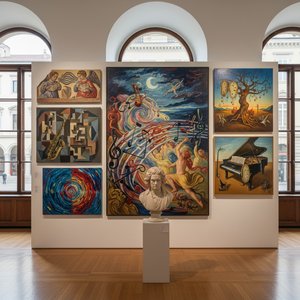
Harmonies on Canvas: Exploring the Visual Representation of Music in Art History
Explore the fascinating history of music's visual representation in art! From ancient symbolism to modern abstraction, discover how artists have captured sound and emotion on canvas. Expert insights & stunning examples.

The Symphony of Canvas: Capturing the Timeless Resonance of Musical Instruments in Fine Art Masterpieces
Explore the profound connection between music and fine art. From ancient iconography to Impressionist masterpieces, discover how legendary instruments are captured on canvas with unparalleled artistry and historical depth for the discerning collector.

10 Iconic Masterpieces That Capture the Magic of Italy
Journey through Italy's soul with 10 iconic masterpieces. From Renaissance classics to romantic landscapes, explore the stories behind these timeless works and find museum-quality art reproductions for your decor. Discover all masterpieces on OriginalUniqueArt.com.