Expressionism
Self-portrait (Paula Modersohn-Becker)
Paula Modersohn-Becker (1876–1907) criou Self-portrait. Pertence ao movimento Expressionism. É feito em Oil On Canvas.
- Oil On Canvas

 Visualizar na parede

 Pintura a Óleo Feita à Mão
 Compartilhar
 Compartilhar
 Ficha técnica


 Baixar imagem
 Semelhantes
 Raio X
 Ver diaporama
 Perguntas e Respostas

 Estatísticas
Self-portrait, em resumo
- Título
- Self-portrait
- Artista
- Paula Modersohn-Becker (1876–1907)
- Artista nascido em
- Dresden, Alemanha
- Técnica
- Oil On Canvas
- Movimento
- Expressionism
- Período
- Modern
- Tema
- woman, red hair, green shirt, face, eyes, wall
O que Self-portrait retrata?
Identification of the Self-portrait
Self-portrait is a creation by the German Expressionist painter and draftswoman Paula Modersohn-Becker. This specific piece belongs to a vast body of work produced during her active life. The artist was born on 8 February 1876 in Dresden, Germany, and passed away on 30 November 1907 in Worpswede.
In this work, Paula Modersohn-Becker turns her gaze toward the viewer. The image captures a moment of quiet intensity through the artist's own likeness. It remains a direct encounter with her presence.
The Composition and Visual Details
The subject is positioned in front of a plain wall, seated in a manner that brings her face into sharp prominence. She wears a green shirt that contrasts with her red hair. Her hair is styled in an unconventional manner, contributing to the singular presence of the figure. The composition focuses heavily on the facial features, emphasizing a directness of gaze. Her eyes are open wide, looking straight ahead to meet the viewer's eyes with quiet intensity.
The arrangement of the figure against the background creates a sense of immediate, unmediated encounter. There is a notable focus on the psychological weight of the stare. The simplicity of the setting ensures that the viewer's attention remains fixed on the subject's expression and the specific arrangement of her features. This directness removes any sense of artifice from the encounter.
Technique and Artistic Medium
Executed in oil on canvas, this work exemplifies the principles of Expressionism. The medium allows for a directness of form that prioritizes the psychological state over mere physical likeness. Through the application of pigment, the artist achieves a sense of quiet intensity, focusing on the essential features of the face and the gaze to facilitate a moment of introspection.
The application of paint emphasizes a recognizable simplicity of form. This approach moves away from the atmospheric concerns of Impressionism, opting instead for a more structured and subjective visual language. The surface carries the weight of the artist's presence, using color and composition to explore the nuances of identity.
Where to See This Artwork Today
This work is held at the Paula Modersohn-Becker Museum in Bremen, Germany. The institution serves as a primary repository for the artist's output, housing a significant portion of her creative legacy.
Founded in 1927, the museum holds a unique position in art history as the first museum in the world devoted solely to a female artist. Its collection provides a comprehensive view of her development from her early training to her final years in Paris.
Related Works by the Artist
The artist's exploration of the self continued through several distinct phases of her career. In 1906, she produced Self-Portrait Looking Slightly Left, a work that shares a similar searching quality with her other studies of identity. During that same year, she completed Self-Portrait at 6th Wedding Anniversary, a piece that captures a specific moment of transition. This work is also known as Self-portrait on the sixth anniversary of marriage.
Earlier compositions reveal a different focus on objects and the female form. Around 1904, she created Self-Portrait with a bowl and a glass. Her interest in the intersection of the female form and the natural world is further evidenced in Self-Portrait with Two Flowers, where she cradles blossoms with a deliberate, steady intention.
Imagens em alta resolução de Self-portrait
Paula Modersohn-Becker, Self-portrait. Domínio público.
Perguntas sobre Self-portrait respondidas
Qual é a técnica utilizada em "Self-portrait", de Paula Modersohn-Becker?
"Self-portrait" é executada em Oil On Canvas.
O que "Self-portrait", de Paula Modersohn-Becker retrata?
Os temas de "Self-portrait" são woman, red hair, green shirt, face, eyes, wall.
"Self-portrait", de Paula Modersohn-Becker está em domínio público?
Informação de direitos autorais para "Self-portrait", de Paula Modersohn-Becker: a obra está em em domínio público — seus direitos autorais expiraram. Isso determina se reproduções da imagem podem ser feitas livremente.
Quem criou "Self-portrait"?
O artista por trás de "Self-portrait" é Paula Modersohn-Becker. A obra está catalogada sob o nome de Paula Modersohn-Becker.
A qual movimento artístico pertence "Self-portrait", de Paula Modersohn-Becker?
O movimento associado a "Self-portrait", de Paula Modersohn-Becker é Expressionism. Esta classificação situa a obra entre artistas e obras de arte relacionados.
Por que o status de direitos autorais de "Self-portrait" é como é?
O status de direitos autorais de "Self-portrait" - em domínio público — seus direitos autorais expiraram - decorre do falecimento do artista em 1907.
Como "Self-portrait" se insere na trajetória artística de Paula Modersohn-Becker?
"Self-portrait" compartilha com as outras obras de Paula Modersohn-Becker o seu estilo Expressionism e os temas recorrentes: cézanne, gauguin, van gogh, identity and femininity, self-exploration and agency, pioneer of expressionism.
De que forma o tema de "Self-portrait" se relaciona com os temas habituais de Paula Modersohn-Becker?
Os temas recorrentes de Paula Modersohn-Becker incluem cézanne, gauguin, van gogh, identity and femininity, self-exploration and agency, pioneer of expressionism; "Self-portrait" foca em woman, red hair, green shirt, face, eyes, wall.
Sobre o artista, Paula Modersohn-Becker

1876–1907, Alemanha
Paula Modersohn-Becker
Uma Visionária da Alma: A Vida e a Arte de Paula Modersohn-Becker Paula Modersohn-Becker, um nome que ressoa com uma força silenciosa nos anais da arte moderna inicial, foi uma artista que ousou olhar para dentro. Nascida Minna Hermine Paula Becker em 8 de fevereiro de 1876, em Dresden, Alemanha, sua vida foi tragicamente curta – faleceu em 30 de novembro de 1907, em Worpswede – mas nesses trinta anos, ela forjou um caminho de notável inovação artística e coragem pessoal. Sua história não é de aclamação imediata ou amplo reconhecimento durante sua vida; é sim um testemunho da força duradoura de uma voz individual que desafiou convenções e explorou as profundezas da experiência humana com honestidade implacável. Proveniente de uma criação relativamente privilegiada em uma família marcada por uma sombra sutil – seu tio tentou assassinar o Rei da Prússia – as inclinações artísticas de Paula foram nutridas, embora não sem expectativas sociais a pressionando.
Sobre Paula Modersohn-Becker Obras notáveis de Paula Modersohn-Becker
Também de Paula Modersohn-Becker
 Portrait of a young woman with red hat1900
 Half-length portrait of an old farmer1903
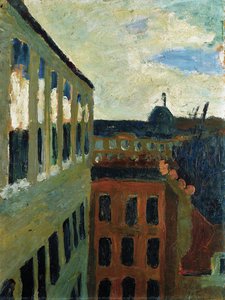 View from the studio window of the artist in Paris1900
 Still life with plant, lemon and orange1906
Ensaios sobre Self-portrait
 Polish artworks of the 1900sPolish Symbolism in the 1900s features masterpieces by Jacek Malczewski, Olga Boznańska, and Józef Mehoffer. View the full collection at Or…
 German artworks of the 1900sGerman Expressionism through the works of Franz Marc, Ernst Ludwig Kirchner, and August Macke. Find museum-quality reproductions on Origina…
 Egon Schiele: As 25 Obras-Primas que Definem um Gênio Expressionista | OriginalUniqueArtDescubra as 25 obras-primas de Egon Schiele, o mestre expressionista austríaco. Explore a vida, técnica e simbolismo por trás de seus retra…