Alternar para Impressão
 Ler mais







































 Para obras de arte ou reproduções com mais de 105 cm (aproximadamente 41 polegadas) em qualquer um dos lados, a moldura será enviada como um kit desmontado. Este método garante uma entrega segura e evita danos durante o transporte.


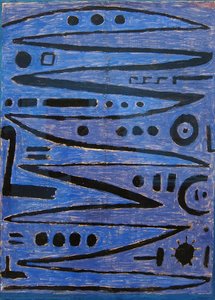
A Symphony in Crimson: The Rhythmic Soul of Paul Klee’s Wall Chart
To encounter Paul Klee’s Wall Chart is to step into a realm where the boundaries between sight and sound begin to dissolve. Painted around 1937, during the profound and transformative years of his Bauhaus period, this masterpiece serves as a captivating exploration of color, pattern, and geometric abstraction. At first glance, the viewer is met with a commanding field of crimson hues—a deliberate and emotive choice that speaks to Klee’s deep fascination with color theory. Yet, beneath this singular wash of red lies a complex, pulsating architecture of intersecting squares and rectangles. Each shape, subtly shaded and textured, contributes to a rhythmic core that feels less like a static image and more like a visual composition, echoing the artist's lifelong connection to musical arrangement.
The technique employed in Wall Chart reveals Klee’s meticulous approach to building depth and tactile presence. Utilizing acrylic paint on canvas, the artist masterfully layered thin, translucent washes of color with thicker, more deliberate impasto strokes. This method creates a palpable surface quality, where light seems to dance across the varying textures of the geometric grid. The result is a dynamic interplay of shadow and luminosity; some squares appear to recede into a dark, velvety abyss, while others emerge with a bright, energetic prominence. For the discerning collector or interior designer, this piece offers an unparalleled sense of movement, making it a sophisticated focal point that breathes life into any curated space.
Order Amidst Chaos: Historical and Symbolic Resonance
Beyond its striking aesthetic, Wall Chart carries a profound historical weight. Created during the tumultuous era leading up to World War II, the painting reflects the broader anxieties of a world on the brink of upheaval. In this period of immense societal instability, Klee sought solace in formal structures and geometric order. The intricate network of shapes can be viewed as an attempt to impose harmony upon chaos, a way to find a stable, rhythmic truth amidst the fragmentation of his time. There is a deep symbolism in this pursuit of balance—a reflection of Klee’s own philosophical inquiry into how art might serve as a sanctuary for the human spirit.
Despite the gravity of its historical context, the work never loses its inherent playfulness. Klee possessed a unique ability to infuse even his most abstract explorations with a sense of lightness and joy. This duality—the tension between structural rigor and spontaneous energy—is what makes Wall Chart so enduringly relevant. It invites the observer to contemplate the hidden rhythms of the universe, finding beauty in the precise alignment of form and the emotive power of pigment. Whether viewed as an academic study in design or a deeply personal expression of resilience, this artwork remains a cornerstone of modern abstraction, offering timeless inspiration for those who seek art that resonates with both intellect and emotion.
Perguntas e Respostas
De que forma o tema de "Wall Chart" se relaciona com os temas habituais de Paul Klee?
Entre os temas recorrentes de Paul Klee — expressionist color theory, bauhaus aesthetic principles, symbolic visual language, geometric abstraction forms, exploring inner emotions — "Wall Chart" traz seu próprio foco em geometric pattern, color exploration, red hue dominance, swiss art style, formal composition, abstract expression, visual texture.
Que paleta e que sentimento "Wall Chart" evoca?
A paleta Dark de "Wall Chart", de Paul Klee harmoniza-se com seu tom emocional Reflective. A cor é uma das formas pelas quais uma obra transmite sentimento.
Qual é a luminosidade de "Wall Chart", de Paul Klee?
A luminância registrada para "Wall Chart", de Paul Klee é Soft Shadow.
 Visualizar na parede
 Compartilhar
 Compartilhar
 Detalhes
 Guia
Guia

 Baixar imagem
 Semelhantes
 Raio X
 Ver diaporama
 Perguntas e Respostas
 Estatísticas