() ·

Uma pintura feita para você, à mão

Alchemy

Reprodução em Óleo Feita à Mão

Óleo sobre tela pintado à mão no tamanho e moldura de sua escolha, feito sob encomenda pelos nossos artistas. ( Alternar para Impressão Alternar para Imagem Digital)

Descrição do Item

Experience Jackson Pollock’s iconic ‘Alchemy’ drip painting, a cornerstone of Abstract Expressionism from 1947. This dynamic canvas explodes with color and texture, showcasing Pollock's innovative technique and transformative vision – discover this masterpiece.

Biografia do Artista

Jackson Pollock (1912-1956) foi um pintor americano revolucionário, pioneiro do Expressionismo Abstrato e conhecido por sua técnica de gotejamento. Suas obras icônicas capturam a energia e emoção da ação artística, influenciando profundamente a arte moderna.

de ·

Capítulo 1

Qual deve ser o tamanho?

Deslize para alterar o tamanho; a imagem à esquerda mostra a moldura em sua largura real. As proporções originais são mantidas.

Tamanho padrão
personalizado
CM
INCH

Escolha entre os nossos tamanhos pré-definidos que respeitam as proporções originais da obra de arte.

largura
altura

Insira a largura e a altura desejadas para se ajustarem à sua moldura ou parede. Como esta obra é pintada à mão, para um tamanho com proporções diferentes, o artista poderá pintar um pouco mais ao redor da imagem ou reduzir ligeiramente a composição — você escolhe. Enviamos uma maquete digital para sua aprovação antes de iniciar a pintura. A imagem exibida nesta página não representa o resultado real — apenas a maquete mostra o resultado final.

Capítulo 2

Como deve chegar?

Escolha as bordas da tela esticada

Escolha sua moldura

Corner sample of the WhiteWrap canvas edge finish, stretched on madeira maciça bars
Branco €1
Corner sample of the BlurSideWrap canvas edge finish, stretched on madeira maciça bars
Bordas esfumaçadas €1
Corner sample of the ExtendedWrap canvas edge finish, stretched on madeira maciça bars
Bordas estendidas €1
Corner sample of the P118B picture frame: poliestireno moldado, 5 cm wide and 3 cm thick
P118B €10
Corner sample of the P118H picture frame: poliestireno moldado, 5 cm wide and 3 cm thick
P118H €10
Corner sample of the P118W picture frame: poliestireno moldado, 5 cm wide and 3 cm thick
P118W €10
Corner sample of the P438Z picture frame: poliestireno moldado, 5.5 cm wide and 3.5 cm thick
P438Z €10
Corner sample of the P508JH picture frame: poliestireno moldado, 7 cm wide and 3.5 cm thick
P508JH €12
Corner sample of the P508YH picture frame: poliestireno moldado, 7 cm wide and 3.5 cm thick
P508YH €12
Corner sample of the P805H picture frame: poliestireno moldado, 5 cm wide and 3.5 cm thick
P805H €10
Corner sample of the P805Z picture frame: poliestireno moldado, 5 cm wide and 3.5 cm thick
P805Z €10
Corner sample of the P919BZ picture frame: poliestireno moldado, 7 cm wide and 3.5 cm thick
P919BZ €10
Corner sample of the P919G picture frame: poliestireno moldado, 7 cm wide and 3.5 cm thick
P919G €10
Corner sample of the P919XJ picture frame: poliestireno moldado, 7 cm wide and 3.5 cm thick
P919XJ €10
Corner sample of the P959ZH picture frame: poliestireno moldado, 5 cm wide and 3 cm thick
P959ZH €10
Corner sample of the P968JZ picture frame: poliestireno moldado, 6 cm wide and 4 cm thick
P968JZ €12
Corner sample of the W106C picture frame: madeira maciça, 5 cm wide and 3 cm thick
W106C €8
Corner sample of the W218G picture frame: madeira maciça, 5 cm wide and 3 cm thick
W218G €10
Corner sample of the W218JH picture frame: madeira maciça, 5 cm wide and 3 cm thick
W218JH €8
Corner sample of the W218Y picture frame: madeira maciça, 5 cm wide and 3 cm thick
W218Y €10
Corner sample of the W307PJ picture frame: madeira maciça, 6 cm wide and 3 cm thick
W307PJ €10
Corner sample of the W316G picture frame: madeira maciça, 6 cm wide and 3 cm thick
W316G €10
Corner sample of the W316PJ picture frame: madeira maciça, 6 cm wide and 3 cm thick
W316PJ €8
Corner sample of the W316Y picture frame: madeira maciça, 6 cm wide and 3 cm thick
W316Y €10
Corner sample of the W398PJ picture frame: madeira maciça, 5 cm wide and 3 cm thick
W398PJ €8
Corner sample of the W4111J picture frame: madeira maciça, 6.5 cm wide and 3.5 cm thick
W4111J €10
Corner sample of the W500HY picture frame: madeira maciça, 7 cm wide and 5 cm thick
W500HY €15
Corner sample of the W500JH picture frame: madeira maciça, 7 cm wide and 5 cm thick
W500JH €15
Corner sample of the W692G picture frame: madeira maciça, 8 cm wide and 4 cm thick
W692G €12
Corner sample of the W849H picture frame: madeira maciça, 5 cm wide and 3 cm thick
W849H €8
Corner sample of the W940BG picture frame: madeira maciça, 7.5 cm wide and 4.5 cm thick
W940BG €15
Corner sample of the W953PJ picture frame: madeira maciça, 6 cm wide and 3.5 cm thick
W953PJ €8
Corner sample of the H24-GOLD picture frame: madeira entalhada com gesso, 10 cm wide and 6 cm thick
H24-GOLD €30
Corner sample of the H24-SILVER picture frame: madeira entalhada com gesso, 10 cm wide and 6 cm thick
H24-SILVER €30
Corner sample of the H36-GOLD picture frame: madeira entalhada com gesso, 15 cm wide and 6.5 cm thick
H36-GOLD €45
Corner sample of the H36-SILVER picture frame: madeira entalhada com gesso, 15 cm wide and 6.5 cm thick
H36-SILVER €45
Prévia da moldura
Com moldura

Moldura: . Dimensões totais com a moldura: .

Capítulo 3

Quem o pinta, e deveria algo mudar?

Exemplos do que pode ser alterado: Substituir o rosto pela foto do cliente; Adicionar um animal de estimação (ex: substituir gato por cachorro); Incluir uma mensagem oculta no fundo; Alterar a paisagem ou elementos do fundo.
Após o pedido, a equipe da OriginalUniqueArt.com enviará um e-mail ao cliente para instruções e fornecerá uma prévia da montagem

Entrega mundial () em 3 a 4 semanas, em vez das 5 semanas padrão. (8 Novembro). Sem comprometer a qualidade.

Capítulo 4

Os retoques finais

Uma placa de identificação, como em um museu?

Detalhes da Placa de Bronze Gravada

This elegant plaque features the artist's name and the title of the artwork, finely engraved for a timeless presentation.

It is made from bronze with a refined, elegant finish. The text is precisely laser-engraved for a sharp and permanent result. Measuring 9x2 cm, the plaque is compact yet easy to read. It's built to be durable and scratch-resistant, offering a professional, museum-quality look. Mounting is simple thanks to the included adhesive backing.

Detalhes da Placa de Acrílico Transparente

The plaque includes essential engraved details such as the artist's name, the title of the artwork, the date it was created, the type of media used-like oil on canvas or watercolor-a brief description of the piece, and a QR code that links to the complete artwork information.

It is crafted from clear acrylic, offering a sleek, modern appearance. The text is UV-engraved in black to ensure strong visual contrast. With a size of 10x15 cm, it ensures optimal readability. It comes equipped with two metal hooks for secure wall mounting. The plaque is designed to be weather-resistant, making it suitable for various environments, and it includes interactive features that work seamlessly with smartphone scanning.

Detalhes da Placa de Acrílico Preto

This elegant plaque includes engraved information such as the artist's name, the title of the artwork, the date it was created, the type of media used (like oil on canvas or watercolor), a short description of the artwork, and a QR code for quick access to more information.

The plaque itself is made from refined black acrylic with a premium finish. The text is laser-engraved in white for high contrast and readability. Its size is 10x15 cm, designed to be easy to read. It comes with two metal hooks for professional mounting. The design is sleek and fits any interior style. It is also weather-resistant and durable, with built-in digital integration for mobile compatibility.

Um verniz protetor?

Para quando você precisa?

Capítulo 5

A sua pintura, conforme encomendada

Alchemy

Técnica de Reprodução

Tamanho da Reprodução

-

Artista Sênior de Elite

Mais detalhes, refinamento e tempo de produção adicional

-

Moldura para Reprodução

-

-

Para obras de arte ou reproduções com mais de 105 cm (aproximadamente 41 polegadas) em qualquer um dos lados, a moldura será enviada como um kit desmontado. Este método garante uma entrega segura e evita danos durante o transporte.

Montagem profissional necessária — este não é um produto DIY (faça você mesmo).
O kit deve ser montado e a tela esticada por um profissional de molduraria experiente, utilizando cola de madeira (não inclusa), um alicate de esticar tela e grampos para manter as travessas alinhadas enquanto a cola seca. A montagem incorreta ou a tensão desigual da tela podem danificar permanentemente a obra de arte e não estão cobertas pela nossa garantia.

  • Todas as barras de madeira maciça estão incluídas, precisamente cortadas ao tamanho certo.

  • Montado com os parafusos fornecidos, além de cola para madeira para as junções dos cantos, que não está inclusa e deve ser providenciada pelo seu moldurista.

  • São necessárias ferramentas profissionais não incluídas: um alicate de estiramento de tela (esticador) e grampos para manter as ripas alinhadas enquanto a cola seca.

Importante:
As junções dos cantos requerem cola para madeira, as ripas devem ser mantidas com grampos até que a cola esteja completamente seca, e o estiramento da tela na moldura montada requer um alicate de esticar tela. Nenhum destes itens está incluído no kit. Por favor, certifique-se de contar com um profissional de molduraria experiente antes de encomendar este tamanho.

Etiqueta de identificação

-

-

Verniz de Proteção

Verniz brilhante (realça as cores e protege contra a luz e a umidade)

-

Personalizar minha obra

Exemplos de alterações possíveis: Substituir o rosto por uma foto do cliente; Adicionar um animal de estimação (ex.: substituir gato por cachorro); Incluir uma mensagem oculta no fundo; Alterar a paisagem ou os elementos do fundo.

-

Urgente

Entrega mundial () em 3 a 4 semanas, em vez das 5 semanas padrão. (8 Novembro). Sem comprometer a qualidade.

-

Envio Expresso

Entrega mundial para em 5 semanas. (15 Novembro).

Com envio incluído

Preço Total

€ 268

Preço Total € 268

A opção de vidro está disponível apenas para tamanhos inferiores a 110 cm

Incluído em todos os pedidos

  • Envio expresso gratuito para todo o mundo
  • Tela de Linho de Alta Qualidade
  • Seguro de transporte completo
  • Garantia de Reembolso de Impostos Alfandegários
  • Garantia de Fidelidade Cromática
  • Política de Devolução em 100 Dias (Apenas para Defeitos)
  • Garantia de reembolso de 100%
  • Oferta de desconto por quantidade

A Dance of Chaos and Transformation: Exploring Jackson Pollock’s Alchemy

  • The Genesis of Spontaneity
  • Decoding the Drip Technique
  • Historical Resonance and Symbolic Weight
  • A Legacy of Innovation
Jackson Pollock’s *Alchemy*, a monumental work from 1947, isn't merely a painting; it’s an immersive experience, a visceral embodiment of the burgeoning Abstract Expressionist movement. Created during a pivotal moment in American art history, this piece captures the raw energy and revolutionary spirit that defined Pollock’s career – a career marked by relentless experimentation and a profound rejection of traditional artistic conventions. The canvas itself, measuring 114 x 195 cm, commands attention, inviting viewers to step into its chaotic yet strangely harmonious world. Pollock's approach, born from years of observation and a desire to translate the dynamism of the physical world onto the surface, is immediately apparent: layers upon layers of enamel paint, applied with a seemingly reckless abandon through a technique he pioneered – dripping and pouring – create a dense network of lines and splatters that defy easy categorization. It’s a visual symphony of controlled chaos, a testament to the artist's mastery over his medium and his willingness to embrace the unpredictable nature of creation.

Decoding the Drip Technique

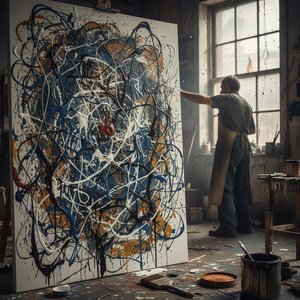
Pollock’s method was anything but conventional. He eschewed the easel and brush entirely, laying the canvas directly on the floor and moving around it with cans of paint, dripping and pouring the wet enamel onto the surface. This process, meticulously documented in photographs and videos, reveals a deeply physical engagement – Pollock wasn't simply applying color; he was wrestling with it, channeling his energy and emotions into every movement. The inclusion of unexpected materials—sand, pebbles, broken wood sticks, and fibers—further complicates the narrative, adding textural layers and hinting at a subconscious desire to incorporate elements from the natural world into his work. These additions aren't accidental; they contribute to the painting’s overall sense of dynamism and reinforce the idea that *Alchemy* is less about representing a specific subject and more about capturing a state of being – a moment of intense creative flux. The glossy finish of the enamel paint, reflecting light in myriad directions, amplifies this effect, creating an almost luminous quality within the composition.

Historical Resonance and Symbolic Weight

The title itself, *Alchemy*, is laden with significance. Given to the painting by Pollock’s neighbors, Ralph Manheim and his wife, it speaks to the transformative nature of the work – a metaphor for the artist's process and perhaps even for life itself. Born in 1912 in Cody, Wyoming, Pollock’s early exposure to the vast landscapes and diverse cultures of the American West undoubtedly shaped his artistic sensibility. His formative years spent traveling with his father, a land surveyor, instilled in him a deep appreciation for natural forms and an understanding of spatial relationships – qualities that would later inform his groundbreaking approach to painting. The painting's creation coincided with a period of intense experimentation within the art world, as artists sought to break free from representational constraints and explore new ways of expressing themselves. *Alchemy* stands as a powerful example of this shift, embodying the core tenets of Abstract Expressionism: spontaneity, emotional intensity, and a focus on the act of painting itself. The nineteen-color palette, revealed after meticulous restoration at the Opificio delle Pietre Dure in Florence, adds another layer of complexity to the work, suggesting a deliberate exploration of color theory and its potential to evoke specific emotions and sensations.

A Legacy of Innovation

Ultimately, *Alchemy* is more than just a beautiful painting; it’s a landmark achievement that continues to inspire artists and captivate audiences today. Pollock's influence on modern art is undeniable, and his work remains a cornerstone of American Abstract Expressionism. The piece’s open-endedness invites endless interpretation – there is no single “correct” reading, encouraging viewers to engage with the artwork on a deeply personal level. Its scale—114 x 195 cm—further enhances this immersive experience, demanding attention and inviting contemplation. A reproduction of *Alchemy* offers a unique opportunity to bring this iconic work into your space, allowing you to appreciate Pollock’s genius and contribute to the ongoing dialogue surrounding one of the most important paintings of the 20th century.

Perguntas e Respostas

"Alchemy" está disponível como uma impressão fine art?

Uma impressão de "Alchemy", de Jackson Pollock pode ser encomendada diretamente na sua página de Impressão Fine Art: uma impressão fine art em tela de algodão ou papel canvas de arquivo.

Por quais outros nomes ou pseudônimos Jackson Pollock é conhecido?

Jackson Pollock também é conhecido como Paul Jackson Pollock.

Qual artista e qual estilo estão por trás de "Alchemy"?

Por trás de "Alchemy" estão Jackson Pollock e o movimento Abstract Expressionism.

Saiba mais sobre esta pintura

Visualizar na parede Visualizar em RA Alternar para Impressão Alternar para Imagem Digital Compartilhar
Detalhes Guia Adicionar aos favoritos Baixar imagem Semelhantes Raio X Ver diaporama Perguntas e Respostas Estatísticas

Em números

  • 1947o ano em que foi pintada
  • 29molduras para escolher
  • tamanhos padrão, em suas próprias proporções
  • 5semanas para pintar e entregar
Jackson Pollock

Jackson Pollock

1912 - 1956, Estados Unidos da América

Informações rápidas sobre Jackson Pollock

  • Artistic Movement Or Style: Expressionismo Abstrato
  • Artists Or Movements Influenced By This Artist:
    • Color Field
    • Expressionismo Abstrato
  • Artists Who Influenced This Artist:
    • Thomas Hart Benton
    • André Masson
  • Date Of Birth: 28 jan 1912
  • Date Of Death: 11 ago 1956
  • Full Name: Paul Jackson Pollock
  • Nationality: Americano
  • Notable Artworks:
    • Número 1, 1950
    • Um: Número 31, 1950
    • Azul-Poles
    • Convergência
  • Place Of Birth: Cody, Wyoming

Biografia do Artista

Early Life and the Seeds of Innovation

Paul Jackson Pollock, born in Cody, Wyoming, in 1912, was a restless spirit from the outset. His early life was marked by frequent relocation as his father pursued work as a land surveyor across the vast landscapes of the American West. This itinerant existence instilled in young Pollock a deep connection to the natural world and an exposure to diverse cultures, particularly through encounters with Native American art during those surveying trips – impressions that would subtly permeate his artistic vision later in life. Though he never explicitly imitated Indigenous styles, the raw energy and spiritual resonance of these early experiences undoubtedly left their mark.

Pollock’s formal artistic training began at the Manual Arts High School in Los Angeles, followed by studies at the Art Students League of New York under the tutelage of Thomas Hart Benton. Benton, a prominent figure in the Regionalist movement, emphasized rhythmic composition and narrative themes rooted in American life. While Pollock initially absorbed these lessons, his inherent inclination leaned toward more abstract explorations. He was also profoundly impacted by Mexican muralists like José Clemente Orozco, whose powerful depictions of social struggle resonated deeply with him. These early influences laid a foundation, but it was the burgeoning world of Surrealism that truly unlocked Pollock’s artistic potential.

The Birth of Action Painting and a Revolutionary Technique

The 1930s saw Pollock experimenting with various techniques, seeking alternatives to traditional brushwork. He began pouring paint, exploring its fluidity and unpredictable nature. However, it was around 1947 that his artistic trajectory underwent a radical transformation. Abandoning the easel altogether, Pollock laid canvases directly on the floor, initiating what would become known as his “drip technique.” He then proceeded to drip, splash, and fling paint onto the canvas from above, orchestrating a dynamic dance between artist, medium, and surface.

This wasn’t merely about applying paint; it was about embodying the act of creation itself. Pollock's canvases became arenas for physical expression, capturing the immediacy of his gestures and emotions. The resulting paintings are characterized by their “all-over” composition – a lack of central focus that invites the viewer to explore the entire surface as a unified field of energy. Intricate networks of lines and colors intertwine, creating a visual complexity that is both captivating and challenging. He employed unconventional tools—sticks, knives, even syringes—to manipulate the paint in unpredictable ways, further emphasizing the spontaneous nature of his process.

This innovative approach positioned Pollock as a central figure in the burgeoning Abstract Expressionist movement, which emerged in post-World War II New York City. Abstract Expressionism prioritized spontaneous gesture, large scale, and non-representational imagery, reflecting a broader cultural shift away from traditional artistic conventions. His marriage to fellow artist Lee Krasner was also pivotal; she provided unwavering emotional support and actively encouraged his artistic development, recognizing the groundbreaking nature of his work.

Iconic Works and Lasting Legacy

Pollock’s most celebrated works—such as Number 1, 1950 (Lavender Mist), One: Number 31, 1950, Blue Poles: Number 11, 1952, and Convergence—are testaments to his revolutionary technique. These paintings are not simply images; they are records of a performance, imbued with the artist’s physical presence and emotional intensity. The dynamic energy that emanates from these canvases is palpable, drawing viewers into a world of pure abstraction.

His style transcends mere aesthetics; it's an exploration of process over product. Pollock sought to capture the immediacy of his actions and emotions on canvas, rejecting traditional notions of composition and representation. He delved into Jungian psychology, exploring archetypes and the subconscious in his art, seeking to tap into universal symbols and primal energies.

Pollock’s impact on the history of art is immeasurable. He fundamentally altered the way artists approached painting, breaking free from easel-based methods and embracing a more performative approach. His work helped solidify New York City's position as a global center for modern art, shifting the focus away from European dominance. His influence can be seen in the work of countless artists who followed, including those associated with Color Field painting and later forms of abstract expressionism.

A Complex Figure

Jackson Pollock’s life was marked by both artistic brilliance and personal struggles. He battled chronic alcoholism throughout much of his career, a condition that profoundly impacted his health and relationships. Despite these challenges, he remained fiercely dedicated to his art, constantly pushing the boundaries of creative expression. His reclusive nature and volatile personality often made him difficult to know personally, yet his work continues to resonate deeply with audiences around the world.

His legacy extends beyond the canvases themselves—it encompasses a revolutionary approach to painting that redefined artistic practice and forever altered the course of modern art. Pollock’s willingness to embrace spontaneity, challenge conventions, and explore the depths of human emotion cemented his place as one of the most important and influential artists of the 20th century.

Informações Rápidas

  • Artistic style: Abstract, Chaotic
  • Dimensions: 114 x 195 cm
  • Notable elements: Drip painting technique
  • Movement: Abstract Expressionism
  • Artist: Paul Jackson Pollock
  • Title: Alchemy