Alternar para Impressão
 Ler mais







































 Para obras de arte ou reproduções com mais de 105 cm (aproximadamente 41 polegadas) em qualquer um dos lados, a moldura será enviada como um kit desmontado. Este método garante uma entrega segura e evita danos durante o transporte.


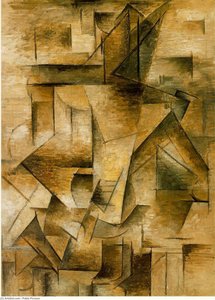
A Study in Quietude: Unveiling Picasso’s ‘Nude’
Pablo Picasso's “Nude” is not merely a depiction of the human form; it’s an exploration of introspection, a moment captured in time that resonates with a profound sense of melancholy and contemplation. Painted during his pivotal Cubist period, this work exemplifies Picasso’s radical departure from traditional representational art, offering instead a fragmented yet powerfully evocative portrait of a woman seated with her head bowed, lost in thought. The painting's power lies not just in its subject matter – the nude is a recurring motif throughout Picasso’s oeuvre – but in the artist’s masterful manipulation of space and form to convey an intensely personal emotional state.
Cubist Innovation and Deconstructed Reality
Created around 1909-1910, “Nude” firmly establishes Picasso within the burgeoning Cubist movement. Rejecting single viewpoints, he presents the figure through multiple perspectives simultaneously, fracturing her body into geometric shapes – sharp angles of the chair, overlapping planes of the torso, and distorted limbs. This technique wasn’t simply an aesthetic choice; it reflected a broader philosophical shift, mirroring the idea that reality itself is subjective and can be perceived in countless ways. The deliberate distortion serves to heighten the emotional impact, forcing the viewer to actively engage with the image and reconstruct its meaning.
- Oil on Canvas: Picasso’s choice of oil paint allowed for a rich, layered texture – crucial for building up the complex forms characteristic of Cubism.
- Geometric Fragmentation: The breakdown of form into interlocking planes is the defining feature of the style, challenging conventional notions of perspective and representation.
- Monochromatic Palette: Primarily utilizing shades of brown and grey, Picasso’s palette contributes to the painting's somber mood and emphasizes the formal elements rather than distracting from them.
Symbolism and Emotional Resonance
The woman’s posture – seated with her head bowed, hands gently resting on her head – immediately evokes a sense of vulnerability and quiet sadness. This isn't a celebratory depiction of the nude; it’s an intimate portrait of someone grappling with internal thoughts or perhaps mourning a loss. The ambiguity surrounding her gaze—directed into the distance—further amplifies this feeling, inviting viewers to project their own emotions onto the canvas. The influence of Picasso’s personal tragedies – the early deaths of his sister and other loved ones – undoubtedly informed this emotional depth.
A Legacy of Innovation
“Nude” stands as a cornerstone in Picasso's artistic development and a pivotal work within the history of modern art. It demonstrates his willingness to challenge established conventions, paving the way for subsequent movements like Futurism and Constructivism. Reproductions of this piece offer an unparalleled opportunity to experience firsthand the genius of one of the 20th century’s most influential artists. OriginalUniqueArt offers meticulously crafted hand-painted reproductions that capture not only the visual details but also the emotional essence of this iconic work, ensuring a timeless addition to any art collection or interior space.
Perguntas e Respostas
Onde posso comprar reproduções pintadas à mão de "Nude", de Pablo Picasso?
"Nude" está disponível como uma reprodução a óleo pintada à mão sobre tela de linho. O pedido pode ser feito em sua página de Reprodução Pintada à Mão, com escolha de tamanhos.
Qual é a luminância de "Nude", de Pablo Picasso?
As cores de "Nude" apresentam uma luminância Soft Shadow.
"Nude", de Pablo Picasso está entre as obras de Cubist Style mais procuradas?
"Nude", de Pablo Picasso é classificada como Iconic e pertence ao movimento Cubist Style.
 Visualizar na parede
 Compartilhar
 Compartilhar
 Detalhes
 Guia
Guia

 Baixar imagem
 Semelhantes
 Raio X
 Ver diaporama
 Q&A
Q&A Estatísticas