

 Visualizar em escala
 Enviar
 Compartilhar
 Ver detalhes

 Baixar imagem
 Semelhantes
 Raio X
 Apresentação de slides
 Estatísticas
Gossip on the Stairs


 Ver mais
Giclée / Impressão de Arte
Impressão giclée ou em tela de qualidade de museu, com produção rápida e opções flexíveis de acabamento. ( Encomendar reprodução pintada à mão Ver Imagem Digital)




































Escolha entre os nossos tamanhos pré-definidos que respeitam as proporções originais da obra de arte.

Você pode inserir suas próprias dimensões para se ajustar a uma moldura ou espaço específico. Se o tamanho selecionado não corresponder às proporções da imagem original, iremos recortar a obra de arte ou estender a imagem com uma borda espelhada ou preenchimento sólido. Um mockup digital será enviado para sua aprovação antes do início da produção.
Por favor, observe que a visualização na tela não reflete o recorte ou a extensão real. Apenas o mockup mostrará com precisão a composição final.
Embora tamanhos personalizados estejam disponíveis, recomendamos selecionar uma dimensão da lista predefinida para preservar as proporções originais.
Entrega mundial () em 2 semanas, em vez das 4/5 semanas padrão. (16 Setembro)

Envio expresso gratuito para todo o mundo

Tela de Linho Premium

Seguro de transporte total

Garantia de Reembolso de Impostos Alfandegários

Garantia de Fidelidade de Cor

Política de Devolução em 100 Dias (Apenas para Defeitos)

Garantia de reembolso de 100%

Desconto para múltiplas unidades
 A opção de vidro está disponível apenas para tamanhos inferiores a 110 cm

Gossip on the Stairs
Giclée / Impressão de Arte
Dimensões da Reprodução
-


Preço Total
$ 80
Biografia do Artista
The Elegance of an Era: The Life and Art of Otto Erdmann
In the golden twilight of the nineteenth century, as the industrial world began its rapid, soot-stained ascent, there existed a profound longing for the vanished splendor of the past. It was within this cultural tension that Otto Erdmann (1834–1905) carved his legacy, acting as a master weaver of nostalgia. Born in Leipzig to the chemist Otto Linné Erdmann, the artist inherited a sense of scientific precision that would later manifest in the meticulous textures of his brushwork. His journey through the prestigious academies of Leipzig, Dresden, and Munich allowed him to absorb the finest traditions of German genre painting, yet it was his encounter with the works of Ludwig von Hagn that truly ignited his passion for the Rococo Revival.
Erdmann’s artistic soul found its true home in Düsseldorf, a city then pulsating with creative energy. Settling there in 1858, he became a cornerstone of the illustrious Malkasten artists' association, serving on its board and contributing to a community that bridged the gap between classical tradition and modern observation. His work did not merely depict scenes; it resurrected an entire atmosphere of courtly grace. Through his eyes, the viewer is transported into opulent salons and sun-drenched corridors where the light dances across silk gowns and gilded ornaments, capturing a world of aristocratic leisure that felt both intimately real and dreamily distant.
A Mastery of Light and Rococo Revival
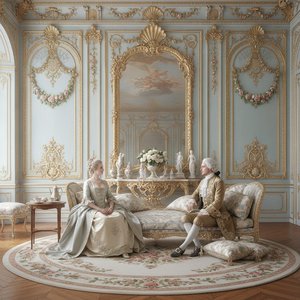
The brilliance of Erdmann’s technique lies in his ability to balance the decorative flourishes of the Rococo style with a profound sense of realism. He did not simply mimic the ornamentation of Louis XIV’s France; he reinterpreted it through a nineteenth-century lens, infusing his compositions with a psychological depth that elevated them above mere decoration. His paintings, such as the captivating Gossip on the Stairs, serve as windows into a highly choreographed social dance. Every fold of fabric, every glint of light on a porcelain tea service, and every subtle glance between figures is rendered with an almost tactile clarity.
This dedication to detail extended beyond the canvas into the realm of illustration, where his ability to capture character and atmosphere made him a sought-after talent for scholarly and high-society publications. His contributions to the Belgian journal L'Illustration Européenne in 1870 demonstrate his versatility as a visual storyteller. Whether he was documenting the intricate patterns of a ballroom or the quiet dignity of an interior scene, Erdmann possessed a unique gift for finding the extraordinary within the elegant.
Legacy and Historical Significance
While some might view the Rococo Revival as a retreat from the pressing realities of the late nineteenth century, Erdmann’s work represents something much more complex: a sophisticated preservation of cultural heritage. He was an artist who understood that beauty is a vital component of the human experience, even when it feels like a memory. His life was a tapestry of diverse interests, ranging from his involvement in theatrical performances to his recognition with the prestigious Order of the Red Eagle in 1898.
Today, the significance of Otto Erdmann resides in his role as a chronicler of an idealized European elegance. His paintings remain enduring testaments to a period of transition, offering a serene refuge of color and light. To study his oeuvre is to witness a master at work, navigating the delicate boundary between historical homage and personal artistic expression, ensuring that the charm of the aristocratic past would never truly fade from the collective memory of the art world.

otto erdmann
1834 - 1905
Informações Rápidas
- Artistic Movement Or Style: Rococo Revival
- Artists Or Movements Influenced By This Artist: ['American Modernism']
- Artists Who Influenced This Artist: ['Ludwig von Hagen']
- Date Of Birth: 1834
- Date Of Death: 1905
- Full Name: Otto Erdmann
- Nationality: German
- Notable Artworks:
- Gossip on the Stairs
- Interior Scene
- Place Of Birth: Germany
Artigos Relacionados

Século XIX na Arte: 10 Obras que Definem uma Era | OriginalUniqueArt
Mergulhe no século XIX com 10 obras de arte icônicas! Explore Monet, Renoir e Van Gogh. Descubra a história, técnica e emoção por trás dos mestres do Impressionismo e Realismo. Encontre reproduções de alta qualidade em OriginalUniqueArt.com.

The Elegance of Rococo: A Journey Through Pastel Dreams and Ornate Splendor
Embark on an elegant journey through the Rococo era. Discover the delicate beauty of pastel masterpieces, the intricate artistry of 18th-century French masters, and how this era of ornate splendor continues to inspire timeless luxury in fine art collecting.

Rococó: 10 Obras-Primas que Definiram um Movimento Artístico Elegante | OriginalUniqueArt.com
Descubra as 10 obras-primas do Rococó! Explore a elegância de Fragonard, Boucher e Watteau. A arte do século XVIII ganha vida com cores pastel e detalhes luxuosos. Encontre reproduções de alta qualidade em OriginalUniqueArt.com.

The Rococo Aesthetic: Opulence, Rebellion & the Pursuit of Pleasure in 18th-Century Art
Explore the opulent world of Rococo art! Discover its origins, key artists like Watteau & Boucher, and lasting influence on design. Expert insights for collectors & enthusiasts.
Rococo Art Guide: Elegance, Ornamentation, and the Era of Luxury
Explore the elegance of Rococo art. From Watteau to Fragonard, discover the history, aesthetics, and masters of 18th-century luxury in this expert guide for art lovers and collectors.