
() ·
A painting made for you, by hand
Reprodução em Óleo Feita à Mão
Óleo sobre tela pintado à mão no tamanho e moldura de sua escolha, feito sob encomenda pelos nossos artistas. ( Alternar para Impressão Alternar para Imagem Digital)
Descrição do Item
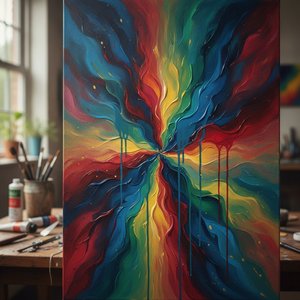
Explore Mordecai Ardon’s "Untitled (254)", a surreal oil painting blending expressionism & Kabbalah-inspired imagery. Witness turbulent waters, a blinding orb, and dynamic lines in this evocative work.
Biografia do Artista
Mordecai Ardon (1896-1992) was a pivotal Israeli painter known for his symbolic abstract expressionism, Kabbalah-inspired imagery & landscapes of Jerusalem. A key figure in regional Israeli art and creator of the iconic 'Ardon Windows'.
 Ler mais
from ·
Chapter 1
How large should it be?
Slide to change the size; the picture on the left shows the frame at its real width. The proportions of the original are kept.
Escolha entre os nossos tamanhos pré-definidos que respeitam as proporções originais da obra de arte.

Insira a largura e a altura desejadas para se ajustarem à sua moldura ou parede. Como esta obra é pintada à mão, para um tamanho com proporções diferentes, o artista poderá pintar um pouco mais ao redor da imagem ou reduzir ligeiramente a composição — você escolhe. Enviamos uma maquete digital para sua aprovação antes de iniciar a pintura. A imagem exibida nesta página não representa o resultado real — apenas a maquete mostra o resultado final.
Chapter 2
How should it arrive?
Choose the edges of the stretched canvas
Choose your frame

White €1

Blurside €1

Extended €1

P118B €10

P118H €10

P118W €10

P438Z €10

P508JH €12

P508YH €12

P805H €10

P805Z €10

P919BZ €10

P919G €10

P919XJ €10

P959ZH €10

P968JZ €12

W106C €8

W218G €10

W218JH €8

W218Y €10

W307PJ €10

W316G €10

W316PJ €8

W316Y €10

W398PJ €8

W4111J €10

W500HY €15

W500JH €15

W692G €12

W849H €8

W940BG €15

W953PJ €8

H24-GOLD €30

H24-SILVER €30

H36-GOLD €45

H36-SILVER €45
Com moldura
Moulding: . Overall size with the frame: .
Chapter 3
Who paints it, and should anything change?
After order, OriginalUniqueArt.com team will email client for instructions and provide a mockup preview
Entrega mundial () em 3 a 4 semanas, em vez das 5 semanas padrão. (2 Novembro). Sem comprometer a qualidade.
Chapter 4
The finishing touches
A nameplate, as in a museum?
Detalhes da Placa de Bronze Gravada
This elegant plaque features the artist's name and the title of the artwork, finely engraved for a timeless presentation.
It is made from bronze with a refined, elegant finish. The text is precisely laser-engraved for a sharp and permanent result. Measuring 9x2 cm, the plaque is compact yet easy to read. It's built to be durable and scratch-resistant, offering a professional, museum-quality look. Mounting is simple thanks to the included adhesive backing.
Detalhes da Placa de Acrílico Transparente
The plaque includes essential engraved details such as the artist's name, the title of the artwork, the date it was created, the type of media used-like oil on canvas or watercolor-a brief description of the piece, and a QR code that links to the complete artwork information.
It is crafted from clear acrylic, offering a sleek, modern appearance. The text is UV-engraved in black to ensure strong visual contrast. With a size of 10x15 cm, it ensures optimal readability. It comes equipped with two metal hooks for secure wall mounting. The plaque is designed to be weather-resistant, making it suitable for various environments, and it includes interactive features that work seamlessly with smartphone scanning.
Detalhes da Placa de Acrílico Preto
This elegant plaque includes engraved information such as the artist's name, the title of the artwork, the date it was created, the type of media used (like oil on canvas or watercolor), a short description of the artwork, and a QR code for quick access to more information.
The plaque itself is made from refined black acrylic with a premium finish. The text is laser-engraved in white for high contrast and readability. Its size is 10x15 cm, designed to be easy to read. It comes with two metal hooks for professional mounting. The design is sleek and fits any interior style. It is also weather-resistant and durable, with built-in digital integration for mobile compatibility.
A protective varnish?
When do you need it?
Chapter 5
Your painting, as you ordered it

Untitled (254)
Técnica de Reprodução
Tamanho da Reprodução
-

Artista Sênior de Elite
Mais detalhes, refinamento e tempo de produção adicional
-

Moldura para Reprodução
-
-
Para obras de arte ou reproduções com mais de 105 cm (aproximadamente 41 polegadas) em qualquer um dos lados, a moldura será enviada como um kit desmontado. Este método garante uma entrega segura e evita danos durante o transporte.
Montagem profissional necessária — este não é um produto DIY (faça você mesmo).
O kit deve ser montado e a tela esticada por um profissional de molduraria experiente, utilizando cola de madeira (não inclusa), um alicate de esticar tela e grampos para manter as travessas alinhadas enquanto a cola seca. A montagem incorreta ou a tensão desigual da tela podem danificar permanentemente a obra de arte e não estão cobertas pela nossa garantia.
 Para obras de arte ou reproduções com mais de 105 cm (aproximadamente 41 polegadas) em qualquer um dos lados, a moldura será enviada como um kit desmontado. Este método garante uma entrega segura e evita danos durante o transporte.
Todas as barras de madeira maciça estão incluídas, precisamente cortadas ao tamanho certo.
Montado com os parafusos fornecidos, além de cola para madeira para as junções dos cantos, que não está inclusa e deve ser providenciada pelo seu moldurista.
São necessárias ferramentas profissionais não incluídas: um alicate de estiramento de tela (esticador) e grampos para manter as ripas alinhadas enquanto a cola seca.
Importante:
As junções dos cantos requerem cola para madeira, as ripas devem ser mantidas com grampos até que a cola esteja completamente seca, e o estiramento da tela na moldura montada requer um alicate de esticar tela. Nenhum destes itens está incluído no kit. Por favor, certifique-se de contar com um profissional de molduraria experiente antes de encomendar este tamanho.

Etiqueta de identificação
-
-

Verniz de Proteção
Verniz brilhante (realça as cores e protege contra a luz e a umidade)
-

Personalizar minha obra
Exemplos de alterações possíveis: Substituir o rosto por uma foto do cliente; Adicionar um animal de estimação (ex.: substituir gato por cachorro); Incluir uma mensagem oculta no fundo; Alterar a paisagem ou os elementos do fundo.
-

Urgente
Entrega mundial () em 3 a 4 semanas, em vez das 5 semanas padrão. (2 Novembro). Sem comprometer a qualidade.
-
Envio Expresso
Entrega mundial para em 5 semanas. (9 Novembro).
Com envio incluído
Preço Total
€ 267
A opção de vidro está disponível apenas para tamanhos inferiores a 110 cm
Included with every order
- Envio expresso gratuito para todo o mundo
- Tela de Linho de Alta Qualidade
- Seguro de transporte completo
- Garantia de Reembolso de Impostos Alfandegários
- Garantia de Fidelidade Cromática
- Política de Devolução em 100 Dias (Apenas para Defeitos)
- Garantia de reembolso de 100%
- Oferta de desconto por quantidade


 Visualizar na parede
 Compartilhar
 Compartilhar
 Detalhes
 Guia
Guia

 Baixar imagem
 Semelhantes
 Raio X
 Ver diaporama
 Q&A
Q&A Estatísticas
In numbers
- 29frames to choose from
- standard sizes, in its own proportions
- 5weeks to paint and deliver it
About the original

Esta obra está protegida por direitos autorais
A obra de arte exibida nesta página é protegida por leis de direitos autorais, o que significa que não podemos criar ou vender legalmente uma reprodução idêntica. Esta proteção é aplicada por meio de acordos internacionais, tais como a Convenção de Berna e pelas leis nacionais, incluindo as estabelecidas por Lei de Direitos Autorais dos EUA - Título 17.
Como uma alternativa respeitosa e legal, oferecemos obras de arte personalizadas e pintadas à mão, inspiradas na obra original. Nossos artistas profissionais e experientes estudam cuidadosamente o estilo, a atmosfera e a essência artística da obra original para criar uma peça nova e única que evoque a mesma sensação — permanecendo como uma criação original por direito próprio.
Este método cumpre plenamente as regulamentações de direitos autorais, pois não envolve a cópia ou duplicação da obra protegida. Em vez disso, trata-se de uma reinterpretação criativa — uma nova pintura que é influenciada pela original, mas não idêntica a ela.

Mordecai Ardon
1896 - 1992, Austria
Quick facts about Mordecai Ardon
- Full Name: Mordecai Ardon
- Nationality: Israeli
- Date Of Birth: 1896
- Date Of Death: 1992
- Place Of Birth: Tuchów, Austria
- Notable Artworks:
- Untitled (216)
- Untitled (790)
- Untitled (254)
- Artistic Movement Or Style: Abstract Expressionism
- Artists Who Influenced This Artist: Johannes Itten, Wassily Kandinsky, Paul Klee
- Artists Or Movements Influenced By This Artist: Bauhaus
Biografia do Artista
Mordecai Ardon: Pioneer of Symbolic Landscape Painting
Mordecai Ardon (Hebrew: מרדכי ארדון; 13 July 1896 – 18 June 1992) was an Israeli painter, considered a pivotal figure in regional Israeli art and recognized for his distinctive approach to landscape painting infused with Kabbalah symbolism. Born Max Bronstein in Tuchów, Galicia (then Austria-Hungary, now Poland), Ardon’s artistic journey began amidst the burgeoning Bauhaus movement, where he honed his architectural skills alongside luminaries like Johannes Itten, Wassily Kandinsky, and Paul Klee. This formative period instilled a profound appreciation for geometric abstraction and influenced his later stylistic explorations.- Early Life & Education: Ardon’s upbringing in Tuchów exposed him to the Austro-Hungarian cultural landscape, shaping his worldview before he emigrated to Jerusalem in 1933 during the British Mandate of Palestine. He pursued architectural studies at Bauhaus University Weimar and Munich, absorbing the revolutionary ideas circulating within the artistic community.
- Bauhaus Influence & Artistic Development: Studying under influential masters like Kandinsky and Klee solidified Ardon’s commitment to abstraction while simultaneously fostering an interest in exploring spiritual themes. His Bauhaus training provided him with a foundational understanding of form and color theory that would permeate his subsequent works.
Kabbalah & Symbolic Imagery: The Roots of His Vision
Ardon’s artistic style evolved dramatically in the 1950s, adopting a complex system of symbolic images drawn from Jewish mysticism (Kabbalah) and biblical narratives. He rejected representational art altogether, prioritizing instead to convey cosmic dimensions within his landscapes—particularly those depicting Jerusalem—by layering textures and colors with meticulous precision. His paintings weren’t merely depictions of places; they were attempts to capture the essence of their spiritual significance. As he famously stated, “I seek to impart a cosmic dimension to the present, linking it to antiquity and mystery.” Recurring motifs like circles, squares, and stylized birds reflected Kabbalistic concepts of divine unity and creation.- Kabbalah’s Impact: Ardon's fascination with Kabbalah profoundly shaped his artistic vocabulary. He utilized geometric forms and color palettes reminiscent of Kabbalistic diagrams to express profound spiritual ideas.
Notable Works & Recognition
Ardon achieved considerable acclaim during his lifetime, notably participating in the Venice Biennale of 1968 where he showcased “Gates of Light,” a painting that powerfully captured "the inner mystery and timelessness of the landscape." His monumental stained-glass windows, known as ‘Ardon Windows,’ installed prominently in the National Library of Israel, exemplify his masterful technique and represent a lasting contribution to Israeli art. The sale of “The Awakening” for $821,000 at Sotheby’s in 2014 underscored the enduring value of his oeuvre. Furthermore, Ardon mentored numerous artists who went on to develop their own distinctive styles, cementing his legacy as a teacher and influential figure within the Israeli art scene.Legacy & Influence
Mordecai Ardon’s artistic vision—characterized by its symbolic depth, geometric precision, and unwavering commitment to conveying spiritual contemplation—continues to inspire artists today. He is regarded as the father of the regional approach in Israeli art, prioritizing local mythology and cultural heritage alongside universal themes of transcendence. His work stands apart for its ability to transform ordinary landscapes into canvases brimming with cosmic resonance, securing his place as one of Israel’s most significant artistic voices.Artigos Relacionados

Top 10 Obras-Primas do Expressionismo Abstrato: Arte para Decorar e Inspirar | OriginalUniqueArt.com
Descubra as 10 obras-primas do Expressionismo Abstrato com Jackson Pollock, Mark Rothko e mais! Explore a história, técnica e emoção por trás de cada pintura. Encontre reproduções de arte exclusivas para decorar sua casa em OriginalUniqueArt.com.

Abstração Geométrica: 10 Obras-Primas que Moldaram a Arte Moderna | OriginalUniqueArt.com
Descubra as 10 obras-primas da Abstração Geométrica que revolucionaram a arte moderna! Explore Kandinsky, Mondrian e outros artistas icônicos. Encontre reproduções de alta qualidade para decorar sua casa com OriginalUniqueArt.com.

Kandinsky: As 25 Obras-Primas que Definem o Abstracionismo | OriginalUniqueArt
Descubra as 25 obras-primas de Wassily Kandinsky, pioneiro da arte abstrata! Explore a história, cores e significado por trás de cada pintura. Encontre reproduções de alta qualidade e inspire sua decoração em OriginalUniqueArt.com.
Lyrical Abstraction: The Emotional Power of Color and Form in Modern Art History
Explore the profound emotional depth of Lyrical Abstraction. Discover how masters like Raymond Parker used color and form to bridge Impressionism and Abstract Expressionism. Learn about this pivotal movement through our expert-led art history guide.
