

 Visualizar na parede
 Compartilhar
 Compartilhar
 Detalhes

 Baixar imagem
 Semelhantes
 Raio X
 Slideshow
 Estatísticas
About Young Sister
 Oil On Canvas
- WallArt
- Expressionism
 1911
1911- Modern
 73.0 x 60.0 cm
 Ler mais
Giclée / Impressão de Arte
Impressão giclée ou em tela de qualidade de museu, com produção rápida e opções flexíveis de acabamento. ( Comprar pintura feita à mão Alternar para Imagem Digital)




P118B $10

P118H $10

P118W $10

P438Z $10

P508JH $12

P508YH $12

P805H $10

P805Z $10

P919BZ $10

P919G $10

P919XJ $10

P959ZH $10

P968JZ $12

W106C $8

W218G $10

W218JH $8

W218Y $10

W307PJ $10

W316G $10

W316PJ $8

W316Y $10

W398PJ $8

W4111J $10

W500HY $15

W500JH $15

W692G $12

W849H $8

W940BG $15

W953PJ $8




Escolha entre os nossos tamanhos pré-definidos que respeitam as proporções originais da obra de arte.

Você pode inserir suas próprias dimensões para se ajustar a uma moldura ou espaço específico. Se o tamanho selecionado não corresponder às proporções da imagem original, iremos recortar a obra de arte ou estender a imagem com uma borda espelhada ou preenchimento sólido. Um mockup digital será enviado para sua aprovação antes do início da produção.
Por favor, observe que a visualização na tela não reflete o recorte ou a extensão real. Apenas o mockup mostrará com precisão a composição final.
Embora tamanhos personalizados estejam disponíveis, recomendamos selecionar uma dimensão da lista predefinida para preservar as proporções originais.
Entrega mundial () em 2 semanas, em vez das 4/5 semanas padrão. (11 Setembro)

Envio expresso gratuito para todo o mundo

Tela de Linho de Alta Qualidade

Seguro de transporte completo

Garantia de Reembolso de Impostos Alfandegários

Garantia de Fidelidade Cromática

Política de Devolução de 100 Dias (Apenas Defeitos)

Garantia de reembolso de 100%

Oferta de desconto por quantidade
 A opção de vidro está disponível apenas para tamanhos inferiores a 110 cm

About Young Sister
Giclée / Impressão de Arte
Tamanho da Reprodução
-


Preço Total
$ 80
About “About Young Sister” – A Glimpse into Duchamp’s Early Style
Marcel Duchamp's *About Young Sister*, painted in 1911, offers a fascinating window into the artist’s formative period—a time of stylistic exploration before his radical departures into Conceptual Art. This 73 x 60 cm canvas isn’t a straightforward portrait; rather, it’s an evocative study of form and atmosphere, hinting at a figure engaged with music while simultaneously dissolving into abstraction.Subject & Composition
The artwork centers on a seated individual, strongly suggested to be playing a stringed instrument – likely a violin – though the depiction is far from literal. The figure isn’t sharply defined; instead, it emerges from and blends with large, amorphous shapes that surround it. Duchamp deliberately positions the subject slightly off-center, creating a dynamic tension within the composition. These surrounding forms aren't merely background elements but active participants in defining space and mood.Style & Technique
*About Young Sister* showcases Duchamp’s early leanings towards both Expressionism and Cubism. Visible brushstrokes and a loose, painterly style dominate the surface, prioritizing emotional expression over precise representation. The color palette is deliberately muted – primarily beige, brown, and gray – contributing to a somber yet contemplative atmosphere. Duchamp employs expressive lines to delineate forms, favoring soft transitions over harsh edges. Layering of paint creates texture and depth, while the diffused lighting minimizes strong contrasts, flattening the image plane. The lack of traditional perspective further emphasizes this flatness, relying instead on spatial relationships between shapes.Historical Context & Artistic Evolution
Created in 1911, *About Young Sister* predates Duchamp’s most famous and provocative works like *Fountain*. It represents a crucial stage in his artistic development, demonstrating his engagement with the avant-garde movements of the time. While still rooted in representational painting, the work foreshadows his later rejection of traditional artistic conventions. Duchamp was beginning to question the very definition of art, moving away from purely “retinal” experiences (pleasing the eye) towards works that engaged the intellect.Symbolism & Emotional Impact
The piece evokes a sense of introspection and perhaps melancholy. The abstracted form of the figure and the muted color scheme contribute to this mood. The musical instrument suggests themes of creativity, expression, and possibly longing. The ambiguity inherent in the work invites viewers to project their own interpretations onto it, fostering a personal connection with the artwork. It’s not simply *about* a young sister; it's about memory, emotion, and the elusive nature of perception.For Collectors & Designers
*About Young Sister* is an exceptional example of Duchamp’s early work, offering collectors a rare opportunity to acquire a piece that demonstrates his artistic transition. Its subdued palette and abstract forms make it incredibly versatile for interior design. It would complement modern or minimalist spaces, adding depth and sophistication without overwhelming the room.- Ideal for living rooms, studies, or bedrooms.
- Pairs well with neutral color schemes and natural materials.
- A conversation starter that showcases discerning taste.
Biografia do Artista
Marcel Duchamp, A Revolutionary Spirit: The Life and Art of Marcel Duchamp
Marcel Duchamp, born Henri-Robert-Marcel Duchamp in 1887 in Blainville-Crevon, Normandy, was more than an artist; he was a philosophical provocateur who fundamentally altered the course of modern art. His early life, though seemingly conventional – nurtured within a family that appreciated artistic expression with both brothers pursuing successful careers as artists – hinted at the iconoclasm to come. Duchamp initially pursued formal training, mastering traditional techniques and experimenting with post-impressionist styles. However, this academic foundation served not as an end in itself, but as a springboard for questioning the very nature of art, its purpose, and its definition. He wasn’t content merely to depict the world; he sought to challenge how we perceive it, and what constitutes artistic value. This restless intellectual curiosity would become the defining characteristic of his prolific career.Early Artistic Explorations: Cubism and Impressionism
Duchamp's initial foray into art began with a grounding in traditional techniques—primarily painting—influenced by Impressionism and Post-Impressionism. He honed his skills studying under Gustave Moreau at École Supérieure des Beaux-Arts in Paris, absorbing the stylistic innovations of artists like Cézanne and Picasso. His early canvases demonstrate an aptitude for capturing light and color, reflecting a sensitivity to visual aesthetics. However, Duchamp quickly recognized that mere imitation wasn’t sufficient to express his profound ideas about art and its role in society. The devastating impact of World War I profoundly affected him, fueling disillusionment with the prevailing artistic conventions of the time. This experience spurred him toward a radical rethinking of artistic practice—a rejection of established norms and a determination to disrupt accepted notions of beauty.The Dadaist Rebellion: Challenging Artistic Conventions
Duchamp’s engagement with Dadaism marked a decisive turning point in his artistic trajectory. Emerging from the disillusionment following World War I, Dada rejected logic, reason, and traditional artistic values—a defiant stance against the perceived hypocrisy of bourgeois society. Artists like Tristan Tzara, Hugo Ball, and Hans Arp embraced absurdity and chance as creative tools, producing performances and collages that deliberately undermined conventional aesthetic standards. Duchamp’s contribution to Dada was particularly significant: he championed the concept of “readymade”—ordinary manufactured objects presented as art—a provocative gesture designed to dismantle hierarchies within the art world. His most famous readymade, *Fountain* (1917), consisted of a porcelain urinal signed "R. Mutt," submitted anonymously to Marcel Duchamp’s own exhibition in New York City. This audacious act challenged the very definition of artistic skill and authorship—was it the artist's hand that created the work, or was it merely the artist’s conceptual intervention?The Readymades: Conceptual Art Takes Root
Duchamp’s exploration of readymades solidified his position as a pioneer of Conceptual Art. He argued that the essence of art resided not in its visual appearance but in its underlying idea—a notion that fundamentally shifted the focus from craftsmanship to intellectual inquiry. Other notable readymades included *L.H.O.O.Q.* (1919), a reproduction of Leonardo da Vinci’s Mona Lisa overlaid with a mustache and goatee, and *The Large Glass* (1915–1923), an ambitious multi-faceted artwork incorporating glass panels, mirrors, and intricate engravings—a testament to Duchamp's meticulous attention to detail and his unwavering commitment to challenging artistic conventions. These works weren’t intended to elicit admiration for their aesthetic qualities; they were designed to provoke contemplation and confront viewers with uncomfortable questions about art history and cultural values.Legacy and Enduring Influence
Marcel Duchamp’s influence on subsequent generations of artists is undeniable. He irrevocably transformed our understanding of art, establishing Conceptual Art as a dominant force in the latter half of the 20th century. His insistence that the artist's concept superseded visual form continues to inspire creativity today—artists grapple with questions of authorship, originality, and the role of intention in artistic creation. Duchamp’s unwavering belief in intellectual rigor and his willingness to disrupt established norms cemented his place as one of the most important figures in modern art history. His legacy persists, urging artists to question assumptions and embrace radical experimentation—a challenge that resonates powerfully within contemporary artistic discourse. He remains a symbol of artistic freedom and intellectual provocation, demonstrating that true innovation lies not merely in mastering technique but in confronting fundamental questions about what constitutes art itself.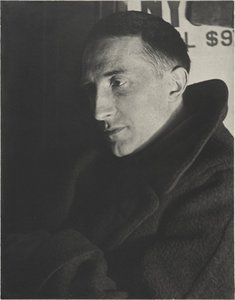
Marcel Duchamp
1887 - 1968 , França
Dados Rápidos
- Artistic Movement Or Style:
- Cubismo
- Dadaísmo
- Artists Or Movements Influenced By This Artist: ['Minimalismo']
- Date Of Birth: 28 Jul 1887 Blainville
- Date Of Death: 2 Oct 1968
- Full Name: Marcel Duchamp Henri-Robert-Marcel
- Nationality: Francês-Americano
- Notable Artworks:
- Fonte
- L.H.O.O.Q.
- Grande Cristal
- Place Of Birth: Normandia França
Artigos Relacionados

Kandinsky: As 25 Obras-Primas que Definem o Abstracionismo | OriginalUniqueArt
Descubra as 25 obras-primas de Wassily Kandinsky, pioneiro da arte abstrata! Explore a história, cores e significado por trás de cada pintura. Encontre reproduções de alta qualidade e inspire sua decoração em OriginalUniqueArt.com.

Abstração Geométrica: 10 Obras-Primas que Moldaram a Arte Moderna | OriginalUniqueArt.com
Descubra as 10 obras-primas da Abstração Geométrica que revolucionaram a arte moderna! Explore Kandinsky, Mondrian e outros artistas icônicos. Encontre reproduções de alta qualidade para decorar sua casa com OriginalUniqueArt.com.
Beyond Representation: Exploring the Emotional Landscape of Abstract Expressionism
Explore the profound emotional world of Abstract Expressionism with OriginalUniqueArt. Discover key artists like Pollock & Rothko, learn about collecting, and find museum-quality reproductions to inspire your space.

Top 10 Obras-Primas do Expressionismo Abstrato: Arte para Decorar e Inspirar | OriginalUniqueArt.com
Descubra as 10 obras-primas do Expressionismo Abstrato com Jackson Pollock, Mark Rothko e mais! Explore a história, técnica e emoção por trás de cada pintura. Encontre reproduções de arte exclusivas para decorar sua casa em OriginalUniqueArt.com.
Cubismo Expressionista: 10 Obras-Primas que Moldaram a Arte Moderna | OriginalUniqueArt
Descubra as 10 obras-primas do Cubismo Expressionista que revolucionaram a arte moderna! Explore Picasso, Braque e outros mestres. Reproduções de alta qualidade para decorar sua casa com estilo. Explore a coleção completa em OriginalUniqueArt.com


