

 Visualizar na parede
 Compartilhar
 Compartilhar
 Detalhes
 Guia
Guia

 Baixar imagem
 Semelhantes
 Raio X
 Ver diaporama
 Estatísticas
An angel painter
 Acrylic On Canvas
- WallArt
- Naïve Art (Primitivism)
 1928
1928- Modern
 66.0 x 51.0 cm
 Ler mais
Get a print-ready file that goes far beyond the web preview. Every digital image we sell comes from a high-resolution master in our stock database — usually 5,000 to 15,000 pixels wide — so you can print large, crop tightly, or reproduce fine detail with confidence.
No file leaves our studio untouched. A digital expert checks the colors against the original painting and corrects them if needed, then improves clarity and detail with professional retouching tools — always staying faithful to the artist's brushwork and style. The result is an image that looks like the painting, not like a filtered scan.
You approve before you're done: our expert sends the image by e-mail within 72 hours for your review. Not satisfied? Ask for improvements or corrections, or request a refund if the quality falls short.
This is the quality relied on by publishers, design studios, galleries and print shops.
Imagem Digital
Baixe um arquivo de alta resolução para exibição pessoal, impressão e projetos criativos. ( Alternar para Impressão Comprar pintura feita à mão)
Incluído em cada compra de imagem digital
Entrega Digital Especializada e Garantida
Ao escolher o OriginalUniqueArt.com, você não está apenas adquirindo uma imagem — você está recebendo uma obra de arte digital profissionalmente aprimorada, elaborada com precisão e com garantia de satisfação. Aqui está tudo o que acompanha seu pedido, automaticamente:

Entrega rápida por e-mail
O seu arquivo de imagem digital em alta resolução será enviado por e-mail em até 72 horas após o pedido — pronto para uso imediato.

Arquivo Digital com IA Otimizado
Sua obra de arte é otimizada profissionalmente por meio de ferramentas avançadas de IA e edição manual, garantindo o máximo de detalhes, clareza e precisão de cores.

Reenvio gratuito vitalício
Apagou ou perdeu o seu ficheiro acidentalmente? Não se preocupe – nós reenviamos para si a qualquer momento, gratuitamente.

Sem Taxas de Importação - Sempre
Desfrute da sua obra de arte instantaneamente, sem taxas alfandegárias, impostos ou custos de entrega — downloads digitais são sempre isentos de taxas.

Garantia de Fidelidade de Cores
Garantimos que sua imagem digital reflita as cores originais com a maior fidelidade possível, utilizando ferramentas profissionais e gerenciamento de cores.

Garantia de satisfação de 100 dias
Se não estiver satisfeito com a sua imagem digital, nós a revisaremos ou reembolsaremos 100% dentro de 100 dias — sem perguntas.

Garantia de Reembolso 100%
Não está satisfeito? Receba o reembolso total em até 100 dias após o recebimento do seu arquivo digital — sem perguntas.

Descontos para pedidos em lote
Compre 3 imagens, economize 10% - Compre 5, economize 15% - Compre 10+, economize 20%. Ideal para projetos criativos, galerias e agências.
An Angel Painter: A Glimpse into Marc Chagall’s Dreamscape
Marc Chagall, a name synonymous with vibrant color and deeply personal symbolism, remains one of the 20th century's most beloved artists. His work transcends mere representation, offering instead a window into his own rich inner world – a world populated by fantastical figures, biblical narratives, and fragments of memory. Amongst his vast oeuvre, “An Angel Painter” (1928), housed within OriginalUniqueArt’s exquisite hand-painted reproductions, stands as a particularly poignant example of this unique artistic vision. Created during a pivotal period in Chagall's career – a time when he was deeply immersed in the avant-garde circles of Paris – the painting is not simply a depiction of an angel; it’s a self-portrait rendered through the lens of his distinctive Naïve Art style, a style that deliberately eschews academic precision for raw emotion and intuitive expression. The scene unfolds within a simple, almost childlike church setting. A doorway dominates the composition, framed by a modest building – a structure suggesting both sanctuary and earthly connection. Standing before this entrance is a figure, unmistakably Chagall himself, holding a paintbrush aloft as if to capture the divine light streaming from above. This gesture immediately establishes the painting’s central theme: the artist's role as a conduit between the spiritual and the material realms. The presence of several other figures – some engaged in artistic pursuits, others seemingly observing with quiet contemplation – adds layers of narrative complexity without disrupting the overall dreamlike atmosphere. A bird, rendered with characteristic Chagallian exuberance, circles overhead, symbolizing freedom, hope, and perhaps even divine guidance. The color palette is dominated by rich blues, yellows, and reds—colors that evoke both the warmth of human emotion and the luminosity of spiritual experience. “An Angel Painter” firmly places itself within the context of Naïve Art (Primitivism), a movement characterized by its directness, simplicity, and rejection of traditional artistic conventions. Artists associated with this style often lacked formal training but possessed an extraordinary ability to convey powerful emotions through bold colors, flattened perspectives, and symbolic imagery. Chagall’s work embodies these qualities perfectly; his brushstrokes are loose and expressive, his forms simplified, and his use of color intensely vibrant. Interestingly, the Naïve Art movement was not entirely dismissed by the established art world. In fact, it gained a certain prestige as “pseudo-naïve” or “faux naïve,” with trained artists deliberately adopting this style to tap into its raw emotional power. This deliberate mimicry highlights the enduring appeal of Naïve Art’s uninhibited expression and its ability to bypass intellectual analysis in favor of direct feeling. The painting's historical context is crucial to understanding its deeper meaning. In the 1920s, Chagall was experiencing a period of intense creative ferment in Paris, surrounded by fellow avant-garde artists like Pablo Picasso and Henri Matisse. This environment profoundly influenced his work, leading him to incorporate more abstract elements while retaining his signature dreamlike imagery. “An Angel Painter” can be interpreted as a reflection of this transformative period – a visual representation of Chagall’s own artistic journey, grappling with the challenges and possibilities of modern art. Furthermore, it echoes themes prevalent in Chagall's broader body of work, particularly his explorations of Jewish folklore, biblical narratives, and the complexities of human relationships. The painting resonates with other iconic works like “Abraham is going to sacrifice his son,” "Study to Jacob Wrestling with the Angel," and "Moses and Aaron," all of which share a common thread of spiritual searching and emotional intensity. OriginalUniqueArt’s hand-painted reproductions capture the essence of “An Angel Painter” with remarkable fidelity, preserving the artist's unique style and vibrant color palette. Each reproduction is meticulously crafted by skilled artists who have painstakingly recreated Chagall’s vision, ensuring that art enthusiasts can experience this masterpiece in all its glory. Available in a range of sizes and framing options, this stunning artwork offers an exceptional opportunity to own a piece of Chagall's extraordinary legacy – a testament to the power of imagination and the enduring beauty of Naïve Art. Explore more of Marc Chagall’s masterpieces at OriginalUniqueArt.com/MarcChagall.Key Features & Technical Details
- Artist: Marc Chagall
- Title: An Angel Painter
- Year: 1928
- Style: Naïve Art (Primitivism)
- Medium: Gouache and Watercolor on Paper
- Dimensions: 66.3 x 51.6 cm
Symbolism & Interpretation
The painting is rich in symbolic meaning, inviting multiple interpretations. The angel figure undoubtedly represents Chagall himself, engaged in the act of creation and seeking divine inspiration. The church doorway symbolizes both earthly existence and access to the spiritual realm. The bird embodies freedom, hope, and perhaps even a connection to the heavens. The other figures likely represent fellow artists or individuals associated with the artistic community of Paris during this period. Overall, “An Angel Painter” is a meditation on the role of the artist, the pursuit of beauty, and the search for meaning in a rapidly changing world.Own a Piece of Art History
OriginalUniqueArt’s hand-painted reproductions offer an unparalleled opportunity to own a genuine representation of Marc Chagall's “An Angel Painter.” Each reproduction is created with meticulous attention to detail, capturing the artist’s unique style and vibrant color palette. Discover more about Marc Chagall and explore other masterpieces at OriginalUniqueArt.com/MarcChagall.Perguntas e Respostas
A que fase da carreira de Marc Chagall corresponde a data de 1928 de "An angel painter"?
Dada a sua data de 1928, "An angel painter" insere-se no período 1920s France de Marc Chagall.
Qual é a orientação de "An angel painter", de Marc Chagall?
"An angel painter", de Marc Chagall possui um formato Portrait. O formato descreve as proporções da composição.
Em que ambiente sugere-se exibir "An angel painter", considerando a sua paleta de cores?
A paleta de cores Neutrals de "An angel painter", de Marc Chagall harmoniza perfeitamente com o ambiente recomendado: um(a) Living Room.
Biografia do Artista
A Life Painted in Dreams: The World of Marc Chagall
Marc Chagall, born Moishe Shagal in 1887 in the small Belarussian town of Liozna near Vitebsk, wasn’t merely a painter; he was a poet of color, a weaver of dreams, and a chronicler of memory. His life, spanning nearly a century, mirrored the tumultuous currents of the 20th century, yet his art remained steadfastly rooted in a deeply personal vision—one infused with the folklore of his Hasidic Jewish upbringing and an unwavering belief in the power of imagination. Vitebsk itself was more than just a birthplace; it became the emotional core of his artistic universe, a recurring motif populated by flying figures, whimsical animals, and the vibrant hues of remembered landscapes. The town’s unique blend of cultures—Russian Orthodox churches alongside bustling Jewish marketplaces—forged an aesthetic sensibility that would defy easy categorization throughout his long career. Though he sought formal training first with a local sign painter and later in St. Petersburg under Léon Bakst, and then in Paris at the Académie de la Grande Chaumière, Chagall never fully embraced any single artistic movement. He absorbed elements of Cubism, Symbolism, and Fauvism, but always filtered them through his own intensely personal lens, creating a style that was uniquely, unmistakably Chagall.Early Influences and Artistic Beginnings
Chagall’s formative years were marked by the traditions of Vitebsk’s Jewish community—a vibrant tapestry woven with religious rituals, folk tales, and ancestral memories. These influences profoundly shaped his artistic sensibility, informing his use of symbolism and his fascination with biblical narratives. His initial training encompassed practical skills honed in the craft of sign painting, followed by a more structured education at St. Petersburg Academy of Art under Léon Bakst, where he encountered the avant-garde spirit of Russian Symbolism. However, Chagall’s artistic path diverged from conventional academic pursuits. He prioritized experimentation and intuition over technical precision, rejecting rigid stylistic constraints in favor of expressive freedom. Paintings like I and the Village (1911) exemplify this approach—a deliberate departure from realistic representation that prioritizes emotional resonance and evocative imagery. The fragmented composition captures not just a landscape but also the artist’s subjective experience of place and time, foreshadowing his signature style.The Symbolist Vision: Color and Emotion
Chagall's artistic language quickly developed into one characterized by bold color palettes and emotionally charged imagery. He eschewed naturalistic hues in favor of vibrant shades—deep blues, fiery reds, luminous yellows—that conveyed feeling rather than factual accuracy. Figures appear to float or dance across the canvas, defying gravity and logic, creating a dreamlike atmosphere that invites viewers into his inner world. This stylistic technique wasn’t merely decorative; it was integral to Chagall's artistic philosophy—a conviction that art should transcend mere imitation of reality and capture the essence of human experience. Recurring motifs—flying figures, musical instruments, animals—became emblems of Chagall’s worldview, reflecting his spiritual beliefs and his fascination with folklore. These symbols weren’t presented in a didactic manner but rather interwoven into complex compositions that demanded contemplation and interpretation.The Revolution and Vitebsk Revisited
The Russian Revolution dramatically altered Chagall's life trajectory, returning him to Vitebsk—the town that had nurtured his artistic imagination since childhood. During this period, he actively participated in cultural initiatives aimed at revitalizing Jewish identity and fostering artistic creativity. He established an art school alongside Aleksandr Rodchenko, attracting young artists from across Russia who embraced the avant-garde spirit of the era. However, Chagall’s engagement with Soviet culture was fraught with tensions—a clash between his artistic vision and the ideological imperatives of the regime. Despite these challenges, he continued to produce groundbreaking works that explored themes of exile, faith, and human dignity.International Recognition and Artistic Legacy
Chagall's reputation soared internationally after World War II, attracting commissions from prominent patrons and securing exhibitions in major museums around the globe. He relocated to Paris in 1940, where he remained until his death in 1985—a period marked by prolific artistic output and profound personal reflection. His monumental stained glass windows for the Hadassah Hebrew University Medical Center synagogue in Jerusalem stand as a testament to his enduring influence on Jewish culture and spirituality. Furthermore, his paintings like Over Vitebsk (1920-1922) and White Crucifixion (1938) continue to resonate with audiences worldwide—powerful expressions of emotion and imagination that transcend cultural boundaries. Chagall’s legacy extends beyond his artistic creations; it resides in the enduring power of his vision—a vision that celebrates love, memory, and the boundless possibilities of the human spirit. He left behind a body of work that is both deeply personal and universally accessible, inviting viewers to lose themselves in a world painted with dreams and illuminated by hope.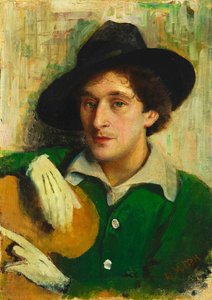
Marc Chagall
1887 - 1985 , Belarus
Breve Biografia
- Artistic Movement Or Style: Cubismo, Surrealismo
- Artists Or Movements Influenced By This Artist:
- Surrealismo
- Modern artistas
- Artists Who Influenced This Artist:
- Bakst
- Delaunay
- Borovikovsky
- Date Of Birth: 6 julho 1887
- Date Of Death: 28 março 1985
- Full Name: Marc Chagall
- Nationality: Russo-Francês
- Notable Artworks:
- I e a Vila
- Sobre Vitebsk
- Place Of Birth: Liozna, Bielorrússia