

 Visualizar em escala
 Enviar
 Compartilhar
 Ver detalhes
 Guia de Obras do Aluno

 Baixar imagem
 Semelhantes
 Raio X
 Apresentação de slides
 Estatísticas
PATRES ET CHEVAL PIE


 Ver mais
Giclée / Impressão de Arte
Impressão giclée ou em tela de qualidade de museu, com produção rápida e opções flexíveis de acabamento. ( Encomendar reprodução pintada à mão Ver Imagem Digital)




P118B $10

P118H $10

P118W $10

P438Z $10

P508JH $12

P508YH $12

P805H $10

P805Z $10

P919BZ $10

P919G $10

P919XJ $10

P959ZH $10

P968JZ $12

W106C $8

W218G $10

W218JH $8

W218Y $10

W307PJ $10

W316G $10

W316PJ $8

W316Y $10

W398PJ $8

W4111J $10

W500HY $15

W500JH $15

W692G $12

W849H $8

W940BG $15

W953PJ $8




Escolha entre os nossos tamanhos pré-definidos que respeitam as proporções originais da obra de arte.

Você pode inserir suas próprias dimensões para se ajustar a uma moldura ou espaço específico. Se o tamanho selecionado não corresponder às proporções da imagem original, iremos recortar a obra de arte ou estender a imagem com uma borda espelhada ou preenchimento sólido. Um mockup digital será enviado para sua aprovação antes do início da produção.
Por favor, observe que a visualização na tela não reflete o recorte ou a extensão real. Apenas o mockup mostrará com precisão a composição final.
Embora tamanhos personalizados estejam disponíveis, recomendamos selecionar uma dimensão da lista predefinida para preservar as proporções originais.
Entrega mundial () em 2 semanas, em vez das 4/5 semanas padrão. (26 Setembro)

Envio expresso gratuito para todo o mundo

Tela de Linho Premium

Seguro de transporte total

Garantia de Reembolso de Impostos Alfandegários

Garantia de Fidelidade de Cor

Política de Devolução em 100 Dias (Apenas para Defeitos)

Garantia de reembolso de 100%

Desconto para múltiplas unidades
 A opção de vidro está disponível apenas para tamanhos inferiores a 110 cm

PATRES ET CHEVAL PIE
Giclée / Impressão de Arte
Dimensões da Reprodução
-


Preço Total
$ 80
A Pastoral Vision: Karel Dujardin’s “Patres et Cheval Pie”
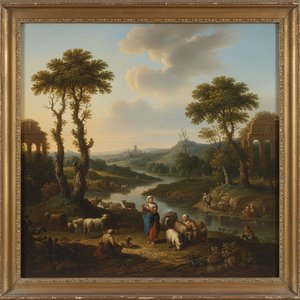
Karel Dujardin's "Patres et Cheval Pie" (roughly translated as “Father and Horse”) offers a serene yet subtly poignant glimpse into the Dutch Golden Age, capturing a quintessential rural scene imbued with both tranquility and a hint of melancholy. Painted around 1675, this oil on canvas work transports us to an idealized landscape – a carefully constructed tableau of pastoral life dominated by the harmonious relationship between man and beast. Dujardin, a master of atmospheric perspective and meticulous detail, skillfully employs light, color, and composition to evoke a profound sense of peace while simultaneously hinting at the complexities inherent in human interaction with nature.
The scene unfolds within a modestly sized horizontal format, immediately establishing a sense of groundedness. A central figure – a man seated near a magnificent chestnut horse – anchors the composition. This isn’t a dynamic action scene; rather, it's a moment of quiet contemplation. The horse, rendered with remarkable realism and exhibiting patches of white and black that create visual interest against the earthy tones, appears to be receiving care or perhaps simply enjoying the companionship of its rider. To the left, a scattering of sheep or goats adds to the authenticity of the setting, while a low hedge and a substantial building – likely a fortified farmhouse or even a small castle – recede into the distance, establishing depth and framing the central narrative.
The Language of Light and Color
Dujardin’s palette is deliberately restrained, dominated by the warm browns, tans, and muted greens characteristic of Dutch landscape painting. These earthy hues create a sense of groundedness and stability, mirroring the scene's tranquil mood. The artist masterfully utilizes atmospheric perspective – a technique perfected during this period – to suggest distance. Objects in the background, particularly the building, appear paler and less distinct than those closer to the viewer, creating an illusion of depth and drawing our eye towards the central figures. Subtle highlights on the horse’s coat catch the light, lending it volume and vitality, while the diffused lighting throughout the scene contributes to its overall sense of serenity.
The brushwork itself is remarkably smooth and blended, indicative of Dujardin's meticulous technique. Layers of thin glazes are applied to build up color transitions and create a soft, almost velvety texture. While visible brushstrokes exist, they’re carefully controlled, contributing to the painting’s overall sense of refinement and polished beauty. The use of horizontal lines – particularly in the landscape itself and the building walls – reinforces the feeling of stability and order, while vertical lines emphasize the height of the tower, adding a subtle element of grandeur.
Symbolism and the Dutch Golden Age
"Patres et Cheval Pie" is more than just a pretty pastoral scene; it’s a window into the values and sensibilities of the Dutch Golden Age. The presence of the imposing building in the background subtly suggests notions of authority, ownership, and perhaps even nobility – themes frequently explored in Dutch art during this period. However, the painting's core message is one of harmony between humanity and nature, a sentiment deeply rooted in the Calvinist worldview that shaped much of Dutch society. The quiet interaction between man and horse speaks to a reverence for the natural world and a recognition of its inherent beauty.
Dujardin’s work aligns perfectly with the broader artistic trends of his time – a focus on realism, meticulous detail, and an appreciation for atmospheric effects. Drawing inspiration from artists like Nicolaes Berchem, who mentored him, Dujardin inherited a deep understanding of how to capture the subtleties of light and shadow, creating landscapes that are both visually stunning and emotionally resonant. “Patres et Cheval Pie” stands as a testament to his skill and a captivating example of Dutch Golden Age artistry, offering a timeless meditation on the beauty of rural life and the enduring connection between humans and the natural world.
Biografia do Artista
A Life Immersed in Light and Landscape
Karel Dujardin, a name resonating softly within the pantheon of Dutch Golden Age masters, was born in Amsterdam in 1626 – though some records suggest 1622. His life unfolded during a period of unprecedented artistic flourishing in the Netherlands, yet his path wasn’t one of immediate acclaim but rather a gradual unfolding of talent nurtured by careful study and extensive travel. Details surrounding his early years remain somewhat elusive, shrouded in the mists of time, however it is widely accepted that he received foundational training under Nicolaes Berchem, a painter celebrated for his idyllic landscapes populated with animals. This mentorship proved pivotal, instilling in Dujardin a deep appreciation for naturalism and a keen eye for capturing the subtle nuances of light and atmosphere. He diligently absorbed Berchem’s techniques—the masterful blending of colors, the precise rendering of textures—skills that would serve as bedrock for his own artistic endeavors.The Bentvueghels and Roman Influences
But Dujardin’s artistic journey wasn't confined to the studios of Amsterdam; he possessed an adventurous spirit that led him to Rome, where he became a member of the *Bentvueghels*, a society of predominantly Dutch and Flemish painters who embraced a bohemian lifestyle and often adopted satirical nicknames. In Rome, he was known as “Barba di Becco” or "Goat-Beard," a moniker likely referencing his distinctive facial hair, and it was here that his artistic voice truly began to mature. The Bentvueghels fostered an environment of intellectual curiosity and playful experimentation, encouraging members to challenge conventions and explore new perspectives. Dujardin’s Roman experiences profoundly impacted his artistic style; he wasn't merely replicating the landscapes he encountered; instead, he synthesized them with the Dutch tradition of genre painting, creating a unique blend that captivated audiences on both sides of the Alps. He skillfully captured the vibrant colors and dramatic lighting of Italian villas and gardens, blending these elements with meticulous depictions of rural scenes populated by animals—a hallmark of his oeuvre.Mastering Light and Detail: A Painter's Technique
Dujardin’s artistic technique was characterized by an unwavering commitment to realism and a remarkable ability to convey atmosphere. He achieved this through painstaking observation and meticulous layering of paint, employing glazing techniques—applying thin translucent washes over underlying layers—to build up depth and luminosity. This method allowed him to capture the ephemeral qualities of light with breathtaking accuracy, imbuing his canvases with warmth and vibrancy. Consider Woman Milking a Red Cow; the artist’s masterful rendering of sunlight filtering through foliage creates an illusion of palpable warmth, drawing the viewer into the scene. Similarly, in Farm Animals in the Shade of a Tree, Dujardin captures the tranquil stillness of a pastoral landscape with remarkable precision—every blade of grass, every ripple of water is rendered with painstaking detail.Notable Works and Legacy
Among his most celebrated paintings are *Rest at an Italian Inn*, which transports viewers to a picturesque Tuscan villa bathed in golden light, and The Regents of the Spinhuis and Nieuwe Werkhuis, Amsterdam—a monumental group portrait that exemplifies Dujardin’s skill in capturing individual likenesses within a larger composition. His self-portrait, completed in 1662, offers an intimate glimpse into his artistic vision and reveals a contemplative demeanor—a testament to his unwavering dedication to craft. Karel Dujardin's influence extends beyond his own lifetime; he remains a pivotal figure in the history of Dutch art, embodying the ideals of observation, craftsmanship, and the celebration of everyday existence. His works continue to inspire artists today, demonstrating the enduring power of beauty and realism—a legacy that secures his place among the giants of the Golden Age. He stands as an exemplar of artistic excellence, forever remembered for his luminous landscapes and captivating genre scenes.
Karel Dujardin
1626 - 1678 , Países Baixos
Informações Rápidas
- Artistic Movement Or Style: Século de Ouro holandês
- Artists Who Influenced This Artist:
- Nicolaes Berchem
- Rembrandt van Rijn
- Date Of Birth: 27 de setembro de 1626
- Date Of Death: 20 de novembro de 1678
- Full Name: Karel Dujardin
- Nationality: Holandês
- Notable Artworks:
- Mulher ordenhando uma vaca vermelha
- Animais na sombra de uma árvore
- Descanso em uma hospedagem italiana
- Retrato próprio (1662)
- Os Governantes da Spinhuis e Nieuwe Werkhuis
- Place Of Birth: Amsterdam, Países Baixos
Artigos Relacionados

Golden Light & Dutch Skies: The Timeless Magic of Dutch Golden Age Landscapes
Discover the breathtaking beauty of Dutch Golden Age landscapes. Explore the mastery of light, chiaroscuro, and 17th-century realism through an expert art history lens, celebrating the enduring legacy of the Dutch Masters for discerning collectors and art lovers.

A Era de Ouro Holandesa: 10 Mestras-Obras Imperdíveis para Decorar com Arte
Descubra as 10 obras-primas da Era de Ouro Holandesa! Explore a história, técnica e beleza atemporal de Rembrandt, Vermeer e outros mestres. Encontre reproduções de arte exclusivas para decorar sua casa com elegância em OriginalUniqueArt.com.

Golden Light & Dutch Skies: Bringing the Magic of Dutch Golden Age Landscapes into Your Home
Transform your home with the breathtaking light of Dutch Golden Age landscapes. Discover how hand-painted oil reproductions of masterworks like Ruisdael and Vermeer bring timeless elegance, atmosphere, and soulful texture to modern interiors. Elevate your space with museum-quality art.

Masterpieces of Light: A Definitive Guide to the Landscapes of the Dutch Golden Age
Discover the luminous mastery of Dutch Golden Age landscapes. Our expert guide explores the atmospheric realism of masters like Van Goyen and Cuyp. Elevate your space with museum-quality, hand-painted oil reproductions from OriginalUniqueArt.com. Art history, beautifully realized.
Nicolaes Berchem: Dutch Golden Age Pastoralism & the Evolution of Landscape Painting
Explore the captivating world of Nicolaes Berchem, a leading Dutch Golden Age painter. Discover his idyllic landscapes, masterful technique & lasting influence on art history. Learn more at OriginalUniqueArt.
