Neoclassicism · 1790
Thomas Mifflin (John Trumbull, 1790)
John Trumbull (1756–1843) criou Thomas Mifflin. Data de 1790. Pertence ao movimento Neoclassicism. É feito em Watercolor. Está conservada no Metropolitan Museum of Art, em Nova York, Estados Unidos da América. Mede 9 × 7 cm.
- 1790
- Watercolor
- 9 × 7 cm
- Metropolitan Museum of Art, Nova York

 Visualizar na parede

 Pintura a Óleo Feita à Mão
 Compartilhar
 Compartilhar
 Ficha técnica


 Baixar imagem
 Semelhantes
 Raio X
 Ver diaporama
 Perguntas e Respostas

 Estatísticas
Thomas Mifflin, em resumo
- Título
- Thomas Mifflin
- Artista
- John Trumbull (1756–1843)
- Artista nascido em
- Lebanon, Estados Unidos
- Data
- 1790
- Técnica
- Watercolor
- Dimensões
- 9 × 7 cm
- Onde ver
- Metropolitan Museum of Art, Nova York, Estados Unidos da América
- Movimento
- Neoclassicism
- Período
- Early Modern
- Tema
- man, portrait, suit, cravat, wig, lapel
O que Thomas Mifflin retrata?
Portrait of Thomas Mifflin by John Trumbull
This miniature portrait of Thomas Mifflin, painted by John Trumbull in 1790, offers a quiet glimpse into the life of a significant figure from colonial Pennsylvania. Mifflin was a man of considerable influence during the formative years of the American republic. He served as a member of the legislature and eventually held the position of governor of the state. His presence in the political landscape of the era was marked by a steady, formal dignity.
Trumbull captures Mifflin from the chest up, presenting him within an elegant oval frame. The subject is depicted with a sense of gravitas, his attire reflecting the status and respectability of a prominent statesman. There is a certain introspection in his expression, a quality that invites closer observation of the fine details Trumbull has rendered. It is a small work, yet it carries the weight of the history it represents.
Composition and Visual Elements of the Portrait
The composition is centered upon the face and upper torso of Thomas Mifflin, presented from the chest up. While the subject occupies the heart of the arrangement, he is positioned slightly off-center within the oval frame, a subtle choice that lends a sense of movement to an otherwise formal posture. This slight asymmetry prevents the portrait from feeling static, providing a quiet dynamism to his presence. The background remains relatively plain, ensuring that no external distractions pull the eye away from the sitter.
The lighting is soft and diffused, appearing to originate from an unseen source above and slightly to the left. This gentle illumination creates subtle shadows that define the contours of his features and the texture of his clothing. Because of the nature of this miniature, the perspective is relatively flat, typical of the medium. Depth is achieved not through spatial recession, but through the careful layering of tonal variations, where the face appears to sit slightly forward of the clothing.
Technique and Materials Used in the Work
In this miniature portrait, the artist utilizes a meticulous approach to capture the likeness of Thomas Mifflin. The medium is likely watercolor or gouache applied to ivory, a choice that allows for a delicate, luminous quality. Through the use of fine brushstrokes, Trumbull achieves subtle gradations of tone that define the contours of the face and the texture of the hair. This careful layering of tones is essential to the work, as it creates a sense of depth and form within such a small scale. The piece measures 9 x 7 cm, requiring a high degree of precision to execute the details of the cravat and the lapels of the suit.
The physical presence of the original work is captured here through a photograph. The soft, diffused lighting suggests an unseen source from above and to the left, casting gentle shadows that give the subject a sense of quiet introspection. The organic shapes of the face and the voluminous texture of the wig are rendered with a controlled hand, contrasting with the geometric oval of the frame. Every detail, from the fine lines of the facial features to the shading of the skin, relies on the artist's ability to manipulate pigment with extreme restraint.
Related Works by John Trumbull
Trumbull’s career was defined by a profound connection to the American Revolution, a period he witnessed firsthand. His ability to capture the gravity of historical moments is evident in his larger compositions, such as his depictions of the Death of General Mercer at the Battle of Princeton and The Resignation of General Washington. These works demonstrate his capacity to translate significant political and military events into visual narratives. He also applied his skill to the monumental Declaration of Independence in 1817, a piece that helped shape the visual memory of the nation's founding.
Beyond these large-scale historical scenes, the artist was a prolific creator of smaller, more intimate works. He produced approximately 250 miniatures throughout his life, demonstrating a remarkable precision in a much more delicate format. This versatility allowed him to move between the grand scale of history painting and the meticulous detail required for private portraiture. His portraits of key figures, such as his 1790 depiction of George Washington and his 1805 portrait of Alexander Hamilton, reflect the same dedication to likeness and character that defines his broader body of work.
Em qual museu se encontra Thomas Mifflin?
Metropolitan Museum of Art
Nova York, Estados Unidos da América
Origens e História do Metropolitan Museum of Art O Metropolitan Museum of Art nasceu de uma visão compartilhada por um grupo de empresários, financistas e importantes artistas e pensadores. Após sua incorporação em 1870, a instituição buscou um lar permanente para abrigar suas crescentes aquisições. Antes de se estabelecer em sua localização atual, o museu residiu brevemente na propriedade da Mansão Douglas, na West 14th Street.


Imagens em alta resolução de Thomas Mifflin

John Trumbull, Thomas Mifflin (1790), Metropolitan Museum of Art. Domínio público.
Perguntas sobre Thomas Mifflin respondidas
Em qual museu se encontra a obra original de "Thomas Mifflin"?
A obra original "Thomas Mifflin", de John Trumbull encontra-se no Metropolitan Museum of Art, Nova York, Estados Unidos da América. Uma reprodução permite que a obra seja exibida em sua casa.
Em que ano foi criado "Thomas Mifflin"?
"Thomas Mifflin", de John Trumbull foi criado em 1790.
Qual é a técnica utilizada em "Thomas Mifflin", de John Trumbull?
John Trumbull utilizou a técnica de Watercolor para "Thomas Mifflin". A técnica define a natureza material da obra original.
Quais são as dimensões de "Thomas Mifflin", de John Trumbull na vida real?
A obra original "Thomas Mifflin", de John Trumbull mede 9 x 7 cm.
O que "Thomas Mifflin", de John Trumbull retrata?
"Thomas Mifflin", de John Trumbull retrata: man, portrait, suit, cravat, wig, lapel, collar.
"Thomas Mifflin", de John Trumbull está em domínio público?
"Thomas Mifflin", de John Trumbull está em em domínio público — seus direitos autorais expiraram. Este status determina como a imagem da obra pode ser reproduzida.
Quem criou "Thomas Mifflin"?
"Thomas Mifflin" foi criado por John Trumbull. As informações nesta página descrevem a obra original de John Trumbull.
A qual estilo pertence "Thomas Mifflin"?
O movimento associado a "Thomas Mifflin", de John Trumbull é Neoclassicism. Esta classificação situa a obra entre artistas e obras de arte relacionados.
A que período da carreira de John Trumbull pertence "Thomas Mifflin"?
Dentro da trajetória de John Trumbull, "Thomas Mifflin" pertence ao período Mature Period. Esta fase permite compará-la com outras obras do artista.
Sobre o artista, John Trumbull

1756–1843, Estados Unidos
John Trumbull
A Life Etched in Revolution: The World of John Trumbull John Trumbull, a name synonymous with the visual narrative of America’s birth, was more than just a painter; he was a witness, a soldier, and a chronicler of a nation forging its identity. Born in Lebanon, Connecticut, in 1756, into a family steeped in patriotic fervor – his father, Jonathan Trumbull, served as governor throughout the Revolutionary War – young John’s destiny seemed intertwined with the unfolding drama of independence. A childhood accident tragically cost him the use of one eye, yet this perceived limitation may have paradoxically sharpened his observational skills, contributing to the meticulous detail that would become a hallmark of his artistic style. His early education at Harvard College further cultivated a mind primed for both intellectual rigor and creative expression.
Também de John Trumbull
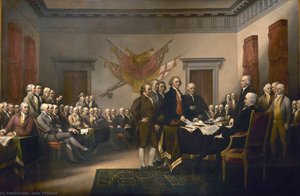 Declaração de Independência1817
 A Rendição de Lord Cornwallis1819
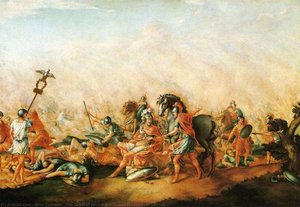 The Death of paulus Aemilius at the Battle of Cannae1773
 The Declaration of Independence, July 4, 17761787

Ensaios sobre Thomas Mifflin
 The Geometry of Presence: Mastering Composition and Stance in Classical PortraitureMaster the secrets of classical portraiture through geometry and light. Explore the techniques of the Old Masters today.
 American neoclassical paintersAmerican Neoclassical painters like Gilbert Stuart, John Singleton Copley, and Benjamin West. Shop museum-quality art reproductions on Orig…
 American artworks of the 1800sIconic American works by Gilbert Stuart and John Trumbull define an era. Explore the full collection online at OriginalUniqueArt.com.