Neoclassicism · 1788
James Bleecker (John Ramage, 1788)
John Ramage (1748–1802) criou James Bleecker. Data de 1788. Pertence ao movimento Neoclassicism. É feito em Oil. Está conservada no Metropolitan Museum of Art, em Nova York, Estados Unidos da América.

 Visualizar na parede

 Pintura a Óleo Feita à Mão
 Compartilhar
 Compartilhar
 Guia


 Baixar imagem
 Semelhantes
 Raio X
 Ver diaporama
 Perguntas e Respostas

 Estatísticas
James Bleecker: o essencial
- Título
- James Bleecker
- Artista
- John Ramage (1748–1802)
- Artista nascido em
- Dublin, Irlanda
- Data
- 1788
- Técnica
- Oil
- Onde ver
- Metropolitan Museum of Art, Nova York, Estados Unidos da América
- Movimento
- Neoclassicism
- Período
- Early Modern
- Tema
- man, portrait, cravat, waistcoat, coat, hair
O que James Bleecker retrata?
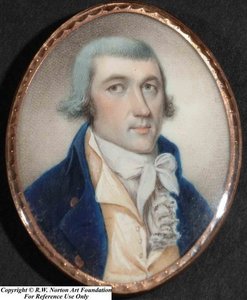
A Portrait of James Bleecker
This monochromatic portrait depicts James Bleecker, a gentleman from the late 18th century. The subject is presented in a formal, seated bust-length depiction, captured within an oval frame. He is positioned slightly off-center to the right, creating a balanced asymmetry. His attire, which includes a cravat, waistcoat, and coat, serves as an indication of his social status. The composition focuses attention solely on his likeness, isolating him from any background context.
The image is rendered in shades of gray, ranging from light to dark. Fine lines are used extensively to define the texture of Bleecker’s hair and clothing, while curved lines outline the oval frame and the contours of his face and neck. Straight lines appear in the details of his waistcoat and cravat. The lighting is diffused and even, creating subtle gradations across his face and clothing, with a gentle highlight on his forehead and nose.
Technical Details and Composition
The artwork is a photograph of an original painting by John Ramage from 1788. The original technique likely involved oil paints applied to canvas or panel. The visual elements include:
The perspective is relatively flat, typical of the period, with minimal depth perception. Depth is achieved through subtle tonal variations and the overlapping of elements, such as the waistcoat partially covering the shirt. The subject's expression is dignified, conveying a sense of seriousness and respectability.
Em qual museu se encontra James Bleecker?
Metropolitan Museum of Art
Nova York, Estados Unidos da América
Origens e História do Metropolitan Museum of Art O Metropolitan Museum of Art nasceu de uma visão compartilhada por um grupo de empresários, financistas e importantes artistas e pensadores. Após sua incorporação em 1870, a instituição buscou um lar permanente para abrigar suas crescentes aquisições. Antes de se estabelecer em sua localização atual, o museu residiu brevemente na propriedade da Mansão Douglas, na West 14th Street.


James Bleecker em alta resolução

John Ramage, James Bleecker (1788), Metropolitan Museum of Art. Domínio público.
Um especialista digital verifica as cores em relação à pintura original e retoca o ficheiro, respeitando fielmente a pincelada do artista.
Comprar a imagem em alta resoluçãoPerguntas sobre James Bleecker
Onde "James Bleecker", de John Ramage está em exibição hoje?
"James Bleecker", de John Ramage está em exibição no Metropolitan Museum of Art, Nova York, Estados Unidos da América. A referência ao museu diz respeito à obra original, não a reproduções.
Em que ano foi criado "James Bleecker", de John Ramage?
"James Bleecker", de John Ramage foi criado em 1788.
Qual técnica foi utilizada em "James Bleecker", de John Ramage?
A técnica de "James Bleecker", de John Ramage é Oil. As reproduções visam reproduzir a aparência desta técnica.
O que representa "James Bleecker"?
"James Bleecker", de John Ramage retrata: man, portrait, cravat, waistcoat, coat, hair, oval frame.
A imagem de "James Bleecker", de John Ramage pode ser reproduzida livremente?
Quanto aos direitos autorais, "James Bleecker" está em em domínio público — seus direitos autorais expiraram.
Quem criou "James Bleecker"?
"James Bleecker" é atribuída a John Ramage.
A qual estilo pertence "James Bleecker"?
"James Bleecker", de John Ramage pertence ao movimento Neoclassicism. Este movimento fornece o contexto estilístico da obra.
A que fase da trajetória de John Ramage "James Bleecker" pertence?
Dentro da trajetória de John Ramage, "James Bleecker" pertence ao período Mature Period. Esta fase permite compará-la com outras obras do artista.
Qual era a idade de John Ramage quando "James Bleecker" foi criada?
John Ramage criou "James Bleecker" aos 40 anos. O artista nasceu em 1748 e a obra data de 1788.
Sobre o artista, John Ramage
1748–1802, Irlanda
John Ramage
A Life Bridging Worlds: The Story of John Ramage Born in Dublin, Ireland, in 1748, John Ramage’s life was one of remarkable transition and artistic dedication, a journey that carried him from the refined world of Irish goldsmithing to the burgeoning art scene of colonial America. Details surrounding his early family life remain elusive, yet it is known he received formal training at the Dublin Society of Artists in 1763, laying a foundation in drawing and painting techniques that would serve as the bedrock for his future endeavors. Ramage’s initial career path was notably versatile; he skillfully combined the precision of a goldsmith with the delicate artistry of a miniaturist—a testament to his inherent talent for detail and decorative arts. This early period instilled within him not only technical proficiency but also an appreciation for craftsmanship that would distinguish his work throughout his life.
Também de John Ramage
 Portrait of a Gentleman1780
 Major Greene, B.A1777
 Gilbert Van Cortlandt1785
 Governor George Clinton1785

Ensaios sobre James Bleecker
 Rococo vs. Neoclassicism: Understanding the Shift from Pleasure to VirtueMaster the visual shift from Rococo pleasure to Neoclassical virtue. Learn to distinguish these 18th-century styles like an expert today.
 American artworks of the 1810s1810s American art by Gilbert Stuart, John Trumbull, and Rembrandt Peale. Find museum-quality reproductions on OriginalUniqueArt.com.
 American artworks of the 1800sIconic American works by Gilbert Stuart and John Trumbull define an era. Explore the full collection online at OriginalUniqueArt.com.