Alternar para Impressão
 Ler mais







































 Para obras de arte ou reproduções com mais de 105 cm (aproximadamente 41 polegadas) em qualquer um dos lados, a moldura será enviada como um kit desmontado. Este método garante uma entrega segura e evita danos durante o transporte.


Jean-Victor Bertin’s Classical Landscape: A Window Into Romantic Reverie
Jean-Victor Bertin (1767–1842) stands as a pivotal figure in the burgeoning landscape painting movement of late 18th and early 19th century France, bridging the gap between Neoclassicism’s rigid formalism and the emotive fervor of Romanticism. Unlike his contemporaries who primarily documented observable realities, Bertin embarked on a more ambitious endeavor: crafting immersive atmospheres steeped in classical allusion while simultaneously capturing the sublime beauty of the natural world.
His artistic journey began under the tutelage of Pierre-Henri de Valenciennes, a sculptor and landscape painter whose influence instilled in Bertin a meticulous approach to observation coupled with compositional rigor. Valenciennes championed the importance of accurately representing nature’s grandeur—a principle that would permeate Bertin's oeuvre throughout his prolific career.
Bertin’s training at the Académie royale de peinture et de sculpture solidified his understanding of artistic conventions, yet he swiftly diverged from established norms. He wasn’t merely replicating scenery; he was actively shaping it—transforming landscapes into canvases brimming with symbolic resonance and imbued with a palpable sense of emotion.
The Painting's Subject Matter: A Pastoral Ideal
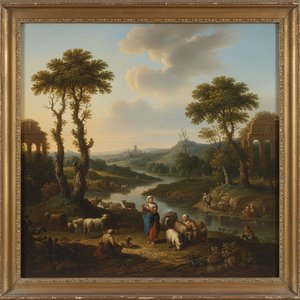
“Classical Landscape” depicts a serene Baroque/Romantic scene centered around ruins and lush vegetation. Bertin’s vision isn’t simply a depiction of a picturesque vista; it’s an imaginative interpretation of classical pastoral ideals—a genre deeply rooted in Renaissance humanist thought.
The composition unfolds with deliberate care, guiding the viewer's eye through a cleft in ancient trees, beyond which a carefully ordered succession of distinct planes culminates in distant mountains. This masterful use of atmospheric perspective softens the contours of the landscape, creating an ethereal quality that evokes feelings of tranquility and contemplation.
Technique and Style: Precision Meets Emotion
Bertin’s technique is characterized by painstaking detail—a hallmark of Neoclassical painting—yet it's tempered with Romantic sensibilities. He employed oil paints on canvas to achieve remarkable luminosity and tonal gradation, capturing the subtle nuances of light and shadow.
The scene unfolds in a clearing dominated by two young women who hold up garlands of flowers, symbolizing fertility and renewal. At the center right, shepherds offer an homage to Pan—the ancient Greek god of shepherds and flocks—further enriching the painting’s symbolic tapestry.
Historical Context: Bridging Eras
“Classical Landscape” emerged during a period of significant artistic transformation. Bertin's work reflects the broader shift from the austere grandeur of Neoclassicism to the expressive dynamism of Romanticism, mirroring the intellectual currents of his time. The painting’s depiction of ruins serves as a poignant reminder of the passage of time and the enduring influence of classical mythology.
Bertin's meticulous rendering—combined with his masterful use of atmospheric perspective—solidifies his place as one of the foremost landscape painters of his era, leaving behind a legacy of breathtaking beauty and profound artistic insight. It exemplifies the Romantic ideal of capturing sublime emotion within meticulously crafted natural settings.
Perguntas e Respostas
Quanta luz as cores de "Classical Landscape" parecem refletir?
"Classical Landscape", de Jean-Victor Bertin possui uma luminância Gentle Luminance. A luminância descreve quanta luz as cores parecem refletir.
A que período da carreira de Jean-Victor Bertin pertence "Classical Landscape"?
"Classical Landscape" pertence ao Late Baroque da carreira de Jean-Victor Bertin. Esta classificação relaciona a obra ao desenvolvimento do artista.
"Classical Landscape" está em domínio público?
Informação de direitos autorais para "Classical Landscape", de Jean-Victor Bertin: a obra está em em domínio público — seus direitos autorais expiraram. Isso determina se reproduções da imagem podem ser feitas livremente.
 Visualizar na parede
 Compartilhar
 Compartilhar
 Detalhes
 Guia
Guia

 Baixar imagem
 Semelhantes
 Raio X
 Ver diaporama
 Perguntas e Respostas
 Estatísticas