

 Visualizar em escala
 Enviar
 Compartilhar
 Ver detalhes
 Guia de Obras do Aluno

 Baixar imagem
 Semelhantes
 Raio X
 Apresentação de slides
 Estatísticas
Falso Início
 Óleo sobre tela
- Arte de Parede
- Abstract Expressionism
 1959
1959- Modernismo
 137.0 x 170.0 cm
 Ver mais
A obra de arte exibida nesta página é protegida por leis de direitos autorais, o que significa que não podemos criar ou vender legalmente uma reprodução idêntica. Esta proteção é aplicada por meio de acordos internacionais, tais como a Convenção de Berna e pelas leis nacionais, incluindo as estabelecidas por Lei de Direitos Autorais dos EUA - Título 17.
Este método cumpre plenamente as regulamentações de direitos autorais, pois não envolve a cópia ou duplicação da obra protegida. Em vez disso, trata-se de uma reinterpretação criativa — uma nova pintura que é influenciada pela original, mas não idêntica a ela.
Giclée / Impressão de Arte
Impressão giclée ou em tela de qualidade de museu, com produção rápida e opções flexíveis de acabamento. ( Encomendar reprodução pintada à mão Ver Imagem Digital)




P118B €10

P118H €10

P118W €10

P438Z €10

P508JH €12

P508YH €12

P805H €10

P805Z €10

P919BZ €10

P919G €10

P919XJ €10

P959ZH €10

P968JZ €12

W106C €8

W218G €10

W218JH €8

W218Y €10

W307PJ €10

W316G €10

W316PJ €8

W316Y €10

W398PJ €8

W4111J €10

W500HY €15

W500JH €15

W692G €12

W849H €8

W940BG €15

W953PJ €8




Escolha entre os nossos tamanhos pré-definidos que respeitam as proporções originais da obra de arte.

Digite a largura e a altura de que necessita, para se ajustar à sua moldura ou à sua parede. Uma impressão só pode ser cortada, nunca ampliada além da imagem original, pelo que um tamanho com uma proporção diferente perderá parte da imagem. Enviamos-lhe uma maquete digital para aprovação antes de imprimirmos qualquer coisa. A imagem apresentada nesta página não mostra o corte real — apenas a maquete o faz.
Entrega mundial () em 2 semanas, em vez das 4/5 semanas padrão. (21 Outubro)

Envio expresso gratuito para todo o mundo

Tela de Linho Premium

Seguro de transporte total

Garantia de Reembolso de Impostos Alfandegários

Garantia de Fidelidade de Cor

Política de Devolução em 100 Dias (Apenas para Defeitos)

Garantia de reembolso de 100%

Desconto para múltiplas unidades
 A opção de vidro está disponível apenas para tamanhos inferiores a 110 cm

Falso Início
Giclée / Impressão de Arte
Dimensões da Reprodução
-


Preço Total
€ 70
A Essência de "False Start": Uma Jornada pela Inovação de Jasper Johns
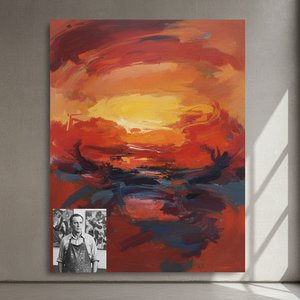
“False Start”, criado em 1959 pelo renomado artista americano Jasper Johns, é uma obra vibrante e dinâmica que captura a essência da espontaneidade e da emoção crua. Esta fascinante pintura é um testemunho da abordagem inovadora de Johns à arte, que une o Expressionismo Abstrato ao Pop Art emergente, marcando um momento crucial na história da arte moderna. Mais do que uma simples composição colorida, “False Start” representa uma exploração audaciosa da linguagem visual, desafiando as convenções e abrindo caminho para novas formas de expressão.
A composição da obra é paradoxalmente caótica e harmoniosa. Não há um ponto focal claro, mas sim uma distribuição equilibrada de cores e formas que se entrelaçam em um jogo complexo de sobreposições. Johns divide a tela em seções repletas de camadas de tinta, criando uma sensação de profundidade e riqueza textural. A paleta de cores é contrastante e intensa, dominada por vermelho, amarelo, azul e branco, aplicados com pinceladas grossas e vigorosas que intensificam a vitalidade da peça. Essa escolha cromática não é aleatória; ela busca evocar uma sensação de energia frenética e movimento constante, refletindo o espírito da época em que foi criada.
Técnica e Estilo: A Expressão Física da Cor
A técnica de Johns é marcada pela aplicação densa e impasto das tintas, com pinceladas grossas e visíveis que enfatizam o próprio ato de pintar. As linhas são fluidas e orgânicas, as formas amorfas e sobrepostas, contribuindo para a natureza abstrata da obra. A textura é rica e tátil, conferindo um aspecto tridimensional à tela – como se estivéssemos contemplando uma superfície viva e pulsante. É importante notar que Johns não buscava um planejamento meticuloso; em vez disso, ele utilizou movimentos aleatórios, guiados por uma intuição visceral, resultando nas explosões de cor e nos fragmentos aparentemente caóticos que caracterizam “False Start”. Essa abordagem, inspirada pelas ideias de Marcel Duchamp e John Cage, representa uma ruptura com a tradição da pintura figurativa e um passo em direção à liberdade expressiva.
Contexto Histórico e Influências: A Transição Artística
"False Start" reflete um momento de transição na carreira de Jasper Johns, enquanto ele buscava superar as limitações de suas obras anteriores. Inspirado pelas “ready-mades” de Duchamp e pelos experimentos com o acaso de Cage, Johns utilizou movimentos aleatórios para guiar suas pinceladas, em vez de uma composição premeditada. Essa abordagem resultou nas explosivas manchas de cor que definem a obra, simbolizando um afastamento das convenções artísticas da época e uma busca por novas formas de representação. A pintura é um reflexo do clima artístico da década de 1950, marcado pela experimentação, pela liberdade criativa e pela rejeição dos padrões estabelecidos.
Simbolismo e Impacto Emocional: Uma Interpretação Aberta
A natureza abstrata de “False Start” permite múltiplas interpretações. As pinceladas enérgicas e as cores vibrantes evocam sentimentos de excitação, caos ou até mesmo turbulência emocional. A utilização de etiquetas coloridas, muitas vezes desalinhadas com as cores reais, chama a atenção para a tensão entre o visual e o conceitual. A obra não busca representar algo específico, mas sim transmitir uma sensação, um estado de espírito. É como se Johns estivesse capturando um momento fugaz de inspiração, uma explosão de criatividade que desafia qualquer tentativa de definição precisa. “False Start” é, portanto, uma pintura que convida o espectador a participar ativamente da construção do significado, tornando-se um espelho das próprias emoções e percepções.
Explore Jasper Johns’ ‘False Start’ (1959) – uma vibrante abstract expressionist masterpiece!
Perguntas e Respostas
Que humor "Falso Início" de Jasper Johns expressa dentro de Abstract Expressionism?
"Falso Início" carrega um tom emocional Enérgico dentro do movimento Abstract Expressionism.
Para que tipo de uso é recomendada uma reprodução de "Falso Início" de Jasper Johns?
O uso sugerido para "Falso Início" de Jasper Johns é Peça de destaque. Também pode servir para outros fins.
Como posso visualizar "Falso Início" de Jasper Johns em formato de apresentação de slides?
"Falso Início" de Jasper Johns pode ser visualizada como um slideshow na página de Apresentação de slides da obra.
Biografia do Artista
A Life Painted in Symbols: The World of Jasper Johns
Jasper Johns emerged as a pivotal figure in the landscape of American art, bridging the emotive intensity of Abstract Expressionism with the burgeoning Pop Art movement that would soon redefine artistic boundaries. Born in Augusta, Georgia, in 1930, his early life was marked by a sense of displacement following his parents’ divorce, an experience that perhaps subtly informed his later explorations of identity and belonging within the context of American iconography. His formative years unfolded across various schools before he briefly attended the University of South Carolina, but it wasn't until his move to New York City in 1949 that Johns truly began to forge his artistic path. A period of service during the Korean War further shaped his perspective, exposing him to a world far removed from the burgeoning art scene he was eager to embrace upon his return.Breaking with Abstraction: The Dawn of a New Visual Language
The post-war American art world was dominated by Abstract Expressionism—a style characterized by spontaneous gesture and deeply personal emotional expression. While initially influenced by this movement, Johns felt compelled to move beyond its purely non-representational approach. He sought a new visual language, one that incorporated recognizable imagery not as illustrations but as vehicles for deeper contemplation. This wasn’t simply about *depicting* the world; it was about questioning how we perceive and interpret symbols within it. Key influences guided his departure: Marcel Duchamp's radical readymades challenged conventional notions of art-making, demonstrating that everyday objects could be elevated to the status of art through their presentation, while the emphasis on materiality in Abstract Expressionism informed Johns’ early techniques. However, it was the everyday objects and potent symbols of American culture—flags, targets, maps, numbers—that truly became central to his artistic vocabulary. He wasn’t interested in escaping representation; he wanted to dissect it, layer it with meaning, and ultimately reveal its inherent ambiguities. Johns' early work often involved layering paint over collage elements – newspaper clippings, photographs, and other found materials – creating a complex interplay of image and texture.Iconic Images: Flags, Targets, and the Language of Symbols
Johns’ breakthrough works arrived in the mid-1950s, instantly establishing him as a force to be reckoned with. His paintings of flags, most notably *Flag* (1954–55), were not patriotic declarations but rather investigations into the very nature of representation. Rendered in a semi-abstract style, using encaustic—pigment mixed with hot wax—and collage techniques, these flags weren’t simply images; they were textured surfaces laden with symbolic weight. The *Flag* painting itself is particularly complex, incorporating elements of a map and a military target, prompting viewers to consider the multiple layers of meaning embedded within a seemingly simple symbol. Similarly, his series of targets—starting in 1958—explored themes of visibility, danger, and the relationship between perception and reality. The stark simplicity of the bullseye contrasted with the meticulous detail of the surrounding paint application, creating a tension that invited contemplation. *Map* (1961), with its fragmented and layered depictions of the United States, delved into themes of geography, identity, and the complexities of national representation. Works like *False Start* (1959) demonstrated his experimentation with language and visual codes, creating complex compositions that challenged viewers to decipher their underlying meanings. Even *White Flag* (1955), a seemingly simple monochrome canvas, prompted profound questions about absence, surrender, and the very act of seeing.A Legacy of Influence: Paving the Way for Pop Art and Beyond
Jasper Johns’ impact on the trajectory of modern art is undeniable. He played a crucial role in the transition from Abstract Expressionism to Pop Art, challenging the prevailing aesthetic norms and opening up new avenues for artistic exploration. By embracing recognizable imagery, he paved the way for artists like Andy Warhol and Roy Lichtenstein, who would further blur the lines between high art and popular culture. His close collaboration with Robert Rauschenberg was also profoundly influential, fostering a spirit of experimentation and pushing the boundaries of artistic practice. Johns’ work often incorporated elements of Neo-Dada, referencing found objects and challenging traditional notions of authorship and originality. He wasn't simply replicating images; he was transforming them through his unique process—building up layers of paint, collage, and other materials to create works that were both visually arresting and intellectually stimulating. Johns’ enduring legacy lies not only in the iconic images he created but also in the profound questions he raised about the nature of representation, symbolism, and the very essence of what it means to be an artist in a rapidly changing world.Recognition and Enduring Impact
Throughout his illustrious career, Jasper Johns has received numerous accolades, including a Golden Lion at the Venice Biennale in 1988, the National Medal of Arts in 1990, and the Presidential Medal of Freedom in 2011. His works are held in major museum collections worldwide—the Museum of Modern Art, the Whitney Museum of American Art, the Metropolitan Museum of Art in New York, and Tate Modern in London, to name just a few. He has been the subject of countless exhibitions, cementing his position as one of the most important figures in 20th and 21st-century art. Beyond his paintings, Johns’ contributions extend to sculpture and printmaking, demonstrating his versatility and unwavering commitment to artistic innovation. He remains an active artist, constantly evolving his approach and solidifying his place as a vital voice in contemporary art.
Jasper Johns
1930 - , Estados Unidos da América
Informações Rápidas
- Artistic Movement Or Style: Pop e Expressionismo Abstrato
- Artists Or Movements Influenced By This Artist: ['Andy Warhol']
- Artists Who Influenced This Artist: ['Marcel Duchamp']
- Date Of Birth: 15 de maio de 1930
- Full Name: Jasper Johns
- Nationality: Americano
- Notable Artworks:
- Flag
- Target
- Mapa
- Place Of Birth: Augusta, EUA
Artigos Relacionados

John Constable: As 25 Obras-Primas que Definem o Mestre da Paisagem Inglesa | OriginalUniqueArt
Descubra as 25 obras-primas de John Constable, o mestre da paisagem inglesa! Explore a arte romântica, cores vibrantes e histórias fascinantes por trás de 'Hay Wain' e outras pinturas icônicas. Encontre reproduções de alta qualidade para decorar sua casa com OriginalUniqueArt.com.
Jacob Kainen: A Pioneer of American Color Field Painting & Abstract Expressionism
Explore the life & work of Jacob Kainen, a pivotal figure in American Abstract Expressionism and Color Field painting. Discover his journey from Social Realism to vibrant abstraction and lasting influence on 20th-century art.

Top 10 Obras-Primas do Expressionismo Abstrato: Arte para Decorar e Inspirar | OriginalUniqueArt.com
Descubra as 10 obras-primas do Expressionismo Abstrato com Jackson Pollock, Mark Rothko e mais! Explore a história, técnica e emoção por trás de cada pintura. Encontre reproduções de arte exclusivas para decorar sua casa em OriginalUniqueArt.com.

Kandinsky: As 25 Obras-Primas que Definem o Abstracionismo | OriginalUniqueArt
Descubra as 25 obras-primas de Wassily Kandinsky, pioneiro da arte abstrata! Explore a história, cores e significado por trás de cada pintura. Encontre reproduções de alta qualidade e inspire sua decoração em OriginalUniqueArt.com.

John Singer Sargent: As 25 Obras-Primas que Definem um Ícone da Arte
Descubra as 25 obras-primas de John Singer Sargent, o mestre do retrato e do impressionismo americano. Explore a história, técnica e beleza atemporal de seus quadros mais famosos. Encontre reproduções de arte exclusivas para decorar sua casa com elegância em OriginalUniqueArt.com.


