Symbolist Expressionism · 1895
The Skeleton Painter (James Ensor, 1895)
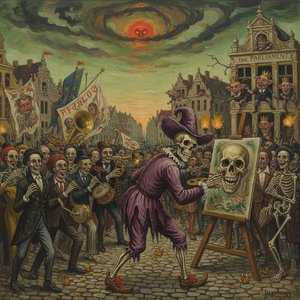
James Ensor (1860–1949) criou The Skeleton Painter. Data de 1895. Pertence ao movimento Symbolist Expressionism. É feito em Acrylic On Canvas. Está conservada no Koninklijk Museum voor Schone Kunsten, em Antuérpia, Bélgica.
- 1895
- Acrylic On Canvas
- Koninklijk Museum voor Schone Kunsten, Antuérpia

 Visualizar na parede

 Pintura a Óleo Feita à Mão
 Compartilhar
 Compartilhar
 Ficha técnica


 Baixar imagem
 Semelhantes
 Raio X
 Ver diaporama
 Perguntas e Respostas

 Estatísticas
The Skeleton Painter, em resumo
- Título
- The Skeleton Painter
- Artista
- James Ensor (1860–1949)
- Artista nascido em
- Oostende, Bélgica
- Data
- 1895
- Técnica
- Acrylic On Canvas
- Onde ver
- Koninklijk Museum voor Schone Kunsten, Antuérpia, Bélgica
- Movimento
- Symbolist Expressionism
- Tema
- skeleton, artist, death, masks, paintings, room
O que The Skeleton Painter retrata?
A Dance with Mortality: James Ensor’s “The Skeleton Painter”
James Ensor's "The Skeleton Painter," completed in 1895, is not merely a painting; it’s an unsettling plunge into the subconscious, a meticulously crafted tableau of morbidity and artistic obsession. The image, rendered with a distinctive and increasingly personal style, immediately confronts the viewer with a scene both bizarre and profoundly familiar – a room overflowing with art, dominated by a central figure: a skeleton diligently wielding a paintbrush. This isn’t a morbid spectacle intended to shock for shock's sake; rather, it’s a complex meditation on life, death, creativity, and the inescapable nature of artistic endeavor. Ensor, born in Ostend, Belgium, in 1860, cultivated an intensely individual vision, one deeply rooted in his upbringing amidst the vibrant chaos of a seaside resort town and fueled by a fascination with masks, disguise, and the theatricality of human experience.
The Artist’s Studio – A Realm of Shadows
The setting itself is crucial to understanding the painting's power. The room is crammed with canvases, each bearing witness to Ensor’s restless hand. A dining table, laden with objects—a clock, a partially consumed meal—suggests an interrupted life, a space where sustenance and creation intertwine. The presence of other skeletons, scattered amongst the chairs and leaning against walls, reinforces the pervasive theme of mortality. These aren't simply decorative elements; they are active participants in the scene, almost as if they’re observing or even contributing to the artist’s work. The inclusion of a cat, curled up near the left edge, adds an element of domesticity and perhaps a subtle critique – a creature of instinct and survival nestled within this world of intellectual pursuit.
Symbolism and Technique: A Palette of Unease
Ensor’s technique is immediately recognizable. He employed a thick, impasto application of paint, building up layers of color to create a tactile surface that seems almost sculptural. The palette is deliberately muted – browns, greys, ochres, and deep blues dominate—contributing to the painting's somber mood. The skeletal figure itself is rendered with remarkable detail, highlighting the fragility of bone while simultaneously conveying a sense of focused determination. Notice how Ensor uses strong diagonals – particularly in the arrangement of the chairs and paintings – to create a feeling of unease and instability. The use of color is not about beauty; it’s about evoking emotion, creating a visual atmosphere of melancholy and contemplation. His style evolved significantly throughout his career, moving away from academic influences towards a highly expressive, often unsettling, approach that anticipated the Symbolist movement.
Ensor's Exploration of Artistic Identity
"The Skeleton Painter" can be interpreted as an exploration of Ensor’s own artistic identity and his relationship to mortality. The skeleton artist represents not just death but also the inevitable end of creative endeavor, the fading of inspiration with time. It speaks to the paradox of the artist – someone who often seems detached from the everyday realities of life, yet is ultimately defined by their engagement with them. Ensor’s own struggles with artistic recognition and his rejection of traditional academic training likely fueled this preoccupation with themes of isolation and the ephemeral nature of existence. The painting isn't a celebration of art; it’s a questioning of its purpose and its ultimate significance in the face of oblivion. It invites us to consider what drives an artist to create, knowing that their work, like their own physical form, will eventually succumb to time.
OriginalUniqueArt offers exquisite, hand-painted reproductions of James Ensor’s “The Skeleton Painter,” allowing you to bring this haunting masterpiece into your home or office. Each reproduction is created with the same meticulous attention to detail and expressive technique as the original, capturing the painting's unique atmosphere and emotional depth. Explore our collection today and experience the unsettling beauty of Ensor’s vision.
Em qual museu se encontra The Skeleton Painter?
Koninklijk Museum voor Schone Kunsten
Antuérpia, Bélgica
Origens e História do Museu O Koninklijk Museum voor Schone Kunsten foi estabelecido em 1810, mas as suas raízes mergulham profundamente no legado da Guilda de São Lucas de Antuérpia, uma instituição que exerceu a sua influência desde o final do século XIV até 1773. A coleção do museu teve o seu génese nas obras de arte que pertenciam a esta guilda, estabelecendo um elo direto e inquebrável entre o passado mercantil da cidade e o seu florescente desenvolvimento artístico. O acervo representa um vasto arco cronológico, abrangendo obras que vão do século XIV ao século XX.


Imagens em alta resolução de The Skeleton Painter

James Ensor, The Skeleton Painter (1895), Koninklijk Museum voor Schone Kunsten. Domínio público.
Perguntas sobre The Skeleton Painter respondidas
Onde posso ver a obra original "The Skeleton Painter", de James Ensor?
A obra original "The Skeleton Painter" pode ser vista no Koninklijk Museum voor Schone Kunsten, Antuérpia, Bélgica.
Em que ano foi criado "The Skeleton Painter", de James Ensor?
"The Skeleton Painter" data de 1895. A data situa a obra na carreira de James Ensor e em sua época.
Qual é a técnica utilizada em "The Skeleton Painter", de James Ensor?
A técnica de "The Skeleton Painter", de James Ensor é Acrylic On Canvas. As reproduções visam reproduzir a aparência desta técnica.
Quais temas aparecem em "The Skeleton Painter", de James Ensor?
Os temas presentes em "The Skeleton Painter", de James Ensor incluem skeleton, artist, death, masks, paintings, room, cat, decay. Juntos, eles sintetizam o assunto da obra.
"The Skeleton Painter" está em domínio público?
Quanto aos direitos autorais, "The Skeleton Painter" está em em domínio público — seus direitos autorais expiraram.
A qual artista "The Skeleton Painter" é atribuída?
"The Skeleton Painter" é atribuída a James Ensor.
A qual estilo pertence "The Skeleton Painter"?
"The Skeleton Painter" é uma obra do Symbolist Expressionism. O movimento indica a tradição artística da qual a obra faz parte.
A que período da carreira de James Ensor pertence "The Skeleton Painter"?
"The Skeleton Painter" pertence ao Late Period da carreira de James Ensor. Esta classificação relaciona a obra ao desenvolvimento do artista.
Com que idade James Ensor criou "The Skeleton Painter"?
Quando "The Skeleton Painter" foi criada em 1895, James Ensor — nascido(a) em 1860 — tinha 35 anos.
Sobre o artista, James Ensor

1860–1949, Bélgica
James Ensor
Juventude, Família e Formação Artística James Ensor nasceu em 13 de abril de 1860, em Ostend, na Bélgica. Sua identidade foi moldada por uma intersecção cultural singular: seu pai, James Frederic Ensor, nasceu em Bruxelas, filho de pais ingleses, enquanto sua mãe, Maria Catherina Haegheman, era belga. Essa herança dual proporcionou a base para uma perspectiva que frequentemente se situava fora dos limites estreitos da tradição local. Ao crescer, o artista viveu entre as paredes de uma loja de souvenirs operada por seus pais em Ostend.
Também de James Ensor
 Entrada de Cristo em Bruxelas1888
 Autoportreto com Máscaras1899
 Os Banhos em Ostend
 Esqueletos Aquecendo-se1889

Ensaios sobre The Skeleton Painter
 Beauty in Mortality: Capturing the Soul of the Skull through the Luminous Lens of Impressionist ArtExplore the profound beauty of mortality through Impressionism. Discover how masters like Monet and Renoir transformed the Memento Mori tra…
 A Psicologia da Imagem Lúdica: Explorando a Pintura Humorística e Fantasiosa como Catalisadora para o Bem-Estar Emocional e Conexão SocialExplore a psicologia da pintura humorística e fantasiosa! Descubra como a arte promove o bem-estar emocional, conexão social e autoconhecim…
 James Ensor's Grotesque Visions: Social Commentary & Artistic InnovationExplore the unsettling yet captivating world of James Ensor, a pioneer of Expressionism. Discover his satirical masterpieces, symbolic imag…