

 Visualizar em escala
 Enviar
 Compartilhar
 Ver detalhes
 Guia de Obras do Aluno

 Baixar imagem
 Semelhantes
 Raio X
 Apresentação de slides
 Estatísticas
The Shipwreck
 Oil On Canvas
- WallArt
- Romanticism
 1805
1805- 19th Century
 241.0 x 170.0 cm
 Tate Britain
 Ver mais
Giclée / Impressão de Arte
Impressão giclée ou em tela de qualidade de museu, com produção rápida e opções flexíveis de acabamento. ( Encomendar reprodução pintada à mão Ver Imagem Digital)




P118B €10

P118H €10

P118W €10

P438Z €10

P508JH €12

P508YH €12

P805H €10

P805Z €10

P919BZ €10

P919G €10

P919XJ €10

P959ZH €10

P968JZ €12

W106C €8

W218G €10

W218JH €8

W218Y €10

W307PJ €10

W316G €10

W316PJ €8

W316Y €10

W398PJ €8

W4111J €10

W500HY €15

W500JH €15

W692G €12

W849H €8

W940BG €15

W953PJ €8




Escolha entre os nossos tamanhos pré-definidos que respeitam as proporções originais da obra de arte.

Digite a largura e a altura de que necessita, para se ajustar à sua moldura ou à sua parede. Uma impressão só pode ser cortada, nunca ampliada além da imagem original, pelo que um tamanho com uma proporção diferente perderá parte da imagem. Enviamos-lhe uma maquete digital para aprovação antes de imprimirmos qualquer coisa. A imagem apresentada nesta página não mostra o corte real — apenas a maquete o faz.
Entrega mundial () em 2 semanas, em vez das 4/5 semanas padrão. (25 Outubro)

Envio expresso gratuito para todo o mundo

Tela de Linho Premium

Seguro de transporte total

Garantia de Reembolso de Impostos Alfandegários

Garantia de Fidelidade de Cor

Política de Devolução em 100 Dias (Apenas para Defeitos)

Garantia de reembolso de 100%

Desconto para múltiplas unidades
 A opção de vidro está disponível apenas para tamanhos inferiores a 110 cm

The Shipwreck
Giclée / Impressão de Arte
Dimensões da Reprodução
-


Preço Total
€ 70
A Tempestuous Vision: J.M.W. Turner’s “The Shipwreck”
J.M.W. Turner's "The Shipwreck," painted in 1805, isn’t merely a depiction of maritime disaster; it’s a visceral embodiment of Romanticism’s fascination with the sublime—the awe-inspiring and potentially terrifying power of nature. This dramatic seascape captures a moment of profound chaos and vulnerability, drawing the viewer into a swirling vortex of turbulent waves, bruised skies, and desperate figures clinging to fragments of shattered vessels. Turner, a lifelong devotee of the sea, wasn't interested in literal accuracy; instead, he sought to convey an emotional response—the primal fear and humbling respect evoked by confronting forces far greater than ourselves.
The painting’s genesis is often linked to the tragic sinking of the Earl of Abergavenny off the coast of Weymouth. While speculation persists about a direct connection, Turner's genius lies in transforming this specific event into a universal allegory for human fragility against the relentless power of the elements. The composition immediately commands attention with its dynamic arrangement: a chaotic cluster of boats—some capsized, others desperately battling the waves—forms the central focus, while a vast, ominous sky dominates the upper half of the canvas. The horizon line is deliberately obscured by swirling clouds and mist, creating an unsettling sense of disorientation and emphasizing the immense scale of the ocean.
Masterful Technique: Light, Color, and Texture
Turner’s signature technique—a masterful manipulation of light and color—is on full display in “The Shipwreck.” He employs loose, expressive brushstrokes to capture the movement of water with breathtaking dynamism. Thick impasto is strategically applied to represent the crests of the waves, lending them a tangible physicality that seems to surge towards the viewer. The palette is predominantly dark and muted – shades of grey, brown, and black—creating a mood of foreboding and despair. However, flashes of yellow and orange punctuate the gloom, particularly within the churning waves and the clothing of the figures, offering brief moments of intense visual drama and hinting at the destructive potential of the storm.
Crucially, Turner wasn’t simply replicating what he saw; he was translating his *experience* of the sea onto canvas. He utilized a technique known as ‘atmospheric perspective,’ subtly lightening and desaturating distant elements to create an illusion of depth and distance. This layering of color and texture contributes significantly to the painting's overall sense of vastness and instability, mirroring the psychological impact of confronting such overwhelming forces.
Symbolism and Emotional Resonance
Beyond its technical brilliance, “The Shipwreck” is rich in symbolic meaning. The scattered ships represent not just a specific maritime disaster but also the precariousness of human existence. The struggling figures embody our vulnerability in the face of nature’s indifference—a poignant reminder of mortality and the limits of control. The tempestuous sea itself functions as a metaphor for the unpredictable forces that shape our lives, capable of both destruction and renewal.
Furthermore, the painting taps into the Romantic concept of the ‘sublime,’ a feeling of awe mixed with terror experienced when confronted with something overwhelmingly powerful. Turner’s depiction isn't intended to offer comfort or reassurance; rather, it compels us to confront our own insignificance within the grand scheme of nature and to appreciate its untamed beauty—and inherent danger.
A Legacy of Atmospheric Impressionism
“The Shipwreck” stands as a pivotal work in Turner’s oeuvre and a cornerstone of Romantic art. Its innovative use of light, color, and brushwork profoundly influenced subsequent generations of artists, particularly those associated with Impressionism. Turner's willingness to prioritize emotional expression over precise representation paved the way for a more subjective and evocative approach to landscape painting. Reproductions of this powerful image continue to resonate today, offering a timeless meditation on humanity’s relationship with the natural world—a reminder that even in the face of overwhelming adversity, there is an undeniable beauty to be found.
Perguntas e Respostas
Qual é o nível de reconhecimento de "The Shipwreck" de J.M.W. Turner?
O nível de popularidade registrado para "The Shipwreck" de J.M.W. Turner é Iconic.
Qual é a luminosidade de "The Shipwreck" de J.M.W. Turner?
"The Shipwreck" de J.M.W. Turner possui uma luminância Dark. A luminância descreve quanta luz as cores parecem refletir.
A que fase da carreira de J.M.W. Turner corresponde a data de 1805 de "The Shipwreck"?
Dada a sua data de 1805, "The Shipwreck" insere-se no período Academician Era de J.M.W. Turner.
Biografia do Artista
A Life Painted in Light: The World of J.M.W. Turner
Joseph Mallord William Turner, known to the world as J.M.W. Turner, was more than just a painter; he was a visionary who redefined landscape art and paved the way for modern abstraction. Born in Maiden Lane, Covent Garden, London, in 1775, his beginnings were humble – the son of a barber and wig maker. Yet, even as a child, a remarkable talent blossomed within him. By age fourteen, he was enrolled at the Royal Academy, exhibiting his first work just a year later. This early promise wasn’t merely technical skill; it hinted at an innate understanding of light, color, and atmosphere that would become the hallmarks of his extraordinary career. He supplemented his artistic education with practical experience as an architectural draftsman, honing his perspective and compositional abilities – skills that would prove invaluable in rendering both detailed topographical views and vast, emotive landscapes. Turner’s early life was marked by a dedication to his craft, fueled by a natural aptitude and a relentless pursuit of artistic excellence.The Romantic Tempest: Style and Influences
Turner emerged during the height of the Romantic era, but he wasn't simply a follower of its conventions. He absorbed influences from various sources – the Dutch masters like Claude Lorrain and Aelbert Cuyp for their luminous landscapes, and artists such as Richard Wilson for his poetic approach to nature. However, Turner didn’t merely imitate; he synthesized these influences into something entirely new. His work is characterized by an expressive use of color, often employing bold contrasts and vibrant hues to convey emotion and atmosphere. He was fascinated by the power and drama of nature – turbulent seascapes, fiery sunsets, and swirling storms became recurring motifs in his paintings. He wasn’t interested in simply depicting what he saw; he sought to capture the *feeling* of a place, the sublime awe inspired by the natural world. This pursuit led him to experiment with increasingly loose brushwork, dissolving forms into washes of color and light – techniques that would anticipate the Impressionist movement decades later. From 1840, his work gained significant recognition thanks to the championing of John Ruskin, who elevated landscape painting to a new level of critical acclaim.A Prolific Legacy: The Scope of Turner’s Output
The sheer volume of Turner's artistic output is astonishing. He created over 550 oil paintings, nearly 2,000 watercolors, and an astounding 30,000 works on paper. This prolificacy wasn’t simply a matter of quantity; it reflected his tireless exploration of different subjects, techniques, and styles. His paintings range from detailed topographical views of British landscapes to dramatic historical scenes and evocative maritime paintings. He was equally adept at capturing the tranquility of a pastoral scene and the terrifying power of a raging storm. Works like “Fort Vimieux” exemplify his mastery of depicting atmospheric effects – the swirling clouds, the crashing waves, and the intense light all contribute to a sense of drama and sublime beauty. Similarly, "Scene in the Campagna" showcases his ability to capture the warmth and serenity of the Italian countryside with delicate brushwork and luminous colors. Beyond painting, Turner was also a skilled printmaker, further disseminating his artistic vision through engravings and lithographs.Eccentricity and Remembrance: The Man Behind the Masterpieces
Turner’s personal life was as complex and enigmatic as his art. He remained intensely private and reclusive, often shunning social gatherings and preferring the solitude of his studio or the open road. He fathered two daughters, Evelina and Georgiana, with Sarah Danby, the wife of a fellow artist, but maintained a distant relationship with them. His later years were marked by increasing eccentricity and declining health. After his father’s death in 1829, he became increasingly morose and withdrawn, living in squalor and neglecting his appearance. He adopted the pseudonym “Mr. Booth” to avoid recognition and even rowed his boat into the Thames during a census to remain untraceable. Despite his eccentricities, or perhaps because of them, Turner remains one of Britain’s most beloved artists. His final years were spent in Chelsea where he passed away on December 19, 1851, at the age of 76. In a fitting tribute to his enduring legacy, he is buried in St Paul's Cathedral, alongside other British luminaries – a testament to his profound impact on art and culture. His work continues to inspire artists and captivate audiences worldwide, ensuring that the light of J.M.W. Turner will continue to shine for generations to come.Major Achievements
Turner’s artistic achievements are numerous and far-reaching. He is considered a pioneer of modern landscape painting, pushing the boundaries of color theory and atmospheric perspective. His seascapes, particularly works like “The Fighting Temeraire,” capture the raw power and beauty of the ocean with unprecedented intensity. His depictions of light – whether capturing the golden glow of sunrise or the dramatic shadows of twilight – are legendary. He also made significant contributions to watercolor painting, developing a unique style that combined spontaneity and precision. His influence can be seen in the works of countless artists who followed him, solidifying his place as one of the most important figures in British art history.Historical Significance
Turner’s work reflects the social and cultural changes of his time. He captured the industrial revolution with a critical eye, depicting the impact of factories and railways on the landscape and its inhabitants. His paintings also reflect the Romantic movement's fascination with nature, emotion, and the sublime. His legacy extends beyond the art world; he is remembered as a visionary who challenged conventional artistic norms and helped to shape the course of modern painting. He remains an enduring symbol of British creativity and innovation.
J.M.W. Turner
1775 - 1851 , Reino Unido
Informações Rápidas
- Artistic Movement Or Style: Romantismo
- Artists Or Movements Influenced By This Artist:
- Impressionismo
- Arte Romântica
- Artists Who Influenced This Artist:
- John Robert Cozens
- Richard Wilson
- Date Of Birth: 23 de abril de 1775
- Date Of Death: 19 de dezembro de 1851
- Full Name: Joseph Mallord William Turner
- Nationality: Britânico
- Notable Artworks:
- Fort Vimieux
- Cena na Campagna
- Place Of Birth: Londres, Reino Unido
Artigos Relacionados

Katsushika Hokusai: As 25 Obras-Primas que Definem um Mestre da Arte Japonesa
Descubra as 25 obras-primas de Katsushika Hokusai, o mestre do ukiyo-e! Explore a história por trás de 'A Grande Onda' e outras gravuras japonesas icônicas. Encontre reproduções de arte exclusivas para decorar sua casa com elegância em OriginalUniqueArt.com.
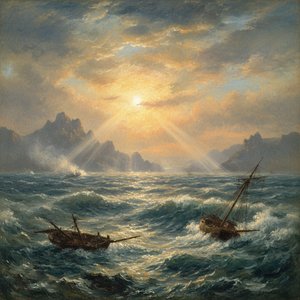
J.M.W. Turner: Light, Atmosphere & the Romantic Sublime
Explore the life & art of J.M.W. Turner, a master of Romantic landscape painting. Discover his innovative techniques, key works, and lasting influence on Impressionism. Find high-quality reproductions at OriginalUniqueArt.
The Evocative Brushstroke: Exploring Emotion, Individuality & the Sublime in Romanticism's Artistic Landscape
Explore the passionate world of Romanticism! Discover masterpieces by Friedrich & Goya, delve into the sublime, and understand the movement's lasting impact on art history. Expert analysis & insights at OriginalUniqueArt.
Os 10 Grandes Mestres do Romantismo: Arte, Emoção e Decoração Inspiradora
Descubra os 10 maiores ícones do Romantismo! Explore a emoção, cores vibrantes e histórias por trás de Delacroix, Goya e Friedrich. Encontre reproduções de arte exclusivas para decorar sua casa com OriginalUniqueArt.com.
The Allure of the Horizon: A Comprehensive Exploration of Seascape Art Through History & Emotion
Explore the captivating world of seascape art! Discover its history, key artists & movements – from Dutch Masters to Impressionism. Expert insights for collectors and enthusiasts at OriginalUniqueArt.