

 Visualizar em escala
 Enviar
 Compartilhar
 Ver detalhes
 Guia de Obras do Aluno

 Baixar imagem
 Semelhantes
 Raio X
 Apresentação de slides
 Estatísticas
Housemaid with Pram


 Ver mais
Reprodução em Óleo Feita à Mão
Óleo sobre tela pintado à mão no tamanho e moldura de sua escolha, feito sob encomenda pelos nossos artistas. ( Alternar para Impressão Ver Imagem Digital)




P118B $10

P118H $10

P118W $10

P438Z $10

P508JH $12

P508YH $12

P805H $10

P805Z $10

P919BZ $10

P919G $10

P919XJ $10

P959ZH $10

P968JZ $12

W106C $8

W218G $10

W218JH $8

W218Y $10

W307PJ $10

W316G $10

W316PJ $8

W316Y $10

W398PJ $8

W4111J $10

W500HY $15

W500JH $15

W692G $12

W849H $8

W940BG $15

W953PJ $8




Escolha entre os nossos tamanhos pré-definidos que respeitam as proporções originais da obra de arte.

Pode inserir as suas próprias dimensões para se adequar a uma moldura ou espaço específico. Se o tamanho selecionado não corresponder às proporções da imagem original, iremos cortar a obra de arte ou estender a pintura com elementos adicionais pintados à mão. Um esboço digital será enviado para sua aprovação antes do início da produção.
Tenha em atenção que a pré-visualização no ecrã não reflete o corte ou extensão real. Apenas o esboço mostrará com precisão a composição final.
Embora tamanhos personalizados estejam disponíveis, recomendamos selecionar uma dimensão da lista predefinida para preservar as proporções originais.
Após o pedido, a equipa OriginalUniqueArt.com enviará um e-mail ao cliente para solicitar instruções e fornecer uma prévia do esboço.
Entrega mundial () em 3 a 4 semanas, em vez das 5 semanas padrão. (25 Setembro). Sem comprometer a qualidade.

Envio expresso gratuito para todo o mundo

Tela de Linho Premium

Seguro de transporte total

Garantia de Reembolso de Impostos Alfandegários

Garantia de Fidelidade de Cor

Política de Devolução em 100 Dias (Apenas para Defeitos)

Garantia de reembolso de 100%

Desconto para múltiplas unidades
 A opção de vidro está disponível apenas para tamanhos inferiores a 110 cm

Housemaid with Pram
Técnica de Reprodução
Dimensões da Reprodução
-


Preço Total
$ 300
A Moment Frozen in Time: Isaac Israëls’ “Housemaid with Pram”
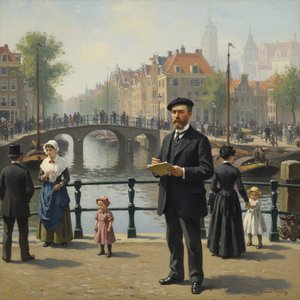
Isaac Lazarus Israëls' "Housemaid with Pram," painted in 1875, isn’t merely a snapshot of urban life; it’s a poignant meditation on the quiet dignity and understated beauty found within the everyday. This watercolor, now housed in the Rijksmuseum in Amsterdam, captures a fleeting moment along a bustling city street – a woman pushing a baby carriage, her face etched with a subtle blend of weariness and contentment. Israëls, a key figure in the Dutch Impressionist movement, masterfully utilizes loose brushstrokes and delicate washes to evoke not just a visual representation but an atmosphere, a feeling of the scene’s transient nature.
Israëls' artistic journey was deeply intertwined with his family history. The son of Jozef Israëls, a renowned Hague School painter known for his realistic depictions of working-class life, Isaac initially followed in his father’s footsteps, exploring similar themes of labor and social realism. However, he quickly developed his own distinct style, moving away from the stark formality of his father's work towards a more impressionistic approach – prioritizing capturing light, color, and mood over precise detail. This shift is powerfully evident in “Housemaid with Pram,” where the focus isn’t on the woman’s physical appearance but rather on her presence within the urban landscape.
The Language of Light and Color
Israëls' technique is characterized by a remarkable sensitivity to light. He employs broken color, layering translucent washes of pigment to create an ethereal quality, as if the scene is bathed in a soft, diffused glow. The muted palette – predominantly blues, greens, and browns – reflects the overcast Amsterdam sky, lending the painting a melancholic yet peaceful atmosphere. Notice how he uses highlights to draw attention to the woman’s face and the details of the pram, while simultaneously blurring the background figures into an indistinct mass. This selective focus directs the viewer's eye and emphasizes the central subject.
The composition itself is carefully constructed. The woman occupies a slightly off-center position, creating a sense of dynamism and inviting the viewer to step into the scene. The placement of the clock tower in the background provides a subtle temporal reference, anchoring the image within a specific moment in time. Israëls’ use of atmospheric perspective – making distant objects appear paler and less distinct – further enhances the illusion of depth and contributes to the painting's overall sense of realism.
Symbolism and Social Commentary
Beyond its aesthetic qualities, “Housemaid with Pram” carries a subtle layer of social commentary. The woman’s posture suggests both responsibility and exhaustion—a common reality for working-class women in 19th-century Amsterdam. The pram itself symbolizes motherhood and the cycle of life, while the bustling street represents the relentless pace of urban existence. Israëls doesn't offer a judgment or moralizing statement; instead, he presents a simple, honest portrayal of a woman’s daily life, inviting viewers to contemplate her experiences and consider the social conditions that shaped them.
The inclusion of other figures in the background – a man standing on the left and another further back on the right – adds to the painting's narrative complexity. They represent the broader context of urban society, highlighting the woman’s place within it. Their presence suggests a community, albeit one largely unseen by the central figure.
A Timeless Portrait of Human Experience
“Housemaid with Pram” is more than just a painting; it's a window into the past—a poignant and evocative depiction of everyday life in 19th-century Amsterdam. Israëls’ masterful use of light, color, and composition creates an image that resonates deeply with viewers today, reminding us of the shared human experiences of labor, motherhood, and the quiet beauty found within the ordinary moments of our lives. Reproductions of this work offer a chance to bring this evocative scene into any space, fostering contemplation and appreciation for Israëls’ enduring legacy.
Biografia do Artista
Early Life and Artistic Beginnings
Isaac Lazarus Israëls was born into a family deeply rooted in the Dutch art world. He was the son of Jozef Israëls, a prominent painter associated with the Hague School, and Aleida Schaap. This artistic heritage fostered an early appreciation for painting within Isaac, who displayed remarkable talent from a young age. Between 1880 and 1882, he studied at the Royal Academy of Art in The Hague, where he met George Hendrik Breitner, forming a lifelong friendship that would significantly influence his artistic trajectory. At just sixteen years old, Israëls achieved early recognition when he sold "Bugle Practice" to artist and collector Hendrik Willem Mesdag even before it was fully completed. Portraits of his grandmother and a family friend, created in the same year, demonstrated his already considerable technical skill.The Amsterdam Impressionist
Israëls became a leading figure within the Amsterdam Impressionism movement. Influenced by the philosophy of the Tachtigers—a group of writers and artists advocating for style to reflect content and emotionally charged subjects represented through intense technique—he shifted his focus towards capturing the vibrant scenes of everyday life in Amsterdam. He frequently spent summers with his father in Scheveningen, painting colorful seaside landscapes. His work reflected a desire to portray the bustling streets, cafes, and cabarets of Amsterdam, moving away from the more traditional subject matter favored by earlier Dutch masters.Travels and Artistic Evolution
In 1904, Israëls relocated to Paris, establishing a studio and embracing the city's unique motifs. He further explored his interest in fashion by studying at Paquin and Drecoll fashion houses. The outbreak of World War I prompted his return to Holland, where he primarily focused on portraiture. Following the war, he embarked on extensive travels throughout Europe and Asia, including two years spent sketching and painting in India and the Dutch East Indies. These experiences broadened his artistic horizons, introducing him to new subjects and perspectives that enriched his later work.Legacy and Recognition
Isaac Lazarus Israëls left behind a significant body of work celebrated for its vibrant colors, loose brushwork, and insightful portrayals of everyday life. His paintings are now housed in prestigious museums worldwide, including the Van Gogh Museum and the Mauritshuis. He achieved international recognition, notably winning a Gold Medal at the 1928 Olympic Games for his painting "Red Rider." Israëls' legacy lies not only in his artistic achievements but also in his contribution to the development of Amsterdam Impressionism, solidifying his place as one of the most important Dutch painters of his era.
Isaac Lazarus Israels
1865 - 1934 , Países Baixos
Informações Rápidas
- Artistic Movement Or Style: Impressionismo
- Artists Or Movements Influenced By This Artist: ['Tachtigers']
- Artists Who Influenced This Artist:
- Jozef Israëls
- George Hendrik Breitner
- Date Of Birth: 3 fevereiro de 1865
- Date Of Death: 7 outubro de 1934
- Full Name: Isaac Lazarus Israëls
- Nationality: Holandês
- Notable Artworks:
- Transporte de soldados coloniais
- Os ordenadores
- Retrato de Mata Hari
- Place Of Birth: Amsterdã, Holanda
Artigos Relacionados
Isaac Lazarus Israëls: A Chronicle of Dutch Life & the Evolution of Impressionistic Realism
Explore the captivating world of Isaac Lazarus Israëls (1865-1934), a leading Dutch Amsterdam Impressionist. Discover his city scenes, portraits & travels through Asia – a chronicle of Dutch life and artistic evolution.

Ephemeral Visions: Exploring the Artistic Legacy & Nuances of Watercolor Painting
Explore the captivating world of watercolor painting! Discover its rich history, essential techniques, influential artists & collecting tips from art experts. A comprehensive guide for enthusiasts.

Aquarelas Imortais: 10 Obras-Primas que Revolucionaram a Arte | OriginalUniqueArt
Descubra as 10 obras-primas em aquarela que revolucionaram a arte! Explore a história de Turner, Cézanne e outros mestres. Encontre reproduções de alta qualidade para decorar sua casa com elegância. OriginalUniqueArt: arte atemporal ao seu alcance.

Ephemeral Visions: Exploring the History & Emotional Resonance of Watercolor Painting
Explore the captivating history of watercolor painting, from ancient techniques to modern masters like Kandinsky & Blake. Discover essential artists, collecting tips & the emotional power of this luminous medium. Expert insights for art enthusiasts.

Ephemeral Visions: Exploring the Artistic Legacy & Contemporary Practice of Watercolor Painting
Explore the captivating world of watercolor painting! Discover its rich history, essential techniques, influential artists & collecting tips. A comprehensive guide for art enthusiasts from OriginalUniqueArt.