

 Visualizar em escala
 Enviar
 Compartilhar
 Ver detalhes
 Guia de Obras do Aluno

 Baixar imagem
 Semelhantes
 Raio X
 Apresentação de slides
 Estatísticas
Ball gown


 Ver mais
Reprodução em Óleo Feita à Mão
Óleo sobre tela pintado à mão no tamanho e moldura de sua escolha, feito sob encomenda pelos nossos artistas. ( Alternar para Impressão Ver Imagem Digital)




































Escolha entre os nossos tamanhos pré-definidos que respeitam as proporções originais da obra de arte.

Pode inserir as suas próprias dimensões para se adequar a uma moldura ou espaço específico. Se o tamanho selecionado não corresponder às proporções da imagem original, iremos cortar a obra de arte ou estender a pintura com elementos adicionais pintados à mão. Um esboço digital será enviado para sua aprovação antes do início da produção.
Tenha em atenção que a pré-visualização no ecrã não reflete o corte ou extensão real. Apenas o esboço mostrará com precisão a composição final.
Embora tamanhos personalizados estejam disponíveis, recomendamos selecionar uma dimensão da lista predefinida para preservar as proporções originais.
Após o pedido, a equipa OriginalUniqueArt.com enviará um e-mail ao cliente para solicitar instruções e fornecer uma prévia do esboço.
Entrega mundial () em 3 a 4 semanas, em vez das 5 semanas padrão. (25 Setembro). Sem comprometer a qualidade.

Envio expresso gratuito para todo o mundo

Tela de Linho Premium

Seguro de transporte total

Garantia de Reembolso de Impostos Alfandegários

Garantia de Fidelidade de Cor

Política de Devolução em 100 Dias (Apenas para Defeitos)

Garantia de reembolso de 100%

Desconto para múltiplas unidades
 A opção de vidro está disponível apenas para tamanhos inferiores a 110 cm

Ball gown
Técnica de Reprodução
Dimensões da Reprodução
-


Preço Total
$ 300
Biografia do Artista
The Architect of Elegance: The Life and Legacy of Charles Frederick Worth
In the grand, shimmering tapestry of fashion history, few names resonate with as much authority and prestige as Charles Frederick Worth. Often revered as the "father of haute couture," Worth did not merely design clothing; he orchestrated an era of unparalleled splendor. Born in 1825 in the quiet town of Bourne, Lincolnshire, his journey from a modest English upbringing to the pinnacle of Parisian high society is a narrative of profound vision and transformative artistry. His early years were shaped by a meticulous apprenticeship with London textile merchants, where he developed an intimate, tactile understanding of fabrics—a foundation that would later allow him to manipulate silk, lace, and velvet into wearable masterpieces. This technical mastery was further enriched by his deep fascination with art history, as he spent countless hours studying the dramatic drapery and regal poise found in portraits at the National Gallery, forever infusing his designs with a sense of classical grandeur.
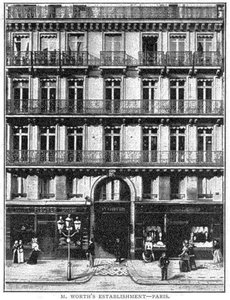
The pivotal moment in Worth’s ascent arrived in 1845 when he relocated to Paris, the undisputed heart of the fashion world. His initial tenure at Maison Gagelin allowed him to showcase his burgeoning talent on an international stage, earning accolades at the Great Exhibition of London and the Exposition Universelle in Paris. However, it was his transition from a skilled craftsman to a visionary entrepreneur that would change the course of fashion forever. In 1858, alongside partner Otto Bobergh, he established the House of Worth at 7 Rue de la Paix. This was not merely a dressmaking shop; it was the birth of the modern fashion house, a place where the designer’s creative will took precedence over the client's mere whims.
A Royal Patronage and the Birth of Haute Couture
The true ascent of Worth into the stratosphere of legend was catalyzed by the patronage of the French Imperial court. The marriage of Napoleon III to Empress Eugénie brought with it a demand for a new kind of magnificence, and Worth was the only artist capable of meeting it. As the appointed court designer, his influence permeated the very fabric of the Second Empire. To dress the Empress was to set the standard for all of Europe; her preference for his exquisite creations turned the House of Serene into a beacon of desirability for royalty and the aristocracy alike.
Worth’s genius lay in his ability to blend structural innovation with breathtaking ornamentation. He revolutionized the business of fashion by introducing several groundbreaking practices:
- The Concept of Seasonal Collections: Rather than simply fulfilling orders, Worth prepared diverse designs for each season, presenting them through live models to inspire his clientele.
- The Designer as Artist: He moved the industry away from simple dressmaking toward a model where the creator’s signature style and "label" became a mark of status.
- Technical Sophistication: His garments were celebrated for their superb fit, utilizing intricate Alençon needlepoint, heavy silks, and detailed trimmings that demanded both precision and passion.
His clientele was a "who's who" of the 19th-century cultural elite, ranging from legendary performers like Sarah Bernhardt and Nellie Melba to the most influential socialites of the age. For these women, a Worth gown was more than attire; it was an armor of elegance, a statement of power, and a piece of living art.
An Enduring Influence on the Modern World
The significance of Charles Frederick Worth extends far beyond the ephemeral nature of seasonal trends. He fundamentally altered the relationship between the creator and the consumer, establishing the designer as a celebrity figure and an arbiter of taste. His ability to adapt 19th-century dressmaking to meet the evolving needs of a modernizing society—making grand silhouettes more suitable for the rhythms of contemporary life—demonstrated a rare foresight. Even after his death in 1895, the House of Worth continued to operate under his descendants, maintaining its prestige until the mid-20th century.
Today, when we speak of haute couture, we are speaking the language that Worth invented. His legacy lives on in every meticulously crafted garment that prioritizes artistry over mass production and every fashion house that seeks to inspire through a singular, inimitable vision. He remains the eternal architect of elegance, a man who took the raw materials of textiles and wove them into the very identity of modern luxury.
House of Worth
1956 , France
Informações Rápidas
- Artistic Movement Or Style: Haute Couture
- Artists Or Movements Influenced By This Artist: ['']
- Artists Who Influenced This Artist: ['']
- Date Of Birth: October 13, 1825
- Date Of Death: March 10, 1895
- Full Name: Charles Frederick Worth
- Nationality: English
- Notable Artworks: ['Ball gown']
- Place Of Birth: Bourne, Lincolnshire, England