Text size

() ·

A painting made for you, by hand

Comedy scene (scene from Molière)

Reprodução em Óleo Feita à Mão

Óleo sobre tela pintado à mão no tamanho e moldura de sua escolha, feito sob encomenda pelos nossos artistas. ( Alternar para Impressão Alternar para Imagem Digital)

Descrição do Item

Honore Daumier's 'Comedy Scene (Scene from Moliere)' captures a lively Parisian encounter with masterful draftsmanship and social commentary. Explore the dynamic scene of two men in a black & white painting, reflecting 19th-century French life.

Biografia do Artista

Descubra Honoré Daumier (1808-1879), mestre francês de realismo e sátira. Explore seus poderosos litografias, pinturas e esculturas criticando a sociedade do século XIX e influenciando a arte moderna.

from ·

Chapter 1

How large should it be?

Slide to change the size; the picture on the left shows the frame at its real width. The proportions of the original are kept.

Tamanho padrão
personalizado
CM
INCH

Escolha entre os nossos tamanhos pré-definidos que respeitam as proporções originais da obra de arte.

largura
altura

Insira a largura e a altura desejadas para se ajustarem à sua moldura ou parede. Como esta obra é pintada à mão, para um tamanho com proporções diferentes, o artista poderá pintar um pouco mais ao redor da imagem ou reduzir ligeiramente a composição — você escolhe. Enviamos uma maquete digital para sua aprovação antes de iniciar a pintura. A imagem exibida nesta página não representa o resultado real — apenas a maquete mostra o resultado final.

Chapter 2

How should it arrive?

Choose the edges of the stretched canvas

Choose your frame

Corner sample of the WhiteWrap canvas edge finish, stretched on madeira maciça bars
White €1
Corner sample of the BlurSideWrap canvas edge finish, stretched on madeira maciça bars
Blurside €1
Corner sample of the ExtendedWrap canvas edge finish, stretched on madeira maciça bars
Extended €1
Corner sample of the P118B picture frame: poliestireno moldado, 5 cm wide and 3 cm thick
P118B €10
Corner sample of the P118H picture frame: poliestireno moldado, 5 cm wide and 3 cm thick
P118H €10
Corner sample of the P118W picture frame: poliestireno moldado, 5 cm wide and 3 cm thick
P118W €10
Corner sample of the P438Z picture frame: poliestireno moldado, 5.5 cm wide and 3.5 cm thick
P438Z €10
Corner sample of the P508JH picture frame: poliestireno moldado, 7 cm wide and 3.5 cm thick
P508JH €12
Corner sample of the P508YH picture frame: poliestireno moldado, 7 cm wide and 3.5 cm thick
P508YH €12
Corner sample of the P805H picture frame: poliestireno moldado, 5 cm wide and 3.5 cm thick
P805H €10
Corner sample of the P805Z picture frame: poliestireno moldado, 5 cm wide and 3.5 cm thick
P805Z €10
Corner sample of the P919BZ picture frame: poliestireno moldado, 7 cm wide and 3.5 cm thick
P919BZ €10
Corner sample of the P919G picture frame: poliestireno moldado, 7 cm wide and 3.5 cm thick
P919G €10
Corner sample of the P919XJ picture frame: poliestireno moldado, 7 cm wide and 3.5 cm thick
P919XJ €10
Corner sample of the P959ZH picture frame: poliestireno moldado, 5 cm wide and 3 cm thick
P959ZH €10
Corner sample of the P968JZ picture frame: poliestireno moldado, 6 cm wide and 4 cm thick
P968JZ €12
Corner sample of the W106C picture frame: madeira maciça, 5 cm wide and 3 cm thick
W106C €8
Corner sample of the W218G picture frame: madeira maciça, 5 cm wide and 3 cm thick
W218G €10
Corner sample of the W218JH picture frame: madeira maciça, 5 cm wide and 3 cm thick
W218JH €8
Corner sample of the W218Y picture frame: madeira maciça, 5 cm wide and 3 cm thick
W218Y €10
Corner sample of the W307PJ picture frame: madeira maciça, 6 cm wide and 3 cm thick
W307PJ €10
Corner sample of the W316G picture frame: madeira maciça, 6 cm wide and 3 cm thick
W316G €10
Corner sample of the W316PJ picture frame: madeira maciça, 6 cm wide and 3 cm thick
W316PJ €8
Corner sample of the W316Y picture frame: madeira maciça, 6 cm wide and 3 cm thick
W316Y €10
Corner sample of the W398PJ picture frame: madeira maciça, 5 cm wide and 3 cm thick
W398PJ €8
Corner sample of the W4111J picture frame: madeira maciça, 6.5 cm wide and 3.5 cm thick
W4111J €10
Corner sample of the W500HY picture frame: madeira maciça, 7 cm wide and 5 cm thick
W500HY €15
Corner sample of the W500JH picture frame: madeira maciça, 7 cm wide and 5 cm thick
W500JH €15
Corner sample of the W692G picture frame: madeira maciça, 8 cm wide and 4 cm thick
W692G €12
Corner sample of the W849H picture frame: madeira maciça, 5 cm wide and 3 cm thick
W849H €8
Corner sample of the W940BG picture frame: madeira maciça, 7.5 cm wide and 4.5 cm thick
W940BG €15
Corner sample of the W953PJ picture frame: madeira maciça, 6 cm wide and 3.5 cm thick
W953PJ €8
Corner sample of the H24-GOLD picture frame: madeira entalhada com gesso, 10 cm wide and 6 cm thick
H24-GOLD €30
Corner sample of the H24-SILVER picture frame: madeira entalhada com gesso, 10 cm wide and 6 cm thick
H24-SILVER €30
Corner sample of the H36-GOLD picture frame: madeira entalhada com gesso, 15 cm wide and 6.5 cm thick
H36-GOLD €45
Corner sample of the H36-SILVER picture frame: madeira entalhada com gesso, 15 cm wide and 6.5 cm thick
H36-SILVER €45
Prévia da moldura
Com moldura

Moulding: . Overall size with the frame: .

Chapter 3

Who paints it, and should anything change?

Examples of what can be changed: Replace face with customer photo; Add pet (e.g., replace cat with dog); Include hidden message in background; Change background landscape or elements.
After order, OriginalUniqueArt.com team will email client for instructions and provide a mockup preview

Entrega mundial () em 3 a 4 semanas, em vez das 5 semanas padrão. (2 Novembro). Sem comprometer a qualidade.

Chapter 4

The finishing touches

A nameplate, as in a museum?

Detalhes da Placa de Bronze Gravada

This elegant plaque features the artist's name and the title of the artwork, finely engraved for a timeless presentation.

It is made from bronze with a refined, elegant finish. The text is precisely laser-engraved for a sharp and permanent result. Measuring 9x2 cm, the plaque is compact yet easy to read. It's built to be durable and scratch-resistant, offering a professional, museum-quality look. Mounting is simple thanks to the included adhesive backing.

Detalhes da Placa de Acrílico Transparente

The plaque includes essential engraved details such as the artist's name, the title of the artwork, the date it was created, the type of media used-like oil on canvas or watercolor-a brief description of the piece, and a QR code that links to the complete artwork information.

It is crafted from clear acrylic, offering a sleek, modern appearance. The text is UV-engraved in black to ensure strong visual contrast. With a size of 10x15 cm, it ensures optimal readability. It comes equipped with two metal hooks for secure wall mounting. The plaque is designed to be weather-resistant, making it suitable for various environments, and it includes interactive features that work seamlessly with smartphone scanning.

Detalhes da Placa de Acrílico Preto

This elegant plaque includes engraved information such as the artist's name, the title of the artwork, the date it was created, the type of media used (like oil on canvas or watercolor), a short description of the artwork, and a QR code for quick access to more information.

The plaque itself is made from refined black acrylic with a premium finish. The text is laser-engraved in white for high contrast and readability. Its size is 10x15 cm, designed to be easy to read. It comes with two metal hooks for professional mounting. The design is sleek and fits any interior style. It is also weather-resistant and durable, with built-in digital integration for mobile compatibility.

A protective varnish?

When do you need it?

Chapter 5

Your painting, as you ordered it

Comedy scene (scene from Molière)

Técnica de Reprodução

Tamanho da Reprodução

-

Artista Sênior de Elite

Mais detalhes, refinamento e tempo de produção adicional

-

Moldura para Reprodução

-

-

Para obras de arte ou reproduções com mais de 105 cm (aproximadamente 41 polegadas) em qualquer um dos lados, a moldura será enviada como um kit desmontado. Este método garante uma entrega segura e evita danos durante o transporte.

Montagem profissional necessária — este não é um produto DIY (faça você mesmo).
O kit deve ser montado e a tela esticada por um profissional de molduraria experiente, utilizando cola de madeira (não inclusa), um alicate de esticar tela e grampos para manter as travessas alinhadas enquanto a cola seca. A montagem incorreta ou a tensão desigual da tela podem danificar permanentemente a obra de arte e não estão cobertas pela nossa garantia.

  • Todas as barras de madeira maciça estão incluídas, precisamente cortadas ao tamanho certo.

  • Montado com os parafusos fornecidos, além de cola para madeira para as junções dos cantos, que não está inclusa e deve ser providenciada pelo seu moldurista.

  • São necessárias ferramentas profissionais não incluídas: um alicate de estiramento de tela (esticador) e grampos para manter as ripas alinhadas enquanto a cola seca.

Importante:
As junções dos cantos requerem cola para madeira, as ripas devem ser mantidas com grampos até que a cola esteja completamente seca, e o estiramento da tela na moldura montada requer um alicate de esticar tela. Nenhum destes itens está incluído no kit. Por favor, certifique-se de contar com um profissional de molduraria experiente antes de encomendar este tamanho.

Etiqueta de identificação

-

-

Verniz de Proteção

Verniz brilhante (realça as cores e protege contra a luz e a umidade)

-

Personalizar minha obra

Exemplos de alterações possíveis: Substituir o rosto por uma foto do cliente; Adicionar um animal de estimação (ex.: substituir gato por cachorro); Incluir uma mensagem oculta no fundo; Alterar a paisagem ou os elementos do fundo.

-

Urgente

Entrega mundial () em 3 a 4 semanas, em vez das 5 semanas padrão. (2 Novembro). Sem comprometer a qualidade.

-

Envio Expresso

Entrega mundial para em 5 semanas. (9 Novembro).

Com envio incluído

Preço Total

€ 267

Preço Total € 267

A opção de vidro está disponível apenas para tamanhos inferiores a 110 cm

Included with every order

  • Envio expresso gratuito para todo o mundo
  • Tela de Linho de Alta Qualidade
  • Seguro de transporte completo
  • Garantia de Reembolso de Impostos Alfandegários
  • Garantia de Fidelidade Cromática
  • Política de Devolução em 100 Dias (Apenas para Defeitos)
  • Garantia de reembolso de 100%
  • Oferta de desconto por quantidade

A Moment of Contention: Honoré Daumier’s “Comedy Scene (Scene from Molière)”

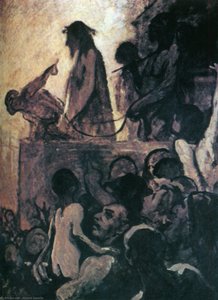
Honoré Daumier's 1862 painting, "Comedy Scene (Scene from Molière)," isn’t merely a depiction of a theatrical moment; it’s a vibrant snapshot of Parisian society grappling with wit, social commentary, and the very nature of performance. The work, rendered in stark black and white – a signature technique for Daumier – immediately draws the viewer into a scene brimming with unspoken tension and subtle gestures. Two men dominate the foreground: one, animatedly gesturing upwards, seemingly addressing an unseen audience; the other, slumped downwards, his gaze fixed on his companion, perhaps lost in thought or responding to the first man’s pronouncements.

Beyond these central figures lies a carefully constructed backdrop of three additional individuals, subtly positioned in the background. Their presence isn't one of active participation but rather serves as a quiet reminder of the broader social context surrounding this private exchange. They are not integrated into the immediate drama, yet their inclusion suggests that this scene unfolds within a larger, more complex world – a world ripe for observation and critique, precisely what Daumier excelled at capturing.

The Artist’s Vision: Realism and Social Satire

Daumier was a pivotal figure in the development of French realism, but his work transcends simple representation. He wasn't interested in idealized beauty or romanticized narratives; instead, he sought to expose the uncomfortable truths of everyday life – particularly the hypocrisy and social inequalities prevalent in 19th-century France. His art became a powerful tool for social commentary, often targeting the aristocracy, the clergy, and the legal system. “Comedy Scene” is no exception, offering a glimpse into a private conversation that hints at underlying tensions and judgments.

The painting’s monochrome palette – predominantly shades of gray and white – contributes significantly to its dramatic effect. This deliberate choice eliminates distractions, forcing the viewer to focus on the figures' expressions and body language. Daumier masterfully employs chiaroscuro—the contrast between light and dark—to sculpt the forms and heighten the sense of drama. The sharp delineation of shadows emphasizes the characters’ postures and gestures, conveying a palpable atmosphere of anticipation and potential conflict.

A Stage Within a Stage: Molière and Parisian Society

The painting's title explicitly references Molière, the renowned French playwright whose comedies satirized societal norms. Daumier wasn’t simply illustrating a scene from one of Molière’s plays; he was capturing the *spirit* of theatrical performance itself – the interplay between performer and audience, the delivery of witty dialogue, and the subtle judgments exchanged during a dramatic moment. The implied setting is likely a Parisian theater, though Daumier deliberately avoids providing specific details, allowing the viewer to project their own interpretations onto the scene.

Furthermore, the painting reflects the vibrant intellectual and artistic life of 19th-century Paris. The Comédie-Française, France’s national theatre, was a central hub for social and political discourse. Daumier's work engages with this dynamic environment, offering a critical perspective on the role of theater in shaping public opinion and exposing societal flaws.

Symbolism and Emotional Resonance

The posture of the two men is particularly revealing. The man gesturing upwards embodies assertiveness and perhaps even arrogance, projecting his thoughts or opinions to an unseen audience. His elevated position suggests a desire for recognition or validation. Conversely, the slumped figure conveys a sense of resignation, doubt, or perhaps quiet disapproval. His downward gaze hints at a critical assessment of the first man’s pronouncements – a subtle challenge to his authority or perspective.

“Comedy Scene” is not a straightforward narrative; it's an invitation to observe and interpret. It evokes a sense of unease, prompting viewers to consider the complexities of human interaction and the often-hidden judgments that shape our perceptions. Daumier’s masterful use of composition, light, and gesture creates a timeless image that continues to resonate with audiences today, reminding us of the enduring power of satire and the importance of critical engagement with the world around us.

Perguntas e Respostas

Qual cor predomina na composição de "Comedy scene (scene from Molière)", de Honoré Daumier?

A cor dominante de "Comedy scene (scene from Molière)", de Honoré Daumier é Espresso (#414a43).

Qual é o tom emocional de "Comedy scene (scene from Molière)", de Honoré Daumier?

"Comedy scene (scene from Molière)", de Honoré Daumier transmite um tom emocional Melancholic.

Qual é a recomendação de impressão para "Comedy scene (scene from Molière)" — qual tamanho e qual orientação?

Recomenda-se uma impressão de "Comedy scene (scene from Molière)", de Honoré Daumier no tamanho Medium com orientação Portrait.

More about this painting

Visualizar na parede Visualizar em RA Alternar para Impressão Alternar para Imagem Digital Compartilhar
Detalhes Guia Adicionar aos favoritos Baixar imagem Semelhantes Raio X Ver diaporama Q&A Estatísticas

In numbers

  • 1862the year it was painted
  • 29frames to choose from
  • standard sizes, in its own proportions
  • 5weeks to paint and deliver it
Honoré Daumier

Honoré Daumier

1808 - 1879, França

Quick facts about Honoré Daumier

  • Artistic Movement Or Style: Realismo, Sátira
  • Artists Or Movements Influenced By This Artist:
    • Impressionismo
    • Arte Moderna
  • Artists Who Influenced This Artist:
    • Alexandre Lenoir
    • Jacques-Louis David
  • Date Of Birth: 26/02/1808
  • Date Of Death: 10/02/1879
  • Full Name: Honoré-Victorin Daumier
  • Nationality: Francês
  • Notable Artworks:
    • Rue Transnonain
    • Les gens de justice
    • Ecce Homo
  • Place Of Birth: Marselha, França

Biografia do Artista

A Vida Esculpida em Sátira: O Mundo de Honoré Daumier

Nascido em Marselha em 1808, a jornada de Honoré-Victorin Daumier esteve intrinsecamente ligada às correntes turbulentas da França do século XIX. Sua vida inicial, marcada pelas ambições poéticas de seu pai e subsequente mudança para Paris em 1814, o imerso em uma cidade fervilhando com energia artística. Embora inicialmente destinado a uma carreira jurídica, a inclinação de Daumier se inclinou irrevogavelmente para as artes. Ele aprendeu com Alexandre Lenoir, absorvendo influências clássicas ao lado de uma apreciação pelo chiaroscuro dramático de Rubens, e aperfeiçoou ainda mais suas habilidades na Academia Suíça. Esse treinamento fundamental provaria crucial para moldar seu estilo distinto – uma combinação poderosa de realismo e draftsmanship expressiva. No entanto, não foi apenas a técnica artística que definiu Daumier; foi uma profunda sensibilidade às injustiças sociais e à absurdidade política ao seu redor.

A Caneta Afiada: Caricatura e Comentário Social

A carreira de Daumier ganhou verdadeiro ímpeto após a Revolução de 1830, um evento que alterou irreversivelmente o curso da história francesa e, simultaneamente, forneceu terreno fértil para seu talento satírico em ascensão. Ele rapidamente se estabeleceu como um mestre litógrafo, contribuindo inicialmente anonimamente para várias publicações antes de ganhar destaque por meio de seu trabalho com *Le Charivari*, uma revista cômica independente fundada por Charles Philipon. Foi aqui que o gênio de Daumier realmente floresceu. Suas caricaturas não eram meras representações humorísticas; eram denúncias mordazes da burguesia, do sistema legal e do establishment político. Ele ridicularizou sem piedade Luís-Philippe, ganhando uma prisão de seis meses em 1832 por uma caricatura particularmente mordaz. Essa experiência, longe de silenciá-lo, solidificou seu compromisso em expor a hipocrisia e desafiar a autoridade através da arte. Seus litografias se tornaram manifestos visuais, capturando o espírito da dissidência e oferecendo um comentário crítico sobre as desavenças sociais de sua época. O volume impressionante de sua produção durante esse período é notável – milhares de litografias que serviram tanto como entretenimento popular quanto como declarações políticas poderosas.

Além da Caricatura: Pintura e Visões Esculturais

Embora Daumier seja mais celebrado por sua litografia, limitar sua existência apenas a caricaturas seria um grave desrespeito. Ele também era um pintor e escultor dedicado, embora o reconhecimento para esses trabalhos tenha chegado mais tarde em sua vida. Suas pinturas, frequentemente retratando cenas da vida cotidiana parisiense – o vagão de terceira classe, as lavadeiras, os advogados – estão imbuídas de um profundo senso de realismo e empatia. Eles não são representações idealizadas, mas sim descrições sem compromisso de dificuldades e lutas. Ele empregou habilmente pinceladas soltas e iluminação dramática para transmitir emoção e atmosfera, prenunciando algumas das técnicas mais tarde adotadas pelos Impressionistas. Seu trabalho escultórico, em grande parte criado em argila (muitos pedaços permanecendo não cozidos durante sua vida), revela um compromisso semelhante em capturar a forma humana com honestidade e profundidade emocional. Essas esculturas, redescobertas após sua morte, demonstram um talento notável para modelagem e uma capacidade de transmitir complexidade psicológica através da postura física.

Um Legado Duradouro: Influência e Significado Histórico

O impacto de Honoré Daumier na história da arte é inegável. Ele preencheu a lacuna entre o Romantismo e o Realismo, abrindo caminho para as gerações futuras de artistas que buscavam retratar o mundo como ele realmente era – com todas as suas imperfeições. Seu comentário social implacável influenciou artistas como Gustave Courbet e Édouard Manet, enquanto seu uso inovador da litografia revolucionou a gravura. Sua obra continua a ressoar hoje, nos lembrando do poder da arte para desafiar a autoridade, expor a injustiça e testemunhar a condição humana. O Musée d'Orsay em Paris abriga uma coleção significativa de suas pinturas e esculturas, oferecendo aos visitantes um vislumbre do mundo que ele retratou tão vívidamente. Suas litografias estão amplamente acessíveis por meio de coleções como as encontradas em OriginalUniqueArt, garantindo que seu gênio satírico continue a provocar o pensamento e inspirar o diálogo. Daumier não era apenas um artista; ele era um cronista de sua época – um poeta visual que usou seu talento para dar voz aos marginalizados e responsabilizar o poder. Seu legado perdura como um testemunho da relevância duradoura da arte como força para a mudança social.

Informações Adicionais

  • Artistas Influenciados: Alexandre Lenoir, Jacques-Louis David
  • Período Artístico: Romantismo, Realismo
  • Técnicas Principais: Litografia, Pintura a óleo, Escultura em argila
  • Temas Recorrentes: A vida cotidiana parisiense, a pobreza, a hipocrisia social, a crítica política

Curiosidades

  • Daumier foi preso por sua caricatura de Luís-Philippe.
  • Sua obra influenciou artistas como Courbet e Manet.
  • Muitas de suas esculturas permaneceram inacabadas durante sua vida.

Ligações Externas

Informações Rápidas

  • Subject or theme: Theater scene
  • Medium: Lithograph
  • Movement: Realism
  • Title: Comedy scene (scene from Molière)
  • Influences: Molière

Quiz de Arte

Cada pergunta possui apenas uma resposta correta.

Pergunta 1:
What is the primary subject matter depicted in Honoré Daumier’s ‘Comedy scene (scene from Molière)’?
Pergunta 2:
In what year was Honoré Daumier’s ‘Comedy scene (scene from Molière)’ created?
Pergunta 3:
The painting utilizes a predominantly monochrome palette. What artistic technique is most prominently employed to achieve this effect?
Pergunta 4:
Considering Honoré Daumier’s artistic style and historical context, what is a key theme explored in this artwork?
Pergunta 5:
Based on the image description, what is the overall composition of the painting?