Visualizar na parede
 Compartilhar
 Compartilhar
 Detalhes
 Guia
Guia

 Baixar imagem
 Semelhantes
 Raio X
 Ver diaporama
 Perguntas e Respostas
 Estatísticas
Carnival Evening

- 117.0 x 90.0 cm


 Ler mais
Giclée / Impressão de Arte
Impressão giclée ou em tela de qualidade de museu, com produção rápida e opções flexíveis de acabamento. ( Comprar pintura feita à mão Alternar para Imagem Digital)




P118B €10

P118H €10

P118W €10

P438Z €10

P508JH €12

P508YH €12

P805H €10

P805Z €10

P919BZ €10

P919G €10

P919XJ €10

P959ZH €10

P968JZ €12

W106C €8

W218G €10

W218JH €8

W218Y €10

W307PJ €10

W316G €10

W316PJ €8

W316Y €10

W398PJ €8

W4111J €10

W500HY €15

W500JH €15

W692G €12

W849H €8

W940BG €15

W953PJ €8




Escolha entre os nossos tamanhos pré-definidos que respeitam as proporções originais da obra de arte.

Insira a largura e a altura desejadas para se ajustarem à sua moldura ou parede. Uma impressão pode ser apenas cortada, nunca ampliada além da imagem original; portanto, um tamanho com proporções diferentes resultará na perda de parte da imagem. Enviamos uma maquete digital para sua aprovação antes de realizarmos a impressão. A imagem exibida nesta página não mostra o corte real — apenas a maquete o faz.
Entrega mundial () em 2 semanas, em vez das 4/5 semanas padrão. (8 Novembro)

Envio expresso gratuito para todo o mundo

Tela de Linho de Alta Qualidade

Seguro de transporte completo

Garantia de Reembolso de Impostos Alfandegários

Garantia de Fidelidade Cromática

Política de Devolução em 100 Dias (Apenas para Defeitos)

Garantia de reembolso de 100%

Oferta de desconto por quantidade
 A opção de vidro está disponível apenas para tamanhos inferiores a 110 cm

Carnival Evening
Giclée / Impressão de Arte
Tamanho da Reprodução
-


Preço Total
€ 72
A Jornada Fascinante de Henri Rousseau e o Mistério da Tarde Carnavalesca
Henri Rousseau’s “A Carnival Evening” transcends mere visual representation; it's an invitation into a realm where reality intertwines with dreamlike fantasy, crafted by one of the most distinctive voices of Naïve Art. Painted in 1885 and currently residing at the Philadelphia Museum of Art, this artwork captivates viewers not only with its striking imagery but also with profound questions about desire, escape, and the complexities inherent in human experience.
- O Fascínio da Arte Naïve e a Visão Única de Rousseau: Rousseau’s rejection of academic training fueled his artistic development—a deliberate divergence from convention that resulted in a visual language characterized by meticulous detail, flattened perspective, and an almost childlike simplicity. This stylistic choice wasn't merely aesthetic; it was a conscious decision to perceive and depict the world through a lens untouched by formal conventions.
- Decifrando o Paisagem Simbólica: Upon initial observation, we encounter a seemingly straightforward depiction of a couple strolling amidst dense foliage. However, beneath this surface lies a rich tapestry of symbolism. The luminous hot air balloon—a potent emblem of aspiration and detachment from earthly constraints—dominates the composition, while the shadowy forest represents the unknown and potential isolation.
- Os Personagens e o Ambiente: Rousseau’s portrayal of the couple is equally intriguing. Their formal attire suggests celebration, yet their downcast gazes hint at introspection and a subtle melancholy. The moon casts its gentle glow upon the scene, amplifying the painting's enigmatic atmosphere and underscoring its connection to themes of intuition and femininity.
- Técnica e Estilo: Executed in oil on canvas, “A Carnival Evening” showcases Rousseau’s masterful technique—a deliberate flattening of perspective combined with painstaking attention to detail. The artist’s use of color is muted yet evocative, creating a harmonious blend that enhances the painting's dreamlike quality and contributes to its enduring emotional impact.
- Context Histórico e Influência: Produced during the Impressionist era, Rousseau’s work stands apart from prevailing artistic trends—a testament to his unwavering commitment to personal vision. His influence can be seen in subsequent generations of artists who embraced Naïve Art's expressive power and its ability to convey emotion without resorting to representational accuracy.
“A Carnival Evening” continues to resonate with audiences today, prompting contemplation on universal themes—the yearning for transcendence, the confrontation with the subconscious, and the beauty found in simplicity. It remains a cornerstone of Naïve Art’s legacy, securing its place as an unforgettable masterpiece.
Perguntas e Respostas
Qual é a atmosfera de "Carnival Evening"?
"Carnival Evening", de Henri Emilien Rousseau é descrito como tendo um clima Místico. Esta classificação pode ajudar a combinar a obra com um ambiente.
De que material é feita a obra "Carnival Evening" e em qual estilo?
"Carnival Evening", de Henri Emilien Rousseau combina a técnica de Óleo sobre tela com o estilo Surrealist Painting. Técnica e movimento descrevem a execução e o estilo da obra.
Qual é a técnica e as dimensões da obra "Carnival Evening"?
A obra original "Carnival Evening", de Henri Emilien Rousseau é um trabalho em Óleo sobre tela com dimensões de 117 x 90 cm. A técnica e o tamanho referem-se ao objeto original.
Biografia do Artista
Henri Emile Rousseau (1875 – 1933): The Enchanted Vision of Primitive Beauty
Henri Emile Rousseau, born in Lyon, France, in 1875, defied the conventions of Impressionism and Post-Impressionism to forge a singular artistic path—one characterized by an uncompromising embrace of Naïve Art. His canvases depict fantastical landscapes populated by animals and humans rendered with childlike simplicity and vibrant color palettes, transporting viewers into dreamlike realms brimming with symbolic resonance. Rousseau’s upbringing in a working-class family instilled in him a deep appreciation for the natural world and folklore, influences that would profoundly shape his artistic vision. Despite facing considerable skepticism from critics of his time—who dismissed his style as amateurish—Rousseau persevered, establishing himself as one of France's most distinctive painters and securing a place among the pioneers of Modern Art.- Early Life & Artistic Beginnings: Rousseau’s formal artistic training was minimal; he largely self-taught, honing his skills through sketching outdoors and studying prints. He initially pursued commercial illustration work to support himself, but his passion for painting remained unwavering.
- The Influence of Primitive Art: Rousseau's fascination with African masks and tribal art—particularly those collected by Alexandre Cabanel—served as a catalyst for his stylistic evolution. These artworks captivated him with their bold colors, stylized forms, and rejection of academic realism, inspiring him to abandon traditional techniques in favor of a more direct and expressive approach.
- Key Paintings & Artistic Style: Rousseau’s oeuvre is dominated by monumental landscapes infused with mythological elements and populated by animals imbued with spiritual significance. Notable works include “The Sleeping Venus” (1890), “The Promised Land” (1893), “The Concert” (1897), and “The Shepherdess,” which exemplifies his signature style—characterized by flattened perspectives, luminous colors, and a deliberate blurring of outlines.
- Recognition & Legacy: Despite initial rejection by the Parisian avant-garde, Rousseau gained recognition in 1905 thanks to the patronage of Ambroise Vollard, who championed his work and secured exhibitions at Galerie Bernheim-Jeune. His paintings gradually attracted admirers among artists like Picasso and Matisse, cementing his reputation as a visionary artist whose uncompromising vision anticipated Surrealism.
- Death & Enduring Influence: Rousseau died in Étampes in 1933, leaving behind a legacy of approximately 800 paintings—a remarkable achievement considering his unconventional methods. His distinctive Naïve Art style continues to inspire artists today, demonstrating the enduring power of imagination and the beauty found in unfiltered observation.
Exploring Rousseau’s Palette & Technique
Rousseau's artistic technique was remarkably simple yet profoundly effective. He eschewed meticulous detail, opting instead for bold brushstrokes and vibrant hues—often achieved through layering thin glazes of color onto a toned ground. This method allowed him to capture the essence of his subjects with remarkable immediacy and luminosity, conveying emotion and atmosphere as much as visual representation. His use of complementary colors—such as reds and greens—created striking contrasts that heightened the dramatic impact of his compositions. Furthermore, Rousseau’s deliberate flattening of perspective—a technique borrowed from African art—reinforced the dreamlike quality of his landscapes and contributed to their captivating allure.
Henri Emilien Rousseau
1875 - 1933
Dados Rápidos
- Full Name: Henri Émile Rousseau
- Nationality: French
- Date Of Birth: 1875
- Date Of Death: 1933
- Place Of Birth: Nancy, France
- Notable Artworks:
- A Carnival Evening
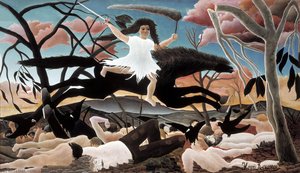
- War or The Ride of Discord
- Fantasia de mariage
- Artistic Movement Or Style: Naive Art
- Artists Who Influenced This Artist:
- Gustave Moreau
- Pierre Puvis de Chavannes
- Artists Or Movements Influenced By This Artist: ['Symbolism']
Artigos Relacionados

Naive Art Unveiled: The Charming Beauty of Simple Masterpieces
Discover the enchanting world of Naive Art. Explore the profound beauty of self-taught masters like Henri Rousseau through an art-history lens, uncovering how simple forms and vibrant colors create timeless, soulful masterpieces for the discerning collector.
Henri Rousseau: Primitivism, Paradox & Subversion of Academic Tradition
Explore the captivating world of Henri Rousseau, the celebrated Naïve artist who challenged academic traditions with his unique jungle scenes & dreamlike symbolism. Discover his lasting influence on modern art and collecting today.

The Untamed Vision: Exploring Naïve Art & Primitivism's Rejection of Convention
Explore the revolutionary world of Naïve Art & Primitivism! Discover how artists challenged academic traditions with raw emotion & unique styles. Learn about Picasso, Rousseau & more at OriginalUniqueArt.
Fauvismo: 10 Obras-Primas que Definiram a Expressão Artística | OriginalUniqueArt
Descubra as 10 obras-primas do Fauvismo com Matisse, Derain e Vlaminck. Explore a história, cores vibrantes e emoção por trás deste movimento artístico revolucionário. Reproduções de arte exclusivas em OriginalUniqueArt.com!

Henri Matisse: As 25 Obras-Primas que Definem um Mestre da Cor | OriginalUniqueArt
Descubra as 25 obras-primas de Henri Matisse que revolucionaram a arte moderna! Explore o Fauvismo, cores vibrantes e a história por trás dos quadros mais famosos do artista. Encontre reproduções de alta qualidade para decorar sua casa com OriginalUniqueArt.com.