Tamanho do texto

() ·

Uma pintura feita para você, à mão

Snow Effect in a Quarry

Reprodução em Óleo Feita à Mão

Óleo sobre tela pintado à mão no tamanho e moldura de sua escolha, feito sob encomenda pelos nossos artistas. ( Alternar para Impressão Alternar para Imagem Digital)

Descrição do Item

Located in Franche-Comté, it’s a testament to artistic resilience and innovation.

Biografia do Artista

Gustave Courbet (1819-1877): Um artista revolucionário que desafiou normas acadêmicas e inspirou o Impressionismo com obras como 'A Burial at Ornans'. Explore sua arte realista e impacto histórico.

de ·

Capítulo 1

Qual deve ser o tamanho?

Deslize para alterar o tamanho; a imagem à esquerda mostra a moldura em sua largura real. As proporções originais são mantidas.

Tamanho padrão
personalizado
CM
INCH

Escolha entre os nossos tamanhos pré-definidos que respeitam as proporções originais da obra de arte.

largura
altura

Insira a largura e a altura desejadas para se ajustarem à sua moldura ou parede. Como esta obra é pintada à mão, para um tamanho com proporções diferentes, o artista poderá pintar um pouco mais ao redor da imagem ou reduzir ligeiramente a composição — você escolhe. Enviamos uma maquete digital para sua aprovação antes de iniciar a pintura. A imagem exibida nesta página não representa o resultado real — apenas a maquete mostra o resultado final.

Capítulo 2

Como deve chegar?

Escolha as bordas da tela esticada

Escolha sua moldura

Corner sample of the WhiteWrap canvas edge finish, stretched on madeira maciça bars
Branco €1
Corner sample of the BlurSideWrap canvas edge finish, stretched on madeira maciça bars
Bordas esfumaçadas €1
Corner sample of the ExtendedWrap canvas edge finish, stretched on madeira maciça bars
Bordas estendidas €1
Corner sample of the P118B picture frame: poliestireno moldado, 5 cm wide and 3 cm thick
P118B €10
Corner sample of the P118H picture frame: poliestireno moldado, 5 cm wide and 3 cm thick
P118H €10
Corner sample of the P118W picture frame: poliestireno moldado, 5 cm wide and 3 cm thick
P118W €10
Corner sample of the P438Z picture frame: poliestireno moldado, 5.5 cm wide and 3.5 cm thick
P438Z €10
Corner sample of the P508JH picture frame: poliestireno moldado, 7 cm wide and 3.5 cm thick
P508JH €12
Corner sample of the P508YH picture frame: poliestireno moldado, 7 cm wide and 3.5 cm thick
P508YH €12
Corner sample of the P805H picture frame: poliestireno moldado, 5 cm wide and 3.5 cm thick
P805H €10
Corner sample of the P805Z picture frame: poliestireno moldado, 5 cm wide and 3.5 cm thick
P805Z €10
Corner sample of the P919BZ picture frame: poliestireno moldado, 7 cm wide and 3.5 cm thick
P919BZ €10
Corner sample of the P919G picture frame: poliestireno moldado, 7 cm wide and 3.5 cm thick
P919G €10
Corner sample of the P919XJ picture frame: poliestireno moldado, 7 cm wide and 3.5 cm thick
P919XJ €10
Corner sample of the P959ZH picture frame: poliestireno moldado, 5 cm wide and 3 cm thick
P959ZH €10
Corner sample of the P968JZ picture frame: poliestireno moldado, 6 cm wide and 4 cm thick
P968JZ €12
Corner sample of the W106C picture frame: madeira maciça, 5 cm wide and 3 cm thick
W106C €8
Corner sample of the W218G picture frame: madeira maciça, 5 cm wide and 3 cm thick
W218G €10
Corner sample of the W218JH picture frame: madeira maciça, 5 cm wide and 3 cm thick
W218JH €8
Corner sample of the W218Y picture frame: madeira maciça, 5 cm wide and 3 cm thick
W218Y €10
Corner sample of the W307PJ picture frame: madeira maciça, 6 cm wide and 3 cm thick
W307PJ €10
Corner sample of the W316G picture frame: madeira maciça, 6 cm wide and 3 cm thick
W316G €10
Corner sample of the W316PJ picture frame: madeira maciça, 6 cm wide and 3 cm thick
W316PJ €8
Corner sample of the W316Y picture frame: madeira maciça, 6 cm wide and 3 cm thick
W316Y €10
Corner sample of the W398PJ picture frame: madeira maciça, 5 cm wide and 3 cm thick
W398PJ €8
Corner sample of the W4111J picture frame: madeira maciça, 6.5 cm wide and 3.5 cm thick
W4111J €10
Corner sample of the W500HY picture frame: madeira maciça, 7 cm wide and 5 cm thick
W500HY €15
Corner sample of the W500JH picture frame: madeira maciça, 7 cm wide and 5 cm thick
W500JH €15
Corner sample of the W692G picture frame: madeira maciça, 8 cm wide and 4 cm thick
W692G €12
Corner sample of the W849H picture frame: madeira maciça, 5 cm wide and 3 cm thick
W849H €8
Corner sample of the W940BG picture frame: madeira maciça, 7.5 cm wide and 4.5 cm thick
W940BG €15
Corner sample of the W953PJ picture frame: madeira maciça, 6 cm wide and 3.5 cm thick
W953PJ €8
Corner sample of the H24-GOLD picture frame: madeira entalhada com gesso, 10 cm wide and 6 cm thick
H24-GOLD €30
Corner sample of the H24-SILVER picture frame: madeira entalhada com gesso, 10 cm wide and 6 cm thick
H24-SILVER €30
Corner sample of the H36-GOLD picture frame: madeira entalhada com gesso, 15 cm wide and 6.5 cm thick
H36-GOLD €45
Corner sample of the H36-SILVER picture frame: madeira entalhada com gesso, 15 cm wide and 6.5 cm thick
H36-SILVER €45
Prévia da moldura
Com moldura

Moldura: . Dimensões totais com a moldura: .

Capítulo 3

Quem o pinta, e deveria algo mudar?

Exemplos do que pode ser alterado: Substituir o rosto pela foto do cliente; Adicionar um animal de estimação (ex: substituir gato por cachorro); Incluir uma mensagem oculta no fundo; Alterar a paisagem ou elementos do fundo.
Após o pedido, a equipe da OriginalUniqueArt.com enviará um e-mail ao cliente para instruções e fornecerá uma prévia da montagem

Entrega mundial () em 3 a 4 semanas, em vez das 5 semanas padrão. (5 Novembro). Sem comprometer a qualidade.

Capítulo 4

Os retoques finais

Uma placa de identificação, como em um museu?

Detalhes da Placa de Bronze Gravada

This elegant plaque features the artist's name and the title of the artwork, finely engraved for a timeless presentation.

It is made from bronze with a refined, elegant finish. The text is precisely laser-engraved for a sharp and permanent result. Measuring 9x2 cm, the plaque is compact yet easy to read. It's built to be durable and scratch-resistant, offering a professional, museum-quality look. Mounting is simple thanks to the included adhesive backing.

Detalhes da Placa de Acrílico Transparente

The plaque includes essential engraved details such as the artist's name, the title of the artwork, the date it was created, the type of media used-like oil on canvas or watercolor-a brief description of the piece, and a QR code that links to the complete artwork information.

It is crafted from clear acrylic, offering a sleek, modern appearance. The text is UV-engraved in black to ensure strong visual contrast. With a size of 10x15 cm, it ensures optimal readability. It comes equipped with two metal hooks for secure wall mounting. The plaque is designed to be weather-resistant, making it suitable for various environments, and it includes interactive features that work seamlessly with smartphone scanning.

Detalhes da Placa de Acrílico Preto

This elegant plaque includes engraved information such as the artist's name, the title of the artwork, the date it was created, the type of media used (like oil on canvas or watercolor), a short description of the artwork, and a QR code for quick access to more information.

The plaque itself is made from refined black acrylic with a premium finish. The text is laser-engraved in white for high contrast and readability. Its size is 10x15 cm, designed to be easy to read. It comes with two metal hooks for professional mounting. The design is sleek and fits any interior style. It is also weather-resistant and durable, with built-in digital integration for mobile compatibility.

Um verniz protetor?

Para quando você precisa?

Capítulo 5

A sua pintura, conforme encomendada

Snow Effect in a Quarry

Técnica de Reprodução

Tamanho da Reprodução

-

Artista Sênior de Elite

Mais detalhes, refinamento e tempo de produção adicional

-

Moldura para Reprodução

-

-

Para obras de arte ou reproduções com mais de 105 cm (aproximadamente 41 polegadas) em qualquer um dos lados, a moldura será enviada como um kit desmontado. Este método garante uma entrega segura e evita danos durante o transporte.

Montagem profissional necessária — este não é um produto DIY (faça você mesmo).
O kit deve ser montado e a tela esticada por um profissional de molduraria experiente, utilizando cola de madeira (não inclusa), um alicate de esticar tela e grampos para manter as travessas alinhadas enquanto a cola seca. A montagem incorreta ou a tensão desigual da tela podem danificar permanentemente a obra de arte e não estão cobertas pela nossa garantia.

  • Todas as barras de madeira maciça estão incluídas, precisamente cortadas ao tamanho certo.

  • Montado com os parafusos fornecidos, além de cola para madeira para as junções dos cantos, que não está inclusa e deve ser providenciada pelo seu moldurista.

  • São necessárias ferramentas profissionais não incluídas: um alicate de estiramento de tela (esticador) e grampos para manter as ripas alinhadas enquanto a cola seca.

Importante:
As junções dos cantos requerem cola para madeira, as ripas devem ser mantidas com grampos até que a cola esteja completamente seca, e o estiramento da tela na moldura montada requer um alicate de esticar tela. Nenhum destes itens está incluído no kit. Por favor, certifique-se de contar com um profissional de molduraria experiente antes de encomendar este tamanho.

Etiqueta de identificação

-

-

Verniz de Proteção

Verniz brilhante (realça as cores e protege contra a luz e a umidade)

-

Personalizar minha obra

Exemplos de alterações possíveis: Substituir o rosto por uma foto do cliente; Adicionar um animal de estimação (ex.: substituir gato por cachorro); Incluir uma mensagem oculta no fundo; Alterar a paisagem ou os elementos do fundo.

-

Urgente

Entrega mundial () em 3 a 4 semanas, em vez das 5 semanas padrão. (5 Novembro). Sem comprometer a qualidade.

-

Envio Expresso

Entrega mundial para em 5 semanas. (12 Novembro).

Com envio incluído

Preço Total

€ 267

Preço Total € 267

A opção de vidro está disponível apenas para tamanhos inferiores a 110 cm

Incluído em todos os pedidos

  • Envio expresso gratuito para todo o mundo
  • Tela de Linho de Alta Qualidade
  • Seguro de transporte completo
  • Garantia de Reembolso de Impostos Alfandegários
  • Garantia de Fidelidade Cromática
  • Política de Devolução em 100 Dias (Apenas para Defeitos)
  • Garantia de reembolso de 100%
  • Oferta de desconto por quantidade

A Moment Frozen in Snow: Courbet’s Quarry Landscape

Gustave Courbet's “Snow Effect in a Quarry” isn’t merely a depiction of winter scenery; it’s a defiant assertion of artistic truthfulness against the prevailing Romantic idealism that dominated 1870s France. Painted during his prolific period, this monumental canvas—measuring 602 x 430 cm—captures a scene strikingly devoid of embellishment, reflecting Courbet's unwavering commitment to portraying the world as he perceived it: honest, tangible, and unapologetically real. The photograph accompanying this article showcases the painting’s impressive scale and invites viewers into a realm where observation reigns supreme.

The Quarry Setting – A Canvas of Reality

The composition centers around a solitary figure traversing a rocky landscape blanketed in snow—a deliberate rejection of idealized pastoral landscapes favored by Romantic artists like Delacroix. Courbet meticulously rendered the textures of stone, capturing the harshness and grandeur of the quarry environment with painstaking detail. Scattered rocks dominate the foreground, subtly guiding the eye upwards towards distant trees silhouetted against a pale winter sky. This careful arrangement isn’t accidental; it underscores Courbet's belief that art should mirror life accurately, eschewing sentimental illusions for unflinching observation.

Courbet’s Revolutionary Technique: Impasto and Color

Courbet employed his signature technique—impasto—to imbue the painting with palpable physicality. Thick layers of paint were applied directly onto the canvas surface, creating a textured surface that mimics the roughness of stone and snow. This method allowed Courbet to convey not only visual information but also emotional resonance – the coldness of winter, the solitude of the figure, and the enduring strength of nature. Furthermore, Courbet’s masterful use of color—primarily muted blues and greys—enhances the painting's atmosphere, creating a sense of quiet contemplation and conveying the bleak beauty of the quarry landscape.

Symbolism Beneath the Surface – Labor and Resilience

Beyond its visual splendor, “Snow Effect in a Quarry” carries symbolic weight. The solitary figure embodies the dignity of labor, representing the working class—a subject frequently explored by Courbet—who faced hardship yet persevered with unwavering determination. The stark landscape symbolizes resilience—the ability to endure adversity without succumbing to despair. Courbet’s intention wasn't simply to depict a place; he aimed to communicate an ethos: confronting reality head-on, accepting its challenges, and finding beauty within its austerity.

A Legacy of Authenticity – Courbet’s Impact on Art History

“Snow Effect in a Quarry” stands as a cornerstone of Realism—a movement that challenged Romantic conventions and championed artistic integrity. Courbet's unwavering dedication to portraying the world truthfully paved the way for subsequent generations of artists who sought to abandon idealized representations in favor of objective observation. This painting continues to inspire admiration for its masterful technique, evocative atmosphere, and profound philosophical message – a testament to Gustave Courbet’s enduring legacy as one of France’s most influential painters.

Perguntas e Respostas

Os direitos autorais de "Snow Effect in a Quarry", de Gustave Courbet permitem reproduções?

O status de direitos autorais de "Snow Effect in a Quarry", de Gustave Courbet é claro: a obra está em em domínio público — seus direitos autorais expiraram. Sua presença no Artizon Museum não altera esse status.

Como o contraste e a harmonia se combinam em "Snow Effect in a Quarry"?

Em "Snow Effect in a Quarry", um Gentle contraste une-se a uma Strong Color Unity harmonia.

Qual era a idade de Gustave Courbet quando "Snow Effect in a Quarry" foi criada?

Gustave Courbet criou "Snow Effect in a Quarry" aos 51 anos. O artista nasceu em 1819 e a obra data de 1870.

Saiba mais sobre esta pintura

Visualizar na parede Visualizar em RA Alternar para Impressão Alternar para Imagem Digital Compartilhar
Detalhes Guia Adicionar aos favoritos Baixar imagem Semelhantes Raio X Ver diaporama Perguntas e Respostas Estatísticas

Em números

  • 1870o ano em que foi pintada
  • 29molduras para escolher
  • tamanhos padrão, em suas próprias proporções
  • 5semanas para pintar e entregar
Gustave Courbet

Gustave Courbet

1819 - 1877, França

Informações rápidas sobre Gustave Courbet

  • Artistic Movement Or Style: Realismo
  • Artists Or Movements Influenced By This Artist:
    • Impressionismo
    • Post-Impressionismo
  • Artists Who Influenced This Artist:
    • Caravaggio
    • Delacroix
    • Géricault
  • Date Of Birth: 31 Jul 1819
  • Full Name: Gustave Courbet
  • Nationality: Francês
  • Notable Artworks:
    • A Ponte da Inundação em Optevoz
    • O Château du Chillon
    • A Onda
  • Place Of Birth: Orléans, França

Biografia do Artista

A Rebel’s Brush: The Life and Legacy of Gustave Courbet

Jean Désiré Gustave Courbet (1819–1877) stands as a monumental figure in the history of art, recognized unequivocally as the progenitor of Realism—a movement that irrevocably altered the trajectory of nineteenth-century painting. More than simply capturing visual impressions; his artistic endeavor was imbued with profound social and political convictions, fueled by an unwavering dedication to portraying reality without embellishment or sentimentality. Born in Ornans, France, a modest village nestled in Burgundy, Courbet’s upbringing instilled within him a spirit of independence that would become synonymous with his revolutionary approach to artmaking.

Early Life and Artistic Training

Courbet's familial circumstances fostered an environment conducive to artistic pursuits. His mother, a woman of considerable intellect and conviction, actively encouraged his burgeoning talent—a nurturing gesture that defied the prevailing societal expectations for young men during his era. Despite initial reservations from some family members regarding his unconventional ambitions, Courbet persevered in his pursuit of formal training at the École des Beaux-Arts in Paris in 1839. However, he swiftly recognized the limitations imposed by the academy’s rigid doctrines and Romantic idealism—a disillusionment that propelled him toward forging his own distinctive artistic path. While acknowledging influences from luminaries like Eugène Delacroix and Théodore Géricault – artists who championed dramatic emotion and historical narrative – Courbet deliberately distanced himself from these stylistic conventions, prioritizing observation over imagination and truthfulness above tradition.

The Birth of Realism: Challenging Artistic Conventions

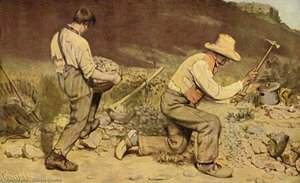
Courbet’s artistic breakthrough arrived with his unwavering commitment to Realism—a movement that fundamentally questioned the accepted aesthetic standards of his time. Rejecting the idealized depictions favored by Romantic painters, he turned his gaze toward the everyday lives of ordinary people—particularly those engaged in labor and rural existence. This decision wasn't merely stylistic; it represented a bold assertion about the inherent dignity and significance of subjects often marginalized within artistic discourse. Early canvases explored landscapes and portraits, yet soon Courbet’s focus shifted decisively towards scenes depicting working-class life—executed on monumental scales traditionally reserved for grand historical or religious paintings. Critics initially scorned his audacious choice, perceiving it as disrespectful to established hierarchies and conventions. Yet, Courbet remained steadfast in his conviction that art should reflect the realities of human experience, unburdened by preconceived notions of beauty or grandeur. The Stone Breakers (1849), tragically destroyed during World War II, epitomized this ethos—a stark portrayal of two laborers toiling under oppressive conditions, their faces obscured by exhaustion and grime. The painting’s deliberate lack of idealized features served as a powerful rebuke to the prevailing artistic preoccupation with heroic narratives and sublime landscapes. Courbet's technique mirrored his philosophical stance: he favored an impasto style—applying paint thickly onto the canvas—that emphasized the materiality of the medium itself, mirroring the textures and colors of the subjects he depicted. This approach was revolutionary in its rejection of academic polish and celebrated instead the raw beauty of unfiltered observation.

Major Works and Artistic Philosophy

Courbet’s oeuvre encompasses a remarkable range of artistic endeavors, reflecting his multifaceted intellect and unwavering dedication to exploring diverse themes. Among his most iconic creations are A Burial at Ornans (1850–51), a monumental canvas depicting a rural funeral—a scene rendered with unflinching realism that provoked considerable controversy among Parisian audiences accustomed to idealized representations of death and mourning. The painting’s sheer scale—typically reserved for historical canvases—combined with its uncompromising depiction of human emotion challenged the conventions of academic artmaking. Courbet deliberately eschewed sentimentalism, presenting mourners as ordinary individuals grappling with grief—a poignant reminder that beauty could be found in confronting uncomfortable truths. Furthermore, The Painter’s Studio (1855) stands as a symbolic meditation on artistic identity and engagement with contemporary social issues—a work imbued with Courbet's conviction that art should serve as a catalyst for societal transformation. Like his landscapes—particularly View in the Forest of Fontainebleau (1855)—Courbet’s paintings were characterized by meticulous attention to detail, capturing the natural world without romantic embellishment. His artistic philosophy extended beyond mere visual representation; it encompassed a profound belief in the transformative power of art to illuminate human experience and provoke critical reflection.

Legacy and Historical Significance

Gustave Courbet's influence on subsequent generations of artists is undeniable—a testament to his enduring legacy as a pioneer of Realism and a champion of artistic freedom. While acknowledging influences from earlier masters like Caravaggio for their dramatic realism and masterful use of light and shadow, Courbet’s impact transcended stylistic imitation. He fundamentally reshaped the landscape of art by liberating painters from the constraints of Romantic idealism—encouraging them to embrace new perspectives on depicting the world around them. His unwavering advocacy for social justice resonated deeply with artists who sought to utilize their work as a vehicle for political commentary and reform. Courbet’s participation in the Salon des Refusés in 1863—an audacious act of defiance against the official Salon’s censorship—solidified his reputation as an iconoclastic rebel and cemented his place among the most influential figures in nineteenth-century art history. He died in Paris in 1877, leaving behind a body of work that continues to inspire awe and provoke debate—a legacy characterized by uncompromising honesty, artistic innovation, and an unwavering commitment to portraying reality without compromise.
  • Pioneer of Realism
  • Challenged academic conventions
  • Influenced Impressionism & Post-Impressionism
  • Advocate for artistic freedom

Informações Rápidas

  • Location: Musée Courbet, Oran
  • Artistic style: Realistic depiction of landscape
  • Medium: Oil on Canvas
  • Artist: Gustave Courbet
  • Notable elements or techniques: Impasto technique
  • Year: 1870

Quiz de Arte

Cada pergunta possui apenas uma resposta correta.

Pergunta 1:
What artistic movement is Gustave Courbet primarily associated with?
Pergunta 2:
The painting depicts a scene in which location?
Pergunta 3:
What is the dominant color palette used in ‘Snow Effect in a Quarry’?
Pergunta 4:
Courbet's artistic approach differed significantly from the academic conventions of his time. How did he challenge established norms?
Pergunta 5:
The image description highlights the presence of a person walking in the snowy landscape. What does this figure symbolize within the context of Courbet’s artistic vision?