Visualizar em escala
 Enviar
 Compartilhar
 Ver detalhes
 Guia de Obras do Aluno

 Baixar imagem
 Semelhantes
 Raio X
 Apresentação de slides
 Estatísticas
The Cook
 Acrylic On Canvas
- WallArt
- Renaissance Mannerism
 1570
1570 53.0 x 41.0 cm
 Nationalmuseum
 Ver mais
Giclée / Impressão de Arte
Impressão giclée ou em tela de qualidade de museu, com produção rápida e opções flexíveis de acabamento. ( Encomendar reprodução pintada à mão Ver Imagem Digital)




P118B €10

P118H €10

P118W €10

P438Z €10

P508JH €12

P508YH €12

P805H €10

P805Z €10

P919BZ €10

P919G €10

P919XJ €10

P959ZH €10

P968JZ €12

W106C €8

W218G €10

W218JH €8

W218Y €10

W307PJ €10

W316G €10

W316PJ €8

W316Y €10

W398PJ €8

W4111J €10

W500HY €15

W500JH €15

W692G €12

W849H €8

W940BG €15

W953PJ €8




Escolha entre os nossos tamanhos pré-definidos que respeitam as proporções originais da obra de arte.

Digite a largura e a altura de que necessita, para se ajustar à sua moldura ou à sua parede. Uma impressão só pode ser cortada, nunca ampliada além da imagem original, pelo que um tamanho com uma proporção diferente perderá parte da imagem. Enviamos-lhe uma maquete digital para aprovação antes de imprimirmos qualquer coisa. A imagem apresentada nesta página não mostra o corte real — apenas a maquete o faz.
Entrega mundial () em 2 semanas, em vez das 4/5 semanas padrão. (21 Outubro)

Envio expresso gratuito para todo o mundo

Tela de Linho Premium

Seguro de transporte total

Garantia de Reembolso de Impostos Alfandegários

Garantia de Fidelidade de Cor

Política de Devolução em 100 Dias (Apenas para Defeitos)

Garantia de reembolso de 100%

Desconto para múltiplas unidades
 A opção de vidro está disponível apenas para tamanhos inferiores a 110 cm

The Cook
Giclée / Impressão de Arte
Dimensões da Reprodução
-


Preço Total
€ 70
A Culinary Portrait: Giuseppe Arcimboldo’s “The Cook”
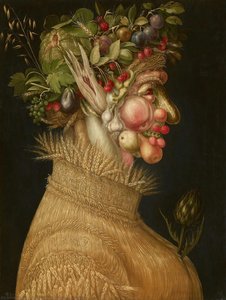
Giuseppe Arcimboldo's "The Cook," painted around 1570 and now residing in the Nationalmuseum of Stockholm, isn’t merely a still life; it’s an audacious visual riddle, a meticulously constructed portrait that simultaneously depicts a roasted fowl and a human face. Turning the canvas upside down unlocks this hidden image – a striking testament to Arcimboldo's mastery of trompe-l'oeil and his profound understanding of Renaissance symbolism. This work transcends simple representation, becoming a meditation on identity, transformation, and the very nature of perception.
The painting itself is dominated by an abundance of autumnal bounty: plump pears, glistening cherries, roasted meats arranged with theatrical precision, and a scattering of herbs and vegetables. Arcimboldo’s technique is remarkably detailed; each fruit and vegetable is rendered with painstaking accuracy, capturing their textures and colors with astonishing realism. The oil paint application is smooth and luminous, creating an almost tactile quality that draws the viewer into the scene. He doesn't simply arrange these objects; he orchestrates them, building a complex composition where every element contributes to the overall effect.
The Renaissance Mind: Symbolism and Allegory
Arcimboldo’s work is deeply rooted in the intellectual currents of the late 16th century. During this period, there was a renewed interest in classical philosophy, particularly Neo-Platonism, which explored the interconnectedness of all things – the idea that the visible world is merely an imitation of a higher realm. Arcimboldo’s portraits, especially those constructed from inanimate objects, can be interpreted as allegorical representations of power and status. The choice of elements—the meats, for instance—suggested abundance, wealth, and the responsibilities associated with leadership. The inverted image, when revealed, subtly hints at the duality inherent in human nature: the animalistic instincts alongside the rational intellect.
Furthermore, Arcimboldo’s work reflects a fascination with metamorphosis – the ability of things to transform into something entirely different. The “Cook” embodies this concept perfectly; it is both a literal depiction of food and a symbolic representation of a human figure. This blurring of boundaries was not uncommon in Renaissance art, where artists often sought to challenge conventional notions of reality.
A Masterpiece of Illusion
The brilliance of "The Cook" lies not only in its subject matter but also in the sheer artistry involved in creating this illusionistic masterpiece. Arcimboldo’s skill as a painter is evident in his ability to seamlessly integrate disparate elements into a cohesive whole. The composition is carefully balanced, with each object placed deliberately to contribute to the overall effect. The use of light and shadow further enhances the sense of depth and realism.
Beyond its technical virtuosity, “The Cook” possesses a captivating charm. It’s a playful invitation to engage in visual problem-solving, rewarding the viewer with a hidden image that delights and surprises. The painting speaks to our innate desire to find patterns and connections, suggesting that even the most mundane objects can hold profound meaning when viewed through the right lens.
Collecting and Displaying Arcimboldo’s Legacy
Reproductions of “The Cook” offer a beautiful way to bring this iconic artwork into your home or office. Consider framing it in a simple, elegant frame that allows the vibrant colors and intricate details of the painting to shine through. The piece would complement a variety of interior design styles, from classic to contemporary. Its intriguing subject matter makes it an excellent conversation starter, inviting viewers to contemplate the artistry and symbolism behind this remarkable creation.
Perguntas e Respostas
Como o movimento e a época se encontram em "The Cook" de Giuseppe Arcimboldo?
"The Cook" pertence ao movimento Renaissance Mannerism, e seu criador trabalhou na era Renascimento.
A qual estilo pertence "The Cook"?
O movimento associado a "The Cook" de Giuseppe Arcimboldo é Renaissance Mannerism. Esta classificação situa a obra entre artistas e obras de arte relacionados.
"The Cook" de Giuseppe Arcimboldo é uma pintura, um desenho ou uma gravura?
"The Cook" de Giuseppe Arcimboldo é classificado como WallArt. A categoria descreve o tipo de obra de arte que a peça original representa.
Biografia do Artista
Giuseppe Arcimboldo: A Master of Illusion and Symbol
Giuseppe Arcimboldo, a name synonymous with playful paradox and profound symbolism, remains one of the most singular figures in the history of Renaissance art. Born in Milan in 1527, his career unfolded against a backdrop of intellectual ferment, religious upheaval, and an unprecedented curiosity about the natural world – a confluence that profoundly shaped his unique artistic vision. Initially recognized for more conventional works—frescoes adorning grand cathedrals and portraits adhering to the established conventions of courtly portraiture—Arcimboldo’s enduring legacy rests upon a series of astonishing composite heads constructed entirely from meticulously arranged objects: fruits, vegetables, flowers, books, musical instruments, even entire animals. These weren't mere whimsical diversions; they were complex allegories, imbued with layers of symbolism that resonated deeply within the Renaissance worldview and continue to captivate audiences today. His father, Biagio Arcimboldo, a skilled painter in his own right, provided young Giuseppe with an early artistic foundation, likely influencing his initial explorations into design work for stained glass windows and frescoes at Milan Cathedral beginning around 1549 – experiences that honed his technical skill and eye for detail, qualities that would become the cornerstones of his later, more unconventional creations.Courtly Patronage and the Birth of a Unique Style
Arcimboldo’s trajectory took a dramatic turn in 1562 when he was appointed court portraitist to Ferdinand I at the Habsburg court in Vienna. This appointment marked a pivotal moment, catapulting him into the heart of European power and providing him with an environment ripe for experimentation. Over the next two decades, he served as a multifaceted artistic polymath for three successive Habsburg rulers: Maximilian II and his son, Rudolf II – a period during which he moved far beyond traditional portraiture, embracing roles as costume designer, festival decorator, and even chief organizer of imperial collections. It was within this atmosphere of refined taste, intellectual curiosity, and the constant demand for spectacle that Arcimboldo’s signature style began to blossom. The Habsburg court, renowned for its lavish celebrations and intricate rituals, provided a fertile ground for his inventive spirit, allowing him to push the boundaries of artistic convention and explore new ways of representing human form. He wasn't simply creating portraits; he was crafting elaborate visual metaphors—statements about power, status, and the interconnectedness of nature and humanity. The influence of earlier artists who experimented with *trompe l’oeil* effects and distorted perspectives can be detected in his work, yet Arcimboldo synthesized these elements into something entirely his own – a unique visual language that challenged conventional notions of representation and invited viewers to engage in a process of interpretation.Decoding the Symbolism: More Than Meets the Eye
To dismiss Arcimboldo’s work as mere whimsicality is to fundamentally misunderstand its profound intellectual depth. Each object within his composite portraits—whether a single peach, a stack of books, or a cluster of flowers—was deliberately chosen, laden with symbolic meaning related to the sitter's character, profession, or social status. *The Librarian*, for example, isn’t simply a face constructed from books; it’s a subtle and witty critique of scholarly pretension – a commentary on those who amass knowledge without truly engaging with its content. The animal tails forming the beard represent dusters, hinting at neglected volumes gathering dust on shelves. Similarly, his portraits of the seasons—particularly *Vertumnus*, depicting Emperor Rudolf II as the Roman god of gardens and change—are rich in botanical symbolism, reflecting the emperor’s patronage of science and natural history. These weren't intended to be immediately deciphered; they were designed to provoke contemplation, inviting viewers to unravel layers of meaning hidden within the seemingly playful arrangement of objects. The very act of constructing a human likeness from inanimate matter served as a meditation on the interconnectedness of all things—a reflection of Renaissance Neoplatonism’s belief in the underlying harmony of the universe. The Habsburg emperors, particularly Rudolf II, were fascinated by such intricate and layered works, appreciating their intellectual complexity and visual ingenuity.Major Achievements and Artistic Innovations
Arcimboldo's most celebrated achievements include his series of “composite heads,” which became a defining feature of his artistic legacy. These portraits—*The Librarian*, *Vertumnus*, *Winter*, *Summer*, and others—demonstrate his mastery of composition, color, and symbolism. Beyond these iconic works, Arcimboldo also produced numerous religious paintings, still lifes, and decorative panels for the Habsburg court. He was a skilled designer of costumes and stage sets, contributing to elaborate festivities and imperial processions. His innovative use of perspective, his ability to create convincing illusions through the arrangement of objects, and his profound understanding of symbolism set him apart from his contemporaries. Notably, he developed the technique of the “Arcimboldo palindrome”—a reversible image that retains its visual coherence when viewed from either side—demonstrating a sophisticated awareness of artistic principles and a playful engagement with the viewer. His work was highly sought after by European royalty and nobility, solidifying his reputation as one of the most inventive and influential artists of his time.Legacy and Rediscovery: A Precursor to Surrealism
Despite achieving considerable success during his lifetime, Arcimboldo’s reputation waned in the centuries following his death in 1593. His work was often relegated to the realm of curiosities—appreciated for its technical skill but dismissed as lacking serious artistic merit. It wasn't until the early 20th century that a renewed appreciation for his art emerged, fueled by the rise of Surrealism. Artists like Salvador Dalí recognized in Arcimboldo a kindred spirit – a visionary who dared to challenge conventional perceptions and explore the subconscious through unexpected juxtapositions of imagery. The influence of Arcimboldo can be seen in Dalí’s own dreamlike compositions and his fascination with metamorphosis and illusion. Today, Giuseppe Arcimboldo is celebrated as a pivotal figure in art history—a precursor to Surrealism whose innovative use of symbolism and playful distortion continues to inspire artists and captivate audiences worldwide. His paintings are housed in prestigious museums such as the Kunsthistorisches Museum in Vienna and the Louvre in Paris, ensuring that his unique vision will continue to resonate for generations to come. *His legacy is a testament to the enduring power of imagination and the ability of art to transform our understanding of the world around us.*
Giuseppe Arcimboldo
1527 - 1593 , Itália
Informações Rápidas
- Artistic Movement Or Style: Mannerismo, Surrealismo
- Artists Or Movements Influenced By This Artist: ['Salvador Dalí']
- Artists Who Influenced This Artist: ['Leonardo da Vinci']
- Date Of Birth: 5 Abril 1527
- Date Of Death: 11 Julho 1593
- Full Name: Giuseppe Arcimboldo
- Nationality: Italiano
- Notable Artworks:
- As Quatro Estações
- Vertumnus
- O Bibliotecário
- Place Of Birth: Milão, Itália
Artigos Relacionados
Beastly Brushstrokes: A Historical Journey Through Animal Painting & Aesthetic Movements
Explore the rich history of animal painting across cultures & movements. Discover iconic artists, symbolism, collecting trends & expert art consultation at OriginalUniqueArt.com.
Beyond the Lens: Transform Your Personal Photos into Timeless AI-Driven Anime Masterpieces with OriginalUniqueArt
Elevate your favorite photos into stunning anime masterpieces with OriginalUniqueArt's AI-driven transformation. Experience the perfect fusion of cutting-edge technology and hand-painted oil artistry to create a timeless, personalized legacy for your home.
From Selfie to Studio Masterpiece: Transform Your Photos into Stunning AI-Driven Anime Art with OriginalUniqueArt
Step into the spotlight with OriginalUniqueArt's AI-driven transformation. Turn your photos into stunning, hand-painted anime oil masterpieces. Experience the perfect fusion of cutting-edge technology and museum-grade craftsmanship to create a timeless pop-culture legacy for your home.

The Bountiful Still Life: Symbolism & Artistic Representation of Fruit Across Art History
Explore the rich history of still life painting & the symbolism of fruit across art movements. Discover masterpieces from Caravaggio to Cézanne with OriginalUniqueArt – expert guidance & museum-quality reproductions.
Animalia: A Presença Duradoura dos Animais na Arte e no Design de Interiores
Explore a rica história da representação animal na arte e como ela inspira o design de interiores. Descubra simbolismos, tendências e artistas que celebram a beleza do reino animal.