Visualizar em escala
 Enviar
 Compartilhar
 Ver detalhes
 Guia de Obras do Aluno

 Baixar imagem
 Semelhantes
 Raio X
 Apresentação de slides
 Estatísticas
Le Printemps


 Ver mais
Giclée / Impressão de Arte
Impressão giclée ou em tela de qualidade de museu, com produção rápida e opções flexíveis de acabamento. ( Encomendar reprodução pintada à mão Ver Imagem Digital)




P118B €10

P118H €10

P118W €10

P438Z €10

P508JH €12

P508YH €12

P805H €10

P805Z €10

P919BZ €10

P919G €10

P919XJ €10

P959ZH €10

P968JZ €12

W106C €8

W218G €10

W218JH €8

W218Y €10

W307PJ €10

W316G €10

W316PJ €8

W316Y €10

W398PJ €8

W4111J €10

W500HY €15

W500JH €15

W692G €12

W849H €8

W940BG €15

W953PJ €8




Escolha entre os nossos tamanhos pré-definidos que respeitam as proporções originais da obra de arte.

Digite a largura e a altura de que necessita, para se ajustar à sua moldura ou à sua parede. Uma impressão só pode ser cortada, nunca ampliada além da imagem original, pelo que um tamanho com uma proporção diferente perderá parte da imagem. Enviamos-lhe uma maquete digital para aprovação antes de imprimirmos qualquer coisa. A imagem apresentada nesta página não mostra o corte real — apenas a maquete o faz.
Entrega mundial () em 2 semanas, em vez das 4/5 semanas padrão. (21 Outubro)

Envio expresso gratuito para todo o mundo

Tela de Linho Premium

Seguro de transporte total

Garantia de Reembolso de Impostos Alfandegários

Garantia de Fidelidade de Cor

Política de Devolução em 100 Dias (Apenas para Defeitos)

Garantia de reembolso de 100%

Desconto para múltiplas unidades
 A opção de vidro está disponível apenas para tamanhos inferiores a 110 cm

Le Printemps
Giclée / Impressão de Arte
Dimensões da Reprodução
-


Preço Total
€ 70
A Sinfonia da Primavera: Uma Imagem de Giuseppe Arcimboldo
Giuseppe Arcimboldo, um nome que evoca imagens tanto fantásticas quanto profundamente enigmáticas, permanece uma figura singular no cânone da arte renascentista. Nascido em Milão em 1527, sua carreira floresceu em um período europeu marcado por fermento intelectual, convulsões religiosas e uma curiosidade insaciável pelo mundo natural. Inicialmente reconhecido por obras mais convencionais – afrescos adornando catedrais e retratos aderindo aos padrões cortesãos estabelecidos – o legado duradouro de Arcimboldo reside em uma série de cabeças compostas inteiramente de objetos: frutas, vegetais, flores, até mesmo instrumentos musicais. Estes não eram meros exercícios lúdicos de truque visual; eram alegorias complexas, imbuídas de simbolismo que ressoavam profundamente no pensamento renascentista e continuam a fascinar o público moderno. Seu pai, Biagio Arcimboldo, era um artista em si mesmo, fornecendo uma base artística para o jovem Giuseppe.
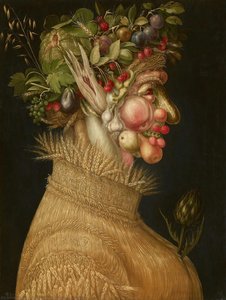
“Le Printemps” (O Primavera), datado de 1563 ou 1573, é um exemplo emblemático da maestria de Arcimboldo. A obra não se limita a ser um retrato; é uma celebração da estação florida, uma ode à natureza e um convite à contemplação. Arcimboldo, com sua visão singular, transforma elementos orgânicos – maçãs rubras, pêssegos dourados, flores vibrantes e folhas exuberantes – em um rosto humano em perfil, um enigma visual que desafia a percepção imediata. A composição é meticulosamente equilibrada, com o perfil do rosto ocupando o centro da tela e sendo elegantemente enquadrado por uma tapeçaria de vinhas, folhas e flores que se estendem como um halo protetor. As linhas são definidas principalmente pelas bordas dos diversos frutos e vegetais utilizados para construir a imagem, criando uma dinâmica visual rica em contrastes entre formas arredondadas – maçãs e peras – e angularidades – folhas verdes. A textura é abundante e variada, refletindo as superfícies naturais de cada componente: a pele lisa da fruta, a aspereza das folhas, a delicadeza dos pétalos.
A Técnica do Trompe-l'oeil e o Poder da Simetria
A técnica empregada por Arcimboldo é um testemunho de sua habilidade artística e precisão. Ele domina a arte do *trompe-l’œil*, ou "enganar o olho", criando uma ilusão de profundidade e volume através da sobreposição cuidadosa de objetos. Cada fruta, cada flor, é posicionada com precisão para sugerir forma e textura, contribuindo para a sensação de que o rosto está realmente ali, esculpido em elementos naturais. A paleta de cores é vibrante e cuidadosamente selecionada para evocar a alegria e a vitalidade da primavera – tons de vermelho, amarelo, rosa e verde dominam a composição, criando um contraste marcante com o fundo negro profundo que serve como tela para esta explosão de cor.
A simetria desempenha um papel fundamental na obra. O rosto ocupa o espaço central, equilibrado por uma elaborada borda floral que se estende em ambos os lados. Essa simetria não é apenas estética; ela também sugere ordem e harmonia, refletindo a crença renascentista no equilíbrio entre o homem e a natureza. A iluminação, suave e difusa, evita sombras duras, permitindo que cada elemento brilhe individualmente, enquanto a perspectiva plana, característica do estilo de Arcimboldo, enfatiza a camada de elementos sobrepostos para criar a ilusão de forma e profundidade.
Simbolismo e Contexto Histórico
“Le Printemps” é mais do que um simples retrato; é uma alegoria carregada de significado. A primavera, com suas flores desabrochando e sua promessa de renovação, simboliza a vida, o renascimento e a fertilidade. Os elementos específicos utilizados por Arcimboldo – maçãs, pêssegos, flores – possuem significados simbólicos associados à primavera na tradição renascentista. A obra também se insere em um contexto histórico mais amplo, refletindo as preocupações e os valores da época. Arcimboldo era conhecido por suas composições que frequentemente carregavam mensagens políticas e religiosas, e “Le Printemps” não é exceção.
A série "As Quatro Estações" de Arcimboldo, a qual este retrato pertence, foi encomendada pelo imperador Maximiliano II do Sacro Império Romano. Cada estação era representada por um retrato composto de objetos relacionados à época, e a obra serviu como um presente para o eleitor Augusto de Saxônia, um aliado importante do imperador. A escolha dos elementos simbólicos e a composição geral da obra refletem as relações políticas e culturais da época, demonstrando a habilidade de Arcimboldo em usar sua arte para comunicar mensagens complexas e sofisticadas.
Uma Obra-Prima para Decorar e Inspirar
Reproduções de alta qualidade de “Le Printemps” de Giuseppe Arcimboldo são peças excepcionais que trazem um toque de fantasia e sofisticação a qualquer ambiente. A riqueza de detalhes, as cores vibrantes e o simbolismo profundo da obra tornam-na uma escolha ideal para amantes da arte, colecionadores e designers de interiores que buscam adicionar um elemento único e memorável à sua decoração. A capacidade de Arcimboldo de transformar objetos cotidianos em obras de arte atemporal é uma prova do poder da criatividade e da habilidade artística.
Perguntas e Respostas
Que atmosfera uma reprodução de "Le Printemps" de Giuseppe Arcimboldo traria para um ambiente?
"Le Printemps" de Giuseppe Arcimboldo possui uma atmosfera Lúdico e fantástico e é recomendado para um(a) Sala de Estar. O clima é o que a obra traz para o espaço ao seu redor.
Posso ver uma visão de raio-X de "Le Printemps" de Giuseppe Arcimboldo?
"Le Printemps" pode ser examinado camada por camada na página Raio X da obra, um visualizador inspirado em uma mesa de luz de conservação com onze leituras ópticas da imagem.
Quanta luz as cores de "Le Printemps" parecem refletir?
As cores de "Le Printemps" apresentam uma luminância Escura.
Biografia do Artista
Giuseppe Arcimboldo: A Master of Illusion and Symbol
Giuseppe Arcimboldo, a name synonymous with playful paradox and profound symbolism, remains one of the most singular figures in the history of Renaissance art. Born in Milan in 1527, his career unfolded against a backdrop of intellectual ferment, religious upheaval, and an unprecedented curiosity about the natural world – a confluence that profoundly shaped his unique artistic vision. Initially recognized for more conventional works—frescoes adorning grand cathedrals and portraits adhering to the established conventions of courtly portraiture—Arcimboldo’s enduring legacy rests upon a series of astonishing composite heads constructed entirely from meticulously arranged objects: fruits, vegetables, flowers, books, musical instruments, even entire animals. These weren't mere whimsical diversions; they were complex allegories, imbued with layers of symbolism that resonated deeply within the Renaissance worldview and continue to captivate audiences today. His father, Biagio Arcimboldo, a skilled painter in his own right, provided young Giuseppe with an early artistic foundation, likely influencing his initial explorations into design work for stained glass windows and frescoes at Milan Cathedral beginning around 1549 – experiences that honed his technical skill and eye for detail, qualities that would become the cornerstones of his later, more unconventional creations.Courtly Patronage and the Birth of a Unique Style
Arcimboldo’s trajectory took a dramatic turn in 1562 when he was appointed court portraitist to Ferdinand I at the Habsburg court in Vienna. This appointment marked a pivotal moment, catapulting him into the heart of European power and providing him with an environment ripe for experimentation. Over the next two decades, he served as a multifaceted artistic polymath for three successive Habsburg rulers: Maximilian II and his son, Rudolf II – a period during which he moved far beyond traditional portraiture, embracing roles as costume designer, festival decorator, and even chief organizer of imperial collections. It was within this atmosphere of refined taste, intellectual curiosity, and the constant demand for spectacle that Arcimboldo’s signature style began to blossom. The Habsburg court, renowned for its lavish celebrations and intricate rituals, provided a fertile ground for his inventive spirit, allowing him to push the boundaries of artistic convention and explore new ways of representing human form. He wasn't simply creating portraits; he was crafting elaborate visual metaphors—statements about power, status, and the interconnectedness of nature and humanity. The influence of earlier artists who experimented with *trompe l’oeil* effects and distorted perspectives can be detected in his work, yet Arcimboldo synthesized these elements into something entirely his own – a unique visual language that challenged conventional notions of representation and invited viewers to engage in a process of interpretation.Decoding the Symbolism: More Than Meets the Eye
To dismiss Arcimboldo’s work as mere whimsicality is to fundamentally misunderstand its profound intellectual depth. Each object within his composite portraits—whether a single peach, a stack of books, or a cluster of flowers—was deliberately chosen, laden with symbolic meaning related to the sitter's character, profession, or social status. *The Librarian*, for example, isn’t simply a face constructed from books; it’s a subtle and witty critique of scholarly pretension – a commentary on those who amass knowledge without truly engaging with its content. The animal tails forming the beard represent dusters, hinting at neglected volumes gathering dust on shelves. Similarly, his portraits of the seasons—particularly *Vertumnus*, depicting Emperor Rudolf II as the Roman god of gardens and change—are rich in botanical symbolism, reflecting the emperor’s patronage of science and natural history. These weren't intended to be immediately deciphered; they were designed to provoke contemplation, inviting viewers to unravel layers of meaning hidden within the seemingly playful arrangement of objects. The very act of constructing a human likeness from inanimate matter served as a meditation on the interconnectedness of all things—a reflection of Renaissance Neoplatonism’s belief in the underlying harmony of the universe. The Habsburg emperors, particularly Rudolf II, were fascinated by such intricate and layered works, appreciating their intellectual complexity and visual ingenuity.Major Achievements and Artistic Innovations
Arcimboldo's most celebrated achievements include his series of “composite heads,” which became a defining feature of his artistic legacy. These portraits—*The Librarian*, *Vertumnus*, *Winter*, *Summer*, and others—demonstrate his mastery of composition, color, and symbolism. Beyond these iconic works, Arcimboldo also produced numerous religious paintings, still lifes, and decorative panels for the Habsburg court. He was a skilled designer of costumes and stage sets, contributing to elaborate festivities and imperial processions. His innovative use of perspective, his ability to create convincing illusions through the arrangement of objects, and his profound understanding of symbolism set him apart from his contemporaries. Notably, he developed the technique of the “Arcimboldo palindrome”—a reversible image that retains its visual coherence when viewed from either side—demonstrating a sophisticated awareness of artistic principles and a playful engagement with the viewer. His work was highly sought after by European royalty and nobility, solidifying his reputation as one of the most inventive and influential artists of his time.Legacy and Rediscovery: A Precursor to Surrealism
Despite achieving considerable success during his lifetime, Arcimboldo’s reputation waned in the centuries following his death in 1593. His work was often relegated to the realm of curiosities—appreciated for its technical skill but dismissed as lacking serious artistic merit. It wasn't until the early 20th century that a renewed appreciation for his art emerged, fueled by the rise of Surrealism. Artists like Salvador Dalí recognized in Arcimboldo a kindred spirit – a visionary who dared to challenge conventional perceptions and explore the subconscious through unexpected juxtapositions of imagery. The influence of Arcimboldo can be seen in Dalí’s own dreamlike compositions and his fascination with metamorphosis and illusion. Today, Giuseppe Arcimboldo is celebrated as a pivotal figure in art history—a precursor to Surrealism whose innovative use of symbolism and playful distortion continues to inspire artists and captivate audiences worldwide. His paintings are housed in prestigious museums such as the Kunsthistorisches Museum in Vienna and the Louvre in Paris, ensuring that his unique vision will continue to resonate for generations to come. *His legacy is a testament to the enduring power of imagination and the ability of art to transform our understanding of the world around us.*
Giuseppe Arcimboldo
1527 - 1593 , Itália
Informações Rápidas
- Artistic Movement Or Style: Mannerismo, Surrealismo
- Artists Or Movements Influenced By This Artist: ['Salvador Dalí']
- Artists Who Influenced This Artist: ['Leonardo da Vinci']
- Date Of Birth: 5 Abril 1527
- Date Of Death: 11 Julho 1593
- Full Name: Giuseppe Arcimboldo
- Nationality: Italiano
- Notable Artworks:
- As Quatro Estações
- Vertumnus
- O Bibliotecário
- Place Of Birth: Milão, Itália
Artigos Relacionados

The Enduring Legacy of Formal Portraiture: Power, Identity & Artistic Exploration
Explore the rich history of formal portraiture & its enduring power to capture identity and shape perception. Discover investment-worthy artworks, expert appraisals, and custom reproduction services at OriginalUniqueArt.

Blossoms of Time: A Historical Journey Through Flower Painting
Explore the captivating history of flower painting! Discover Dutch masters, symbolic meanings, & botanical art. Expert insights & high-quality reproductions at OriginalUniqueArt.
Blossoming Symbolism: A Historical Journey Through Flowers in Western Painting
Explore the rich history of flower symbolism in Western painting! Discover how artists from the Renaissance to Modernism used blossoms to convey meaning, emotion & beauty. Learn about iconic artworks and movements.
The Grandeur of Presence: Exploring Representations of Stately Bearing in Western Portraiture
Explore the art of stately bearing in Western portraiture with expert analysis of Renaissance & Baroque masterpieces. Discover symbolism, techniques, and the legacy of iconic portraits – a guide for discerning collectors.

The Bountiful Still Life: Symbolism & Artistic Representation of Fruit Across Art History
Explore the rich history of still life painting & the symbolism of fruit across art movements. Discover masterpieces from Caravaggio to Cézanne with OriginalUniqueArt – expert guidance & museum-quality reproductions.