

 Visualizar em escala
 Enviar
 Compartilhar
 Ver detalhes
 Guia de Obras do Aluno

 Baixar imagem
 Semelhantes
 Raio X
 Apresentação de slides
 Estatísticas
Reading the Bible
 Acrylic On Canvas
- WallArt
- Dutch Golden Age Painting
 1645
1645 60.0 x 46.0 cm
 Museu do Louvre
 Ver mais
Giclée / Impressão de Arte
Impressão giclée ou em tela de qualidade de museu, com produção rápida e opções flexíveis de acabamento. ( Encomendar reprodução pintada à mão Ver Imagem Digital)




P118B €10

P118H €10

P118W €10

P438Z €10

P508JH €12

P508YH €12

P805H €10

P805Z €10

P919BZ €10

P919G €10

P919XJ €10

P959ZH €10

P968JZ €12

W106C €8

W218G €10

W218JH €8

W218Y €10

W307PJ €10

W316G €10

W316PJ €8

W316Y €10

W398PJ €8

W4111J €10

W500HY €15

W500JH €15

W692G €12

W849H €8

W940BG €15

W953PJ €8




Escolha entre os nossos tamanhos pré-definidos que respeitam as proporções originais da obra de arte.

Type the width and the height you need, to fit your frame or your wall. A print can only be cut, never made bigger than the picture, so a size with a different shape loses a part of the image. We send you a digital mockup to approve before we print anything. The picture shown on this page does not show the real cut — only the mockup does.
Entrega mundial () em 2 semanas, em vez das 4/5 semanas padrão. (14 Outubro)

Envio expresso gratuito para todo o mundo

Tela de Linho Premium

Seguro de transporte total

Garantia de Reembolso de Impostos Alfandegários

Garantia de Fidelidade de Cor

Política de Devolução em 100 Dias (Apenas para Defeitos)

Garantia de reembolso de 100%

Desconto para múltiplas unidades
 A opção de vidro está disponível apenas para tamanhos inferiores a 110 cm

Reading the Bible
Giclée / Impressão de Arte
Dimensões da Reprodução
-


Preço Total
€ 69
A Moment of Quiet Contemplation: Unveiling Gerrit Dou’s “Reading the Bible”
Gerrit Dou's "Reading the Bible," painted in 1645, isn’t merely a portrait; it’s a carefully constructed tableau of domestic piety and profound introspection. The scene unfolds within a modestly furnished room – a chair, a potted plant, two vases, and a simple bowl offering a glimpse into the everyday life of a Dutch family. Yet, it's the central figures, a man absorbed in scripture and a woman seated beside him, that immediately draw the eye, radiating an aura of serene engagement. Dou’s masterful manipulation of light and shadow, characteristic of his “fijnschilder” style, elevates this intimate moment to something far more resonant – a meditation on faith, family, and the quiet power of shared devotion.
Dou's technique is remarkably detailed, almost obsessively so. He employs a meticulous layering of glazes, building up color gradually to achieve an astonishing level of realism and luminosity. Notice how the light streams through the window, illuminating the man’s face and hands as he pores over the Bible, while casting subtle shadows across the woman's features. This chiaroscuro effect isn’t simply decorative; it serves to emphasize the drama within the scene – the intensity of his concentration juxtaposed with her quiet attentiveness. The textures are equally convincing: the rough weave of the chair upholstery, the delicate leaves of the plant, and the sheen on the woman's dress all contribute to a palpable sense of presence.
The Leiden Fijnschilder and the Pursuit of Perfection
Gerrit Dou was a pivotal figure in the Dutch Golden Age, belonging to the esteemed group known as the “Leiden fijnschilders.” This collective of artists distinguished themselves through their commitment to painstaking detail, refined technique, and an almost photographic realism. Unlike many of their contemporaries who favored grand historical or mythological subjects, the fijnschilders focused on intimate genre scenes – everyday moments of domestic life, portraits of ordinary people, and still lifes brimming with subtle nuances. Dou’s work embodies this ethos perfectly; he sought not to simply depict reality but to capture its essence with unparalleled precision and emotional depth.
Born in Leiden in 1613, Dou's artistic journey was shaped by his apprenticeship under Rembrandt van Rijn. While absorbing the master’s innovative use of light and shadow, Dou quickly developed a distinct style – one characterized by an extraordinary level of polish and a meticulous attention to detail that bordered on obsessive. He famously employed a unique method for achieving this precision: using a concave lens and convex mirror to create a magnified image of his subject, allowing him to render every minute detail with astonishing accuracy.
Symbolism and the Values of Early Modern Dutch Society
Beyond its technical brilliance, “Reading the Bible” is rich in symbolic meaning. The act of reading scripture represents a cornerstone of early modern Dutch society – a time when religious observance was deeply ingrained in daily life. The couple’s quiet contemplation suggests a shared commitment to faith and family values. The woman's presence isn’t merely decorative; she embodies domesticity, piety, and the nurturing role within the household. The room itself, though modest, speaks volumes about their status – a comfortable space dedicated to intellectual and spiritual pursuits.
Furthermore, the inclusion of objects like the potted plant and the vases hints at the importance of nature and beauty in Dutch culture. These elements contribute to a sense of harmony and balance within the scene, reflecting the ideals of the Golden Age. The painting, therefore, offers a window into the values and beliefs that shaped 17th-century Holland – a society deeply committed to faith, family, and the pursuit of excellence.
Bringing “Reading the Bible” Home: A Reproduction for Today
OriginalUniqueArt is proud to offer high-quality reproductions of Gerrit Dou’s "Reading the Bible," capturing the artist's remarkable skill and evocative atmosphere. Whether you are an art collector, interior designer, or simply someone seeking a piece that embodies quiet contemplation and timeless beauty, this reproduction provides a stunning tribute to one of the Dutch Golden Age’s most accomplished painters. Available in various sizes and on premium archival paper, it is a perfect addition to any home or office – a reminder of the enduring power of faith, family, and artistic mastery.
Perguntas e Respostas
Posso usar realidade aumentada para ver "Reading the Bible" de Gerrit Dou no meu ambiente?
"Reading the Bible" possui uma prévia em realidade aumentada: a página de Visualização em RA da obra mostra como ela ficaria no seu próprio espaço através de um dispositivo compatível.
Quem criou "Reading the Bible" e em qual estilo se encontra?
Por trás de "Reading the Bible" estão Gerrit Dou e o movimento Dutch Golden Age Painting.
Que emoção a obra "Reading the Bible" do Dutch Golden Age Painting transmite?
Dentro do movimento Dutch Golden Age Painting, "Reading the Bible" é registrada com um tom Reflective.
Biografia do Artista
Gerrit Dou (1613 - 1675)
Gerrit Dou was born in Leiden, Netherlands, on April 7, 1613, the son of Marytje Jansdr van Rosenburg and the glassmaker and engraver Douwe Jansz de Vries van Arentsvelt. According to Jan Jansz. Orlers’s biography published in 1641, *Beschryvinge van de Stad Leyden,* Dou evinced “a pleasure and desire toward painting” at a young age. He studied drawing under Bartholomäus Dolendo, and then trained in the stained-glass workshop of Pieter Couwenhorn. In February 1628, at the age of fourteen, his father sent him to study painting in the studio of Rembrandt van Rijn, who lived nearby. From Rembrandt, with whom he remained for about three years, Dou acquired his skill in colouring and in the more subtle effects of *chiaroscuro*, and his master’s style is reflected in several of his earlier pictures, notably a self-portrait at the age of 22, around 1635–1638, in the Bridgewater Collection, and in the *Blind Tobit going to meet his Son*, at Wardour Castle. Rembrandt's influence was profound, shaping Dou’s artistic vision and technique.Artistic Style and Specialization
Gerrit Dou is renowned for his distinctive “fijnschilder” style—fine painting—characterized by meticulous detail and polished realism. He achieved this remarkable level of precision through innovative methods, including the use of a concave lens combined with a convex mirror to examine subjects accurately and meticulously applying brushstrokes. This technique allowed him to capture subtle nuances of light and texture, creating images that are both visually stunning and intellectually stimulating. Dou’s mastery of *chiaroscuro*, particularly in his candlelit night-scenes—such as *The Astronomer by Candlelight*—established him as a pioneer in portraying atmospheric illumination with unparalleled fidelity. These paintings exemplify the Leiden Fijnschilders' commitment to capturing the essence of reality through masterful manipulation of light and shadow.Notable Works and Collections
Gerrit Dou produced over 200 paintings during his lifetime, many of which are housed in prominent museums across Europe. Among his most celebrated works is *The Astronomer by Candlelight*, a masterpiece that exemplifies his exceptional skill in rendering candlelight effects—a technique he perfected through painstaking observation and experimentation. This painting resides on OriginalUniqueArt.com. Furthermore, the Leiden Collection, located in New York, showcases an impressive assemblage of artworks by Gerrit Dou alongside other masters of the Dutch Golden Age. For a comprehensive guide to this collection, visit Leiden Collection, New York: A Comprehensive Guide on OriginalUniqueArt.com.Influences and Legacy
Gerrit Dou’s artistic trajectory was shaped by several influential figures, notably Rembrandt van Rijn, who served as his mentor during his formative years. Dou's pupil Frans van Mieris the Elder continued Dou’s legacy, inheriting his meticulous style and mastering the art of *trompe l'œil*, creating illusions that blurred the boundaries between reality and representation. Gerrit Dou’s work has been recognized for its enduring beauty and technical brilliance, securing his place as one of the most important artists of the Dutch Golden Age. His influence extends beyond his immediate contemporaries, inspiring generations of painters who sought to emulate his masterful approach to artmaking. You can find more information about Gerrit Dou's legacy in museums like Het Rijksmuseum in Amsterdam and The Mauritshuis in Delft.
Gerrit Dou
1613 - 1675 , Países Bajos
Informações Rápidas
- Artistic Movement Or Style: Fijnschilder (Fine Painting)
- Artists Or Movements Influenced By This Artist: ['Leiden Fijnschilders']
- Artists Who Influenced This Artist: ['Rembrandt van Rijn']
- Date Of Birth: 7 de abril de 1613
- Full Name: Gerrit Dou
- Nationality: Holandés
- Notable Artworks:
- O Astrônomo à luz de velas
- Retrato de uma Velha
- Place Of Birth: Leiden, Países Bajos
Artigos Relacionados

Golden Age Reflections: Dutch Baroque Painting & Cultural Innovation
Explore the Dutch Golden Age of painting! Discover key artists like Vermeer & ter Borch, their innovative techniques, and the rich cultural context behind these Baroque masterpieces. Learn about collecting & appreciating this iconic art period.
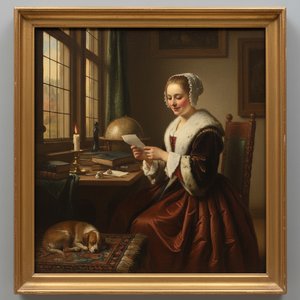
Gerrit Dou: Intimacy & Light in the Dutch Golden Age
Explore the exquisite world of Gerrit Dou, a master of Dutch Golden Age painting. Discover his intimate genre scenes, signature use of light, and lasting legacy. Learn about collecting Dou's works & their value.

A Era de Ouro Holandesa: 10 Mestras-Obras Imperdíveis para Decorar com Arte
Descubra as 10 obras-primas da Era de Ouro Holandesa! Explore a história, técnica e beleza atemporal de Rembrandt, Vermeer e outros mestres. Encontre reproduções de arte exclusivas para decorar sua casa com elegância em OriginalUniqueArt.com.
Illuminating Realism: Exploring the Dutch Golden Age of Painting (1600-1700)
Explore the Dutch Golden Age of painting (1600-1700) with OriginalUniqueArt. Discover Rembrandt, Vermeer & other masters. Learn about techniques, history & find museum-quality reproductions.

Golden Light & Dutch Skies: The Timeless Magic of Dutch Golden Age Landscapes
Discover the breathtaking beauty of Dutch Golden Age landscapes. Explore the mastery of light, chiaroscuro, and 17th-century realism through an expert art history lens, celebrating the enduring legacy of the Dutch Masters for discerning collectors and art lovers.


