Academic Art · 1915
Kit Carson (Frederick William Macmonnies, 1915)
Frederick William Macmonnies (1863–1937) criou Kit Carson. Data de 1915. Pertence ao movimento Academic Art. É feito em Bronze. Está conservada no Sagamore Hill National Historic Site, em Oyster Bay, Estados Unidos da América.

 Pintura a Óleo Feita à Mão
 Compartilhar
 Compartilhar
 Ficha técnica


 Baixar imagem
 Semelhantes
 Ver diaporama
 Perguntas e Respostas

 Estatísticas
Kit Carson, em resumo
- Título
- Kit Carson
- Artista
- Frederick William Macmonnies (1863–1937)
- Artista nascido em
- Brooklyn Heights, United States
- Data
- 1915
- Técnica
- Bronze
- Onde ver
- Sagamore Hill National Historic Site, Oyster Bay, Estados Unidos da América
- Movimento
- Academic Art
- Período
- 19th Century
- Tema
- man, horse, rifle, rock, foliage, bronze
O que Kit Carson retrata?
The Depiction of Kit Carson by Macmonnies
In this bronze work, Frederick William Macmonnies captures Kit Carson on horseback. The sculpture portrays the frontiersman as a significant figure from American history, presented in a moment of action. It was unveiled in 1911 as a large public sculpture celebrating the pioneers of the American Old West. Macmonnies, a sculptor known for his ability to imbue bronze with a sense of vitality, focuses here on the physical presence of the rider and his mount.
The subject, Kit Carson, is depicted with a sense of determination. He sits poised upon the horse, his form integrated into the rugged landscape of the base. This piece reflects the artist's interest in capturing the essence of movement and the spirit of the American frontier. By focusing on the tension within the figure, Macmonnies provides a study of a man defined by the landscape he navigated.
Composition and Visual Elements of the Sculpture
The composition is inherently dynamic, capturing a fleeting moment of action. The rider is poised with a focused intensity, appearing as if he is in the very act of aiming a rifle. This sense of movement is anchored by an elaborate base, where sculpted rocks and foliage provide a rugged foundation for the scene. The perspective is slightly low, looking up at the statue to lend the figure an imposing presence.
Visual rhythm is achieved through a careful balance of lines. Strong, defined lines delineate the musculature of both the horse and the rider, emphasizing the physical tension of the moment. These angular elements contrast with the curved lines that define the contours of the horse's body and the flowing mane. Depth is achieved through the use of overlapping forms, such as the rider positioned in front of the horse’s head, which creates a sense of three-dimensional space within the bronze.
Technique and Materials of the Bronze Work
The sculpture is cast in bronze, a choice that allows for the intricate rendering of the rider and his mount. The execution suggests the use of the lost-wax casting method, or cire perdue, which has enabled the artist to capture fine details within the musculature and the folds of the clothing. This technique provides a level of precision necessary for such a dynamic, active pose.
The surface of the bronze is not perfectly smooth; instead, it possesses a granular quality. This texture lends a sense of realism to the piece, mimicking the ruggedness of the frontier setting. The color palette remains quiet, dominated by muted tones of brown and grey. These hues shift subtly where light meets the metal, creating highlights and shadows that emphasize the three-dimensional form of the horse and rider.
The work rests upon an elaborate base composed of sculpted rocks and foliage. While the sculpture itself is bronze, the base is likely fashioned from stone or plaster to provide a stable, grounded foundation for the equestrian figure. The interplay between the heavy, textured base and the detailed bronze figure creates a sense of weight and presence.
Related Works by Frederick William Macmonnies
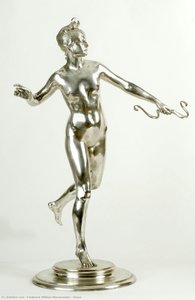
To understand the breadth of Macmonnies's sculptural language, one might look toward his earlier explorations of form and movement. His ability to capture a sense of rhythmic vitality is evident in works such as Bacchante and Infant Faun and his depiction of Diana. These pieces demonstrate a particular sensitivity to the human figure in motion, a quality that defined much of his celebrated output during the Beaux-Arts era. He possessed a rare capacity to imbue bronze and marble with a sense of breath, moving beyond static representation to capture fleeting gestures.
His reach extended from intimate mythological studies to significant civic commissions. He designed the Pan fountain sculpture for Rohallion in New Jersey, a work that reflects his ability to integrate sculpture into functional, decorative environments. This skill for public engagement is further seen in the colossal group Civic Virtue, a fountain created for New York City Hall. Such large-scale projects required a mastery of both monumental scale and intricate detail, balancing the requirements of urban architecture with a refined aesthetic sensibility.
The artist also achieved significant recognition through his portraiture and historical depictions. His 8' tall Nathan Hale statue remains a notable example of his ability to imbue historical figures with profound dignity. Through these diverse subjects—from the mythological to the patriotic—Macmonnies established a presence that bridged classical traditions with a modern, energetic approach to the medium of bronze.
Em qual museu se encontra Kit Carson?
Sagamore Hill National Historic Site
Oyster Bay, Estados Unidos da América
Um Santuário de Estadismo: Explorando Sagamore Hill O Sítio Histórico Nacional de Sagamore Hill não é meramente uma casa; é uma crônica imersiva da liderança americana, um elo tangível aos anos formativos de um dos presidentes mais consequentes dos Estados Unidos. Aninhada em 83 acres de uma paisagem deslumbrante em Long Island – uma tapeçaria de gramados ondulantes, pinheiros sussurrantes e vislumbres do Atlântico – esta mansão em estilo Shingle ergue-se como um testemunho do espírito inquieto de Theodore Roosevelt e seu profundo impacto na nação. Mais do que uma simples residência, Sagamore Hill encarna uma narrativa complexa: um refúgio pessoal, um palco diplomático e, em última análise, uma janela para a alma de um homem que moldou o século XX.


Imagens em alta resolução de Kit Carson

Frederick William Macmonnies, Kit Carson (1915), Sagamore Hill National Historic Site. Domínio público.
Perguntas sobre Kit Carson respondidas
Em qual museu se encontra a obra original de "Kit Carson"?
A obra original "Kit Carson" pode ser vista no Sagamore Hill National Historic Site, Oyster Bay, Estados Unidos da América.
Em que ano foi criada a obra "Kit Carson", de Frederick William Macmonnies?
"Kit Carson", de Frederick William Macmonnies foi criado em 1915.
Qual técnica foi utilizada em "Kit Carson", de Frederick William Macmonnies?
A técnica de "Kit Carson", de Frederick William Macmonnies é Bronze. As reproduções visam reproduzir a aparência desta técnica.
Quais temas aparecem em "Kit Carson", de Frederick William Macmonnies?
"Kit Carson", de Frederick William Macmonnies retrata: man, horse, rifle, rock, foliage, bronze, hat.
"Kit Carson", de Frederick William Macmonnies está em domínio público?
"Kit Carson", de Frederick William Macmonnies está em em domínio público — seus direitos autorais expiraram. Este status determina como a imagem da obra pode ser reproduzida.
A qual artista "Kit Carson" é atribuída?
O artista por trás de "Kit Carson" é Frederick William Macmonnies. A obra está catalogada sob o nome de Frederick William Macmonnies.
A qual estilo pertence "Kit Carson"?
"Kit Carson", de Frederick William Macmonnies pertence ao movimento Academic Art. Este movimento fornece o contexto estilístico da obra.
A que fase da trajetória de Frederick William Macmonnies "Kit Carson" pertence?
"Kit Carson" representa o Mature Period de Frederick William Macmonnies.
Com que idade Frederick William Macmonnies criou "Kit Carson"?
Quando "Kit Carson" foi criada em 1915, Frederick William Macmonnies — nascido(a) em 1863 — tinha 52 anos.
Sobre o artista, Frederick William Macmonnies

1863–1937, United States
Frederick William Macmonnies
The Sculptor of Light and Bronze: The Life of Frederick William MacMonnies In the vibrant intersection of American ambition and European refinement, the name Frederick William MacMonnies resonates as a symbol of the Beaux-Arts era. Born in Brooklyn Heights in 1863, MacMonnies was a child prodigy of stone carving, possessing an innate ability to breathe life into cold medium from a remarkably young age. His journey was not merely one of personal growth but a transatlantic odyssey that would eventually see him become the most celebrated expatriate sculptor of his generation. He possessed a rare, dual mastery over both the fluid strokes of painting and the structural permanence of sculpture, allowing him to approach form with a unique sensitivity to light and movement that few of his contemporaries could replicate.
Sobre Frederick William Macmonnies Obras notáveis de Frederick William Macmonnies
Também de Frederick William Macmonnies
 Diana1890
 Young Chevalier1898
 May Suydam Palmer1903
 Stephen S. Palmer, Trustee 1908-1913, Donor of Palmer Hall (1853-1913)1915

Ensaios sobre Kit Carson
 American artworks of the 1900sIconic American works by Winslow Homer and Frederic Remington define this era. Explore the full collection online at OriginalUniqueArt.com.
 Capturing Motion: The Timeless Beauty of Sir Alfred James Munnings' Equestrian MasterpiecesDiscover the breathtaking equestrian mastery of Sir Alfred James Munnings. Explore an art-history journey through his impressionistic captu…
 American artworks of the 1910s1910s American art by Childe Hassam, George Bellows, and Robert Henri. View the complete collection of iconic US works online at OriginalUn…