Visualizar em escala
 Enviar
 Compartilhar
 Ver detalhes
 Guia de Obras do Aluno

 Baixar imagem
 Semelhantes
 Raio X
 Apresentação de slides
 Estatísticas
Michiel de Wael
 Oil On Canvas
- WallArt
- Dutch Golden Age
 1628
1628 118.0 x 95.0 cm
 Taft Museum of Art
 Ver mais
Giclée / Impressão de Arte
Impressão giclée ou em tela de qualidade de museu, com produção rápida e opções flexíveis de acabamento. ( Encomendar reprodução pintada à mão Ver Imagem Digital)




P118B $10

P118H $10

P118W $10

P438Z $10

P508JH $12

P508YH $12

P805H $10

P805Z $10

P919BZ $10

P919G $10

P919XJ $10

P959ZH $10

P968JZ $12

W106C $8

W218G $10

W218JH $8

W218Y $10

W307PJ $10

W316G $10

W316PJ $8

W316Y $10

W398PJ $8

W4111J $10

W500HY $15

W500JH $15

W692G $12

W849H $8

W940BG $15

W953PJ $8




Escolha entre os nossos tamanhos pré-definidos que respeitam as proporções originais da obra de arte.

Você pode inserir suas próprias dimensões para se ajustar a uma moldura ou espaço específico. Se o tamanho selecionado não corresponder às proporções da imagem original, iremos recortar a obra de arte ou estender a imagem com uma borda espelhada ou preenchimento sólido. Um mockup digital será enviado para sua aprovação antes do início da produção.
Por favor, observe que a visualização na tela não reflete o recorte ou a extensão real. Apenas o mockup mostrará com precisão a composição final.
Embora tamanhos personalizados estejam disponíveis, recomendamos selecionar uma dimensão da lista predefinida para preservar as proporções originais.
Entrega mundial () em 2 semanas, em vez das 4/5 semanas padrão. (27 Setembro)

Envio expresso gratuito para todo o mundo

Tela de Linho Premium

Seguro de transporte total

Garantia de Reembolso de Impostos Alfandegários

Garantia de Fidelidade de Cor

Política de Devolução em 100 Dias (Apenas para Defeitos)

Garantia de reembolso de 100%

Desconto para múltiplas unidades
 A opção de vidro está disponível apenas para tamanhos inferiores a 110 cm

Michiel de Wael
Giclée / Impressão de Arte
Dimensões da Reprodução
-


Preço Total
$ 80
A Portrait of Dignified Resolve: Michiel de Wael by Frans Hals
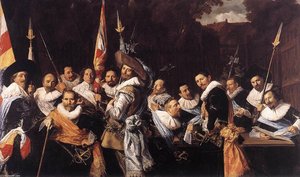
Frans Hals’s portrait of Michiel de Wael, completed in 1628, isn't merely a likeness; it’s a carefully constructed tableau of status, wealth, and the quiet contemplation characteristic of the Dutch Golden Age. The painting immediately commands attention with its formal composition – De Wael occupies nearly the entire frame, an assertion of his importance within the social landscape of Haarlem. Yet, this formality isn't cold or austere; rather, it’s imbued with a palpable sense of humanity, achieved through Hals’s masterful manipulation of light and shadow, and most notably, his signature loose brushwork.
The subject himself is presented as a man of considerable standing – a brewer and civic guard captain. His dark velvet coat, rich in detail thanks to Hals' meticulous rendering of the fabric’s texture, speaks volumes about his prosperity. The voluminous white ruff collar, a fashionable extravagance of the period, further emphasizes his elevated position. He holds a small pouch or bag in his left hand – a subtle emblem of trade and wealth, hinting at the tangible rewards of his endeavors. But it's De Wael’s expression that truly captivates; a serious, almost melancholic gaze suggests an inner life, a thoughtful observer of the world around him. This isn’t a boisterous celebration of success, but rather a moment of quiet reflection – a rare and compelling quality in portraiture of this era.
The Language of Dutch Portraiture: Style and Technique
Hals's approach to portraiture was revolutionary for his time. He deliberately eschewed the meticulous detail favored by many of his contemporaries, opting instead for a vibrant, expressive style characterized by loose brushstrokes and an emphasis on capturing fleeting moments. This technique isn’t haphazard; it’s carefully controlled, creating a sense of immediacy and dynamism within the painting. Notice how Hals uses light to sculpt De Wael's face – strong directional lighting casts dramatic shadows that define the contours of his features, adding depth and volume. The subtle gradations in tone create an illusion of three-dimensionality, pulling the viewer into the scene.
The composition itself is a testament to Hals’s skill. The shallow perspective focuses primarily on De Wael's face and upper body, creating an intimate yet imposing presence. Linear elements – the precise lines of his clothing and the architectural background – are balanced by softer, more organic shapes within the folds of the fabric. This interplay between structure and fluidity is a hallmark of Hals’s style, lending a sense of both order and vitality to the painting.
Historical Context: A Glimpse into 17th-Century Haarlem
To fully appreciate this portrait, it's essential to understand the social and economic context in which it was created. The Dutch Golden Age (roughly 1600-1700) witnessed an unprecedented flourishing of art, commerce, and intellectual life. Haarlem, a thriving port city, became a center for brewing, trade, and civic engagement – industries that fueled the rise of prosperous merchants like De Wael. Portraits during this period weren’t simply representations of individuals; they were statements of social status, economic success, and civic responsibility.
The inclusion of symbolic elements—the pouch representing trade, the elaborate clothing signifying wealth—reinforces this message. Hals subtly communicates De Wael's position within the hierarchical structure of 17th-century society, while simultaneously capturing his individual character and personality. Further research reveals that Michiel de Wael was a prominent figure in Haarlem’s civic life, serving as captain of the St. George Civic Guard – a role that would have further elevated his status and contributed to the painting's significance.
Beyond the Canvas: Reproduction and Legacy
The original portrait, now housed at the Taft Museum of Art in Cincinnati, is a remarkable example of Hals’s genius. High-quality reproductions offer an opportunity to experience this masterpiece firsthand, bringing its rich colors, dramatic lighting, and profound emotional depth into any space. Consider how the painting's muted palette—dominated by dark browns and greys—creates a sense of gravitas and introspection, while subtle highlights on De Wael’s face draw attention to his thoughtful expression.
Frans Hals’s portrait of Michiel de Wael stands as a testament to the enduring power of art to capture not just likenesses but also the essence of human experience. It's a painting that invites contemplation, prompting us to consider the complexities of wealth, status, and the quiet dignity of a man navigating the challenges and triumphs of his time.
Biografia do Artista
Frans Hals I: A Life in Paint
Frans Hals I was a Dutch painter born in Antwerp, Belgium, around 1580. Though his early life remains somewhat shrouded in mystery, he rose to become one of the most important figures of the Dutch Golden Age, celebrated for his innovative portraiture and genre scenes. His artistic legacy continues to inspire artists and captivate audiences centuries later.Early Life and Training
Details surrounding Hals’s formative years are scarce. It is believed he received initial artistic training in Antwerp, a prominent center for painting at the time. However, due to religious and political turmoil, his family relocated to Haarlem in the Netherlands. He became a member of the Haarlem Guild of St. Luke in 1610, marking the formal beginning of his professional career—a pivotal moment that secured him access to influential patrons and established him as a respected artist within the artistic community.Artistic Style and Development
Hals distinguished himself through a remarkably fresh and spontaneous style. Unlike many of his contemporaries who favored meticulous detail, Hals employed a loose and expressive brushstroke. This technique imbued his paintings with a sense of immediacy and vitality, capturing the personality and character of his subjects in a way that was revolutionary for its time. He wasn’t merely attempting to reproduce appearances; he sought to convey emotion and psychological insight—a characteristic that distinguishes him from many other painters of his era. His masterful use of light and shadow added depth and drama to his compositions, creating scenes brimming with atmosphere and capturing fleeting moments of human interaction.Notable Works
While Hals produced a wide range of works, he is best known for his portraits. Some of his most celebrated paintings include:- The Laughing Cavalier (1624) – This iconic portrait exemplifies Hals’s ability to capture character and movement with breathtaking realism. The subject's joyous expression—a subtle smirk—is rendered with remarkable precision, conveying a sense of confidence and amusement that transcends time.
- Malle Babbe (c. 1633-1635) – Hals’s depiction of an elderly woman is equally striking. He skillfully portrays age and vulnerability while simultaneously capturing the subject's inner life—a testament to his profound understanding of human psychology.
- Portraits of the Regents of the Old Men’s Home in Haarlem (1664) - Demonstrating Hals’ mastery of group portraiture, these canvases showcase a remarkable feat of artistic skill. He captured the dignity and solemnity of the elderly residents with sensitivity and nuance, creating images that resonate with compassion and respect.
Beyond portraits, Hals created compelling genre scenes—depictions of everyday life—that offered glimpses into Dutch society during his lifetime. These works reveal a keen observation of human behavior and an ability to convey atmosphere and emotion with remarkable effectiveness.
Influences and Legacy
Determining Hals’s direct influences is challenging, as he developed a highly individual style. However, it's likely he was aware of the work of earlier Flemish painters like Pieter Bruegel the Elder—particularly his depictions of peasant life—who championed a naturalistic approach to art. His innovative technique profoundly impacted subsequent generations of artists. He influenced figures such as Adriaen Brouwer and Johannes Vermeer, who adopted Hals’s looser brushwork and focus on capturing light and atmosphere. Furthermore, Hals's legacy extends beyond the immediate artistic circle; his emphasis on portraying personality paved the way for more intimate and psychological portraits in later centuries—a testament to his enduring influence on Western art history.Today, Hals’s paintings are housed in major museums worldwide, including the Frans Hals Museum in Haarlem, which holds the largest collection of his work—a remarkable achievement that ensures his artistic vision continues to inspire admiration and scholarly study.

Frans Hals
1580 - 1585 , Bélgica
Informações Rápidas
- Artistic Movement Or Style: Século de Ouro Holandês
- Artists Or Movements Influenced By This Artist:
- Adriaen Brouwer
- Johannes Vermeer
- Artists Who Influenced This Artist: ['Pieter Bruegel o Velho']
- Date Of Birth: c. 1582
- Date Of Death: 1666
- Full Name: Frans Hals I
- Nationality: Holandês
- Notable Artworks:
- O Cavalheiro Rindo
- Malle Babbe
- Retratos dos Regentes do Lar Idoso
- Place Of Birth: Antwerp, Belgium
Artigos Relacionados

Frans Hals I: Innovation, Intimacy & the Dutch Golden Age Portrait
Explore the revolutionary portraiture of Frans Hals I, a master of the Dutch Golden Age. Discover his innovative techniques, captivating character studies & lasting impact on art history. Learn more at OriginalUniqueArt.

Golden Light & Dutch Skies: The Timeless Magic of Dutch Golden Age Landscapes
Discover the breathtaking beauty of Dutch Golden Age landscapes. Explore the mastery of light, chiaroscuro, and 17th-century realism through an expert art history lens, celebrating the enduring legacy of the Dutch Masters for discerning collectors and art lovers.

A Era de Ouro Holandesa: 10 Mestras-Obras Imperdíveis para Decorar com Arte
Descubra as 10 obras-primas da Era de Ouro Holandesa! Explore a história, técnica e beleza atemporal de Rembrandt, Vermeer e outros mestres. Encontre reproduções de arte exclusivas para decorar sua casa com elegância em OriginalUniqueArt.com.

Golden Age Reflections: Dutch Baroque Painting & Cultural Innovation
Explore the Dutch Golden Age of painting! Discover key artists like Vermeer & ter Borch, their innovative techniques, and the rich cultural context behind these Baroque masterpieces. Learn about collecting & appreciating this iconic art period.

Illuminating Innovation: Exploring the Dutch Golden Age of Painting
Explore the Dutch Golden Age of painting with OriginalUniqueArt. Discover Rembrandt, Vermeer & other Masters. Learn about key characteristics, iconic artworks, and lasting influence. Expert insights for collectors & enthusiasts.