Alternar para Impressão
 Ler mais







































 Para obras de arte ou reproduções com mais de 105 cm (aproximadamente 41 polegadas) em qualquer um dos lados, a moldura será enviada como um kit desmontado. Este método garante uma entrega segura e evita danos durante o transporte.


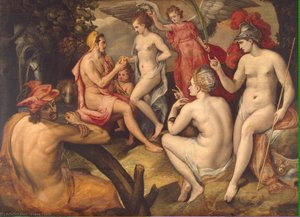
The Judgment of Paris: A Baroque Triumph
“The Judgment of Paris” by Frans Floris stands as a monumental achievement in Northern Renaissance art, embodying the fervor for classical ideals that characterized the Romanist movement. Painted around 1550, this opulent oil painting transcends mere visual representation; it’s a carefully crafted tableau brimming with narrative complexity and imbued with profound humanist thought.
- Subject Matter: The scene depicts the pivotal moment from Greek mythology – the contest between Hera, Athena and Aphrodite to determine who was the fairest among goddesses. Paris, the Trojan prince, is tasked with adjudicating their claims, ultimately awarding the golden apple to Aphrodite, securing Helen’s affections and triggering the legendary Trojan War.
- Style: Floris's work firmly establishes itself within the Baroque style, distinguished by dynamic movement, dramatic lighting, and theatrical composition. Unlike the serene elegance of earlier Renaissance art, “The Judgment of Paris” pulsates with energy, capturing the intensity of human emotion and divine intervention.
- Technique: Floris’s mastery is evident in his meticulous application of oil paint—a technique perfected during this period. He skillfully employs blending, glazing, and scumbling to achieve remarkable textural depth and luminosity. The artist's attention to detail extends to the depiction of skin tones, drapery folds, and stone surfaces, creating a palpable sense of realism.
The painting’s color palette dominates with warm hues—rich reds, golds, and browns—contrasting sharply against cooler blues and greens in the background. These colors amplify the dramatic atmosphere, highlighting key figures and emphasizing the opulent grandeur of the scene. Floris's use of perspective contributes to the theatrical effect, flattening space while suggesting depth through layering and atmospheric haze.
- Symbolism: Beyond its narrative core, “The Judgment of Paris” is laden with symbolic elements. The presence of Hermes guides the goddesses and Paris, representing divine authority and rational judgment. Nike, the winged goddess of victory, crowns Aphrodite, signifying triumph and fulfillment. Furthermore, the depiction of fruits and foliage underscores themes of fertility and abundance.
- Historical Context: Floris’s painting reflects the intellectual currents of its time—the Romanist movement's passionate embrace of Italian High Renaissance masters like Michelangelo and Raphael. Artists traveled to Italy to study these masters and assimilate their stylistic innovations into Northern art traditions. This artwork embodies the humanist spirit prevalent in Antwerp during the mid-16th century.
Emotionally, “The Judgment of Paris” evokes a powerful blend of passion, drama, and transgression. Floris captures the psychological complexities of desire and ambition, presenting a scene that resonates with timeless themes of beauty, love, and divine influence. It remains an unforgettable testament to Baroque artistry and Northern Renaissance intellectual heritage.
Perguntas e Respostas
Qual ambiente combina com as cores de "O Julgamento de Páris", de Frans Floris?
Com sua paleta Tons terrosos, "O Julgamento de Páris", de Frans Floris é recomendado para um Sala de Estar. As cores são parte do motivo desta sugestão.
Posso visualizar "O Julgamento de Páris", de Frans Floris antes de fazer o pedido?
Uma prévia de "O Julgamento de Páris", de Frans Floris está disponível na página de Pré-visualização da obra.
Qual é a luminosidade de "O Julgamento de Páris", de Frans Floris?
A luminância registrada para "O Julgamento de Páris", de Frans Floris é Sombra Suave.
 Visualizar na parede
 Compartilhar
 Compartilhar
 Detalhes
 Guia
Guia

 Baixar imagem
 Semelhantes
 Raio X
 Ver diaporama
 Q&A
Q&A Estatísticas