Alternar para Impressão
 Ler mais







































 Para obras de arte ou reproduções com mais de 105 cm (aproximadamente 41 polegadas) em qualquer um dos lados, a moldura será enviada como um kit desmontado. Este método garante uma entrega segura e evita danos durante o transporte.


The Portrait’s Genesis: François Boucher and the Dawn of Rococo
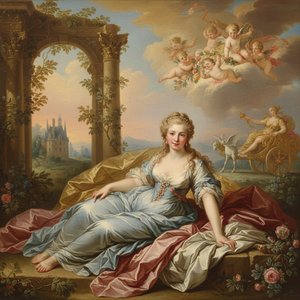
François Boucher's "A Lady on Her Day Bed," painted in 1743, isn’t merely a portrait; it’s a carefully constructed tableau vivant—a snapshot of an era. Born into a family already touched by artistic talent, Boucher’s journey began humbly, apprenticed to François Lemoyne before securing the prestigious Grand Prix de Rome, a gateway to the heart of French art. This early success paved the way for his appointment to the Académie Royale de Peinture et de Sculpture and ultimately, to the role of Premier Peintre du Roi – a position that solidified his status as one of the most influential figures in the burgeoning Rococo style. The painting itself emerged from Boucher’s close collaboration with Madame de Pompadour, the influential mistress of Louis XV, reflecting the refined tastes and opulent sensibilities of the French court. It's a testament to the era’s fascination with pleasure, beauty, and the delicate balance between intimacy and public display.
- Rococo Roots: Boucher masterfully embodies the Rococo movement – characterized by its graceful curves, pastel palettes, and playful subject matter.
- Courtly Patronage: The painting’s creation was intrinsically linked to the patronage system of the French court, shaping both its aesthetic and its narrative.
- A Window into a World: The room depicted offers a glimpse into Boucher's own apartment, revealing his personal style and reflecting the trends of the time – particularly the embrace of Oriental influences.
An Intimate Scene: Marie-Jeanne Buzeau and the Model’s Role
At the heart of "A Lady on Her Day Bed" is Marie-Jeanne Buzeau, a woman whose identity remains somewhat shrouded in history but who nonetheless emerges as a captivating presence. Boucher frequently employed his wife as a model, capturing her likeness in numerous paintings and engravings – a practice that speaks to both their personal relationship and the artist’s desire to portray authentic beauty. The portrait isn't simply a representation of Buzeau; it’s an exploration of femininity, leisure, and the quiet dignity of domestic life. Her pose—relaxed yet poised, her legs crossed with effortless grace—suggests a moment of contemplation, perhaps a stolen respite from the demands of motherhood and household duties. The painting subtly challenges conventional representations of women in art, presenting a figure of serene beauty rather than one defined solely by her role as wife or mother.
Note: Historians believe Buzeau’s pose was deliberately inspired by Titian's Venus of Urbino, creating a witty commentary on classical ideals within the context of Rococo aesthetics.Symbolism and Detail: A Symphony of Refinement
Beyond its immediate beauty, "A Lady on Her Day Bed" is rich in symbolic detail. The porcelain figurine and tea service adorning the hanging étagère—a feature of Boucher’s apartment—are emblems of luxury and Oriental influence, reflecting the fashionable taste for exotic objects during the 18th century. The clock above the bed serves as a subtle reminder of time's passage, while the books suggest an appreciation for learning and intellectual pursuits. The carefully arranged flowers – likely roses and lilies – represent love and purity, further reinforcing the painting’s themes of domestic harmony and refined sensibility. Even the pink hue of the room contributes to the overall atmosphere of tranquility and indulgence.
Key Elements:- Porcelain Figurine: Symbolizes luxury and Oriental influence.
- Tea Service: Represents social status and refined taste.
- Clock: A reminder of time and the importance of leisure.
- Flowers: Represent love, purity, and beauty.
Emotional Resonance: A Moment Frozen in Time
“A Lady on Her Day Bed” transcends its status as a mere portrait; it evokes a profound sense of intimacy and nostalgia. The painting’s soft light, delicate brushstrokes, and carefully composed details create an atmosphere of serene beauty—a world removed from the pressures and anxieties of everyday life. It invites us to step into this private moment, to imagine the quiet pleasures of a leisurely afternoon, and to appreciate the artistry with which Boucher captured a fleeting glimpse of domestic tranquility. The painting’s enduring appeal lies in its ability to transport us back to a bygone era—a time of elegance, refinement, and an appreciation for the simple joys of life. It remains a powerful testament to Boucher's mastery and his profound understanding of human emotion.
Perguntas e Respostas
As cores de "A Lady on Her Day Bed", de François Boucher são vibrantes ou suaves?
A cor de "A Lady on Her Day Bed" apresenta Balanced Soft de saturação e Balanced de intensidade.
Por que a emoção e a ocasião de presente se combinam em "A Lady on Her Day Bed", de François Boucher?
Com seu tom emocional Nostalgic, "A Lady on Her Day Bed", de François Boucher é recomendado como um presente para Wedding.
Qual é a proporção de "A Lady on Her Day Bed", de François Boucher e quais são as suas dimensões?
O formato de "A Lady on Her Day Bed" é Landscape e a obra original mede 57 x 68 cm. Ambas as informações são úteis ao planejar uma reprodução.
 Visualizar na parede
 Compartilhar
 Compartilhar
 Detalhes
 Guia
Guia

 Baixar imagem
 Semelhantes
 Raio X
 Ver diaporama
 Perguntas e Respostas
 Estatísticas