Visualizar na parede
 Compartilhar
 Compartilhar
 Detalhes

 Baixar imagem
 Semelhantes
 Raio X
 Slideshow
 Estatísticas
The same
 Acrylic On Canvas
- WallArt
- Romanticism
 1815
1815 16.0 x 22.0 cm
 Ler mais
Reprodução em Óleo Feita à Mão
Óleo sobre tela pintado à mão no tamanho e moldura de sua escolha, feito sob encomenda pelos nossos artistas. ( Alternar para Impressão Alternar para Imagem Digital)




































Escolha entre os nossos tamanhos pré-definidos que respeitam as proporções originais da obra de arte.

Pode inserir as suas próprias dimensões para se adequar a uma moldura ou espaço específico. Se o tamanho selecionado não corresponder às proporções da imagem original, iremos cortar a obra de arte ou estender a pintura com elementos adicionais pintados à mão. Um esboço digital será enviado para sua aprovação antes do início da produção.
Tenha em atenção que a pré-visualização no ecrã não reflete o corte ou extensão real. Apenas o esboço mostrará com precisão a composição final.
Embora tamanhos personalizados estejam disponíveis, recomendamos selecionar uma dimensão da lista predefinida para preservar as proporções originais.
Após o pedido, a equipa OriginalUniqueArt.com enviará um e-mail ao cliente para solicitar instruções e fornecer uma prévia do esboço.
Entrega mundial () em 3 a 4 semanas, em vez das 5 semanas padrão. (10 Setembro). Sem comprometer a qualidade.

Envio expresso gratuito para todo o mundo

Tela de Linho de Alta Qualidade

Seguro de transporte completo

Garantia de Reembolso de Impostos Alfandegários

Garantia de Fidelidade Cromática

Política de Devolução de 100 Dias (Apenas Defeitos)

Garantia de reembolso de 100%

Oferta de desconto por quantidade
 A opção de vidro está disponível apenas para tamanhos inferiores a 110 cm

The same
Técnica de Reprodução
Tamanho da Reprodução
-


Preço Total
$ 300
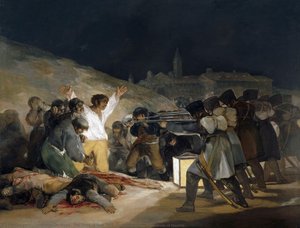
A Grim Testament of Conflict: Examining ‘The Same’ by Francisco Goya
Francisco José de Goya y Lucientes, a titan amongst Romantic artists, stands apart not merely for his prodigious talent but for his unflinching gaze upon the darkest corners of human experience. Born in 1746 amidst the opulent grandeur of Fuendetodos, Spain, Goya’s artistic trajectory defied convention, transforming him from a provincial painter into a court artist and ultimately, into a searing chronicler of societal ills – a role that cemented his legacy as one of art history's most profound voices.
His formative years were spent honing skills under José Luzán y Martinez, establishing a grounding in classical draughtsmanship before venturing to Madrid and collaborating with Anton Raphael Mengs, the dominant artistic influence at the Spanish court. This initial exposure instilled within him an unparalleled command of form and composition, evident in his early commissions – elaborate tapestry designs that showcased meticulous attention to detail and adherence to established aesthetic standards.
The Style of Desolation: Romantic Expressionism
‘The Same,’ etched circa 1815, embodies the very essence of Romantic expressionism. Unlike the polished idealism prevalent in preceding eras, Goya abandons decorative elegance for a visceral portrayal of brutality and despair. The artwork’s stark monochrome palette—primarily black and white—amplifies its dramatic impact, mirroring the emotional intensity characteristic of the movement.
The composition is deliberately claustrophobic, compressing figures into a tightly packed space that conveys the suffocating pressure of violence. Lines dominate the image, rendered with forceful hatching and drypoint technique, creating jagged edges and conveying urgency—a stylistic choice directly reflective of Goya’s engagement with the turbulent political landscape of his time.
Symbolism Rooted in Historical Trauma
This etching isn't merely a depiction of physical struggle; it’s laden with symbolic resonance. The axe, prominently displayed, serves as a potent emblem of destruction and ruthless power—a visual shorthand for the oppressive forces confronting Spanish citizens during the Peninsular War (1808-1814). The fallen figure represents vulnerability and defeat, highlighting the devastating consequences of conflict.
Furthermore, Goya’s masterful use of lighting casts dramatic shadows that heighten the scene's emotional impact, mirroring the psychological torment experienced by individuals caught in times of upheaval. The flattened perspective contributes to a sense of immediacy, immersing the viewer within the unfolding drama and underscoring the artwork’s timeless relevance as a commentary on human suffering.
Technical Mastery: Drypoint Etching – A Legacy of Detail
Goya's technique—drypoint etching—is itself remarkable. This method utilizes a stylus to incise lines directly into copper plate, producing exceptional textural detail and tonal variation. The resulting print captures the raw physicality of the subject matter with astonishing accuracy, demonstrating Goya’s unwavering commitment to artistic innovation while remaining firmly rooted in traditional craftsmanship.
As exemplified by works like ‘The Third of May 1808,’ Goya consistently confronted uncomfortable truths about human nature and political corruption. ‘The Same’ continues this tradition, offering a haunting glimpse into the psychological scars inflicted by war—a masterpiece destined to inspire contemplation and provoke discussion for generations to come.
Biografia do Artista
The Spanish Soul: A Life Forged in Shadow and Light
Francisco José de Goya y Lucientes, a name that echoes through the corridors of art history, embodies a profound paradox – a man simultaneously rooted in the traditions of the Old Masters and a visionary who presaged the anxieties and expressive freedom of modern art. Born in 1746 in the unassuming village of Fuendetodos, Spain, Goya’s journey from a provincial artist to court painter, and ultimately, to a chronicler of human suffering and societal decay, is a testament to his extraordinary talent and the turbulent era he navigated. His early training began at fourteen under José Luzán y Martinez, laying a foundational understanding of classical techniques before he sought refinement in Madrid with Anton Raphael Mengs, then the dominant artistic force within the Spanish court. This initial period instilled in him a mastery of form and composition, vividly demonstrated in his early commissions – intricate designs for tapestries depicting lively scenes of everyday life, subtly infused with a distinctly Spanish realism that hinted at both Rococo elegance and a burgeoning critical eye. His marriage to Josefa Bayeu, sister to another painter within the royal circle, further solidified his position within the artistic establishment, providing access to influential patrons and opportunities for advancement. However, these early works, while technically proficient and aesthetically pleasing, offered little indication of the profound emotional depth and unsettling darkness that would characterize much of his later oeuvre.Ascension and Transformation: From Courtly Grace to Inner Turmoil
Goya’s ascent through the ranks of the Spanish court was a steady climb. He secured a position as a painter to the Royal Chamber in 1786, amassing a substantial commission portfolio from the aristocracy and royalty. These portraits are remarkable not merely for their technical brilliance – Goya possessed an uncanny ability to capture likeness with startling honesty – but also for their astute psychological insight. He didn’t simply paint what his sitters *looked* like; he revealed something of their character, their vulnerabilities, and often, their hidden anxieties. The Countess of Chinchón, for example, is not merely a beautiful woman adorned in elegant attire, but a figure radiating intelligence, perhaps tinged with melancholy – a subtle suggestion of the complexities beneath her outward composure. Yet, beneath this veneer of courtly success, a significant transformation was taking place within Goya’s soul. In 1793, a debilitating illness, likely a combination of syphilis and mercury poisoning, left him profoundly deaf, an event that irrevocably altered his perception of the world and consequently, his artistic vision. This affliction plunged him into a period of intense introspection and isolation, severing his connection to the social life he once enjoyed and forcing him inward, towards a darker, more subjective reality. The shift in his artistic style was dramatic – a deliberate departure from the bright colors and cheerful scenes that had defined his earlier work. He began to explore themes of madness, violence, and the irrational, foreshadowing the anxieties that would grip Europe during the tumultuous years ahead.The Dark Visions: Caprichos, Disasters, and Black Paintings
This period of artistic ferment culminated in some of Goya’s most iconic and unsettling works. Los Caprichos, a series of eighty etchings published in 1799, serve as a scathing satire of Spanish society – its follies, superstitions, and moral corruption laid bare with biting wit and unflinching irony. The images are often grotesque yet undeniably captivating, populated by witches, monstrous figures, and caricatures of the aristocracy, all rendered with a masterful command of etching techniques. However, it was The Disasters of War, created between 1810 and 1820, that truly cemented Goya’s reputation as a fearless chronicler of human suffering. These harrowing etchings depict the brutal realities of the Peninsular War – the atrocities committed by both sides, the starvation, the despair, and the utter devastation inflicted upon the Spanish people. They are not romanticized accounts of battle; they are unflinching portrayals of its horrors, devoid of any glorification or sentimentality. Perhaps most profoundly disturbing are The Black Paintings, a series of fourteen murals Goya painted directly onto the walls of his house, “Quinta del Sordo” (the Deaf Man’s Villa), between 1819 and 1823. These works – including the terrifying Saturn Devouring His Son and the haunting Asmodea – represent a descent into the darkest recesses of the human psyche, expressing themes of despair, madness, and existential dread with unparalleled intensity. They are a radical departure from traditional artistic conventions, anticipating the expressive power of abstract art and reflecting Goya’s own inner turmoil.Themes and Techniques
Throughout his career, several recurring themes emerge in Goya’s work. The exploration of human folly and societal corruption is prominent in Los Caprichos, while the horrors of war are brutally depicted in The Disasters of War. A fascination with darkness, superstition, and the irrational pervades much of his later output, culminating in the unsettling imagery of The Black Paintings. Technically, Goya was a master of various mediums. He excelled in portraiture, capturing not only physical likeness but also psychological depth. His use of color evolved over time, from the lighter palettes of his early works to the somber tones of his later paintings and etchings. He was particularly innovative in his printmaking techniques, utilizing aquatint to create tonal variations and dramatic effects.- Etching: Goya’s mastery of etching allowed him to create intricate details and expressive lines.
- Aquatint: This technique enabled him to achieve a range of tones and textures, enhancing the emotional impact of his prints.
- Brushwork: His loose and expressive brushwork, particularly in his later paintings, contributed to their sense of immediacy and emotional intensity.
A Legacy of Innovation and Influence
In 1824, disillusioned by political unrest in Spain, Goya sought exile in Bordeaux, France, where he continued to work until his death in 1828. His final years were marked by a renewed focus on printmaking, culminating in the La Tauromaquia series, which explored the spectacle and brutality of bullfighting. Francisco Goya’s legacy is immense and far-reaching. He stands as a pivotal figure in art history, bridging the gap between the Old Masters and the modern movement. His influence can be seen in the works of countless artists who followed – from Édouard Manet and Pablo Picasso to Francis Bacon – all drawn to his expressive brushwork, psychological depth, and willingness to confront uncomfortable truths. He challenged artistic conventions, embraced innovation, and dared to explore the darker aspects of human experience, leaving behind a body of work that continues to resonate with audiences today. Goya wasn’t merely painting pictures; he was holding up a mirror to society, forcing us to confront our own flaws and vulnerabilities, and reminding us of the enduring power – and fragility – of the human spirit.
Francisco de Goya
1746 - 1828 , Espanha
Dados Rápidos
- Artistic Movement Or Style: Romantismo
- Artists Or Movements Influenced By This Artist:
- Manet
- Picasso
- Artists Who Influenced This Artist:
- Mengs
- Luzán
- Date Of Birth: 30 Mar 1746
- Date Of Death: 16 Abr 1828
- Full Name: Francisco José de Goya y Lucientes
- Nationality: Espanhol
- Notable Artworks:
- Los Desastres de la Guerra
- Caprichos
- Saturno Devorando Seu Filho
- Place Of Birth: Fuendetodos, Espanha
Artigos Relacionados

Os 10 Quadros Mais Famosos Dominados pelo Branco: Arte e Decoração
Descubra os 10 quadros mais famosos dominados pelo branco, de Monet a Kandinsky! Explore a história da arte, técnicas e o poder da paleta neutra. Encontre reproduções de alta qualidade para sua decoração em OriginalUniqueArt.com.
As 10 Gravuras Mais Icônicas da História da Arte | OriginalUniqueArt
Descubra as 10 gravuras mais influentes da história, de Rembrandt a Goya! Explore a técnica, o contexto e a beleza atemporal dessas obras-primas. Encontre reproduções de alta qualidade para decorar sua casa com arte clássica em OriginalUniqueArt.com.

As 10 Pinturas Mais Famosas Dominadas pelo Preto: Arte, História e Decoração
Descubra as 10 pinturas mais icônicas dominadas pelo preto! Explore a história, técnica e emoção por trás de obras-primas do Romantismo, Realismo e Expressionismo. Encontre reproduções de arte exclusivas na OriginalUniqueArt.com.
Francisco Goya: Darkness & Enlightenment – A Comprehensive Exploration of the Artist's Life, Works, and Enduring Legacy
Explore the life & works of Francisco Goya, Spain's Romantic master. Discover his evolution from court painter to a visionary chronicler of war and social injustice. A comprehensive guide for art enthusiasts.

Goya: As 25 Obras-Primas que Definem um Mestre da Arte Espanhola | OriginalUniqueArt
Descubra as 25 obras-primas de Francisco Goya, o mestre espanhol do Romantismo. Explore retratos icônicos, gravuras impactantes e a história por trás de 'Saturno Devorando seu Filho' e 'A Majas'. Encontre reproduções de arte exclusivas para decorar sua casa com OriginalUniqueArt.com.