Obter pintura a óleo
 Tudo sobre Transport forces







































 Para obras de arte ou reproduções com mais de 105 cm (aproximadamente 41 polegadas) em qualquer um dos lados, a moldura será enviada como um kit desmontado. Este método garante uma entrega segura e evita danos durante o transporte.


A Monument to Modernity Embodied in Paint
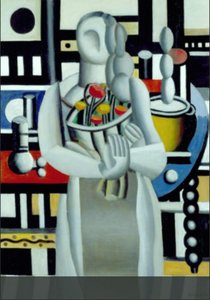
Fernand Léger's "Transport Forces," completed in 1937, stands as a cornerstone of Purism – an artistic movement that vehemently rejected Impressionism’s fleeting effects and embraced instead the bold geometries and vibrant hues characteristic of industrial landscapes. Measuring an impressive 50.9 x 870 cm, this monumental canvas resides at the Musée National Fernand Léger in Biot, France, offering visitors a visceral encounter with Léger's singular vision of the burgeoning twentieth century.
The Genesis of Geometric Abstraction
Born Joseph Fernand Henri Léger in Argentan, Normandy, in 1881, Léger’s artistic journey began amidst rural surroundings but swiftly propelled him into the pulsating heart of Parisian avant-garde. Influenced by Cubism's fragmentation and Picasso’s exploration of form, Léger pushed beyond mere representation, striving to distill the essence of mechanized existence onto canvas. Unlike many artists of his time who sought refuge in abstraction as a reaction against realism, Léger actively embraced it – perceiving it as the most truthful method for conveying the dynamism and transformative power of industrial progress.
A Celebration of Technological Harmony
“Transport Forces” isn’t simply a depiction of trains; it's an elaborate allegory for humanity’s relationship with technology. Léger meticulously crafted a composition dominated by angular forms – locomotives, bridges, signal towers – rendered in a palette of striking reds, yellows, and blues that echo the fiery glow of incandescent lamps. These colors aren’t merely decorative; they symbolize energy and illumination, mirroring the optimistic spirit of the era.
Purist Principles: Form Above All Else
The painting exemplifies Purism's core tenets: a rejection of illusionistic depth and color blending in favor of simplified shapes and bold hues. Léger’s meticulous brushstrokes emphasize texture, creating a palpable sense of materiality – the rough surface of steel juxtaposed with the smooth expanse of painted planes. This technique underscores his belief that art should serve as a conduit for conveying fundamental truths about the world around us.
Symbolism and Emotional Resonance
"Transport Forces" transcends its literal subject matter, resonating with deeper themes of progress, transformation, and humanity’s engagement with the machine age. Léger's deliberate use of color – particularly the radiant reds – conveys a feeling of optimism and vitality, reflecting the fervent belief in technological advancement that characterized 1930s France. Ultimately, this artwork invites contemplation on how art can capture not only what we see but also what we feel—a testament to Léger’s enduring legacy as one of the most influential figures in modern art.
Perguntas e Respostas
Transport forces é uma pintura feita à mão ou uma impressão?
Pintada à mão: um pintor profissional reproduz Transport forces em óleo sobre tela de linho.
Qual tamanho devo escolher para Transport forces?
A obra original mede 50 x 100 cm. Os tamanhos variam de 22.5 x 44.4 cm (€178) a 126.3 x 248.7 cm (€1080); a tabela nesta página lista as principais opções e seus respectivos preços.
Qual é o prazo de entrega?
O prazo de entrega é de 4 a 5 semanas, com envio expresso gratuito para todo o mundo; uma opção de produção urgente está disponível nesta página. Você pode devolvê-la em até 100 dias para obter o reembolso total, sem qualquer condição.
Qual técnica Fernand Léger utilizou em Transport forces?
Acrylic On Canvas
 Visualizar na parede

 Compartilhar
 Compartilhar
 Detalhes
 Ficha técnica


 Baixar imagem
 Semelhantes
 Raio X
 Ver diaporama
 Perguntas e Respostas

 Estatísticas