Obter pintura a óleo
 Tudo sobre Staircase 19







































 Para obras de arte ou reproduções com mais de 105 cm (aproximadamente 41 polegadas) em qualquer um dos lados, a moldura será enviada como um kit desmontado. Este método garante uma entrega segura e evita danos durante o transporte.


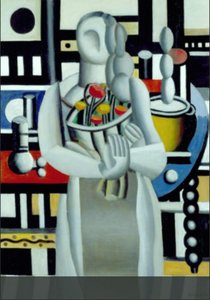
Fernand Léger, a prominent figure in the Cubism movement, created "Staircase" in 1914. This painting is a quintessential example of Cubist art, characterized by its geometric forms and fragmented objects.
Composition and Elements
The scene depicts a stairwell with various objects scattered throughout the space. Multiple cups of different sizes are placed on the steps, some closer to the viewer and others further away. A bowl is located near the center of the painting, while a vase is positioned towards the left side. Several bottles are scattered throughout the scene, with one close to the top right corner, another in the middle-right area, and two more on the bottom right side. A chair can be seen near the center of the painting, while a clock is located towards the upper left corner.Cubism and Proto-Cubism
Cubism, pioneered by Pablo Picasso and Georges Braque, revolutionized painting and visual arts in the early 20th century. The movement influenced artistic innovations in music, ballet, literature, and architecture. Cubist subjects are analyzed, broken up, and reassembled in an abstract form, depicting multiple perspectives to represent the subject in a greater context. Proto-Cubism, also referred to as Protocubism, Early Cubism, and Pre-Cubism or Précubisme, is an intermediary transition phase in the history of art chronologically extending from 1906 to 1910. This period is characterized by a move towards the radical geometrization of form and a reduction or limitation of the color palette.Artistic Influences
Fernand Léger's "Staircase" reflects the influence of Paul Cézanne's late works, which represented three-dimensional forms in a more geometric manner. The painting also showcases the artist's adherence to the principles of Cubism, as seen in the fragmented objects and multiple perspectives.Relevance and Legacy
Cubism has been considered the most influential art movement of the 20th century. Its impact was far-reaching and wide-ranging in the arts and popular culture. The movement introduced collage as a modern art form and influenced various offshoots, including Orphism, abstract art, Futurism, Suprematism, Dada, Constructivism, De Stijl, and Art Deco. In conclusion, Fernand Léger's "Staircase" is a significant work in the Cubist movement, showcasing the artist's skillful use of geometric forms and fragmented objects. The painting reflects the influence of Cézanne and the principles of Cubism, contributing to the movement's lasting impact on modern art.Perguntas e Respostas
Staircase 19 é uma pintura feita à mão ou uma impressão?
Pintada à mão: um pintor profissional reproduz Staircase 19 em óleo sobre tela de linho.
Qual tamanho devo escolher para Staircase 19?
Os tamanhos variam de 28.3 x 35.4 cm (€179) a 196.6 x 245.8 cm (€1587); a tabela nesta página lista as principais opções e seus respectivos preços.
Qual é o prazo de entrega?
O prazo de entrega é de 4 a 5 semanas, com envio expresso gratuito para todo o mundo; uma opção de produção urgente está disponível nesta página. Você pode devolvê-la em até 100 dias para obter o reembolso total, sem qualquer condição.
Onde está a obra original Staircase 19?
O original faz parte da coleção do Kunstmuseum Basel, Basileia.
Qual técnica Fernand Léger utilizou em Staircase 19?
Acrylic On Canvas
 Visualizar na parede

 Compartilhar
 Compartilhar
 Detalhes
 Ficha técnica


 Baixar imagem
 Semelhantes
 Raio X
 Ver diaporama
 Perguntas e Respostas

 Estatísticas